addthis_pub = ‘yogagal60510’;
metta to you all
addthis_pub = ‘yogagal60510’;
addthis_pub = ‘yogagal60510’;
1. I am of the nature to grow old. There is no way to escape growing old.
The forever changing images that I see in the mirror each morning remind me of the first of Buddha’s Five Remembrances. Today this soul’s present incarnation has been on this planet for over 50 years.
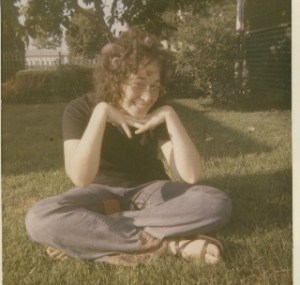
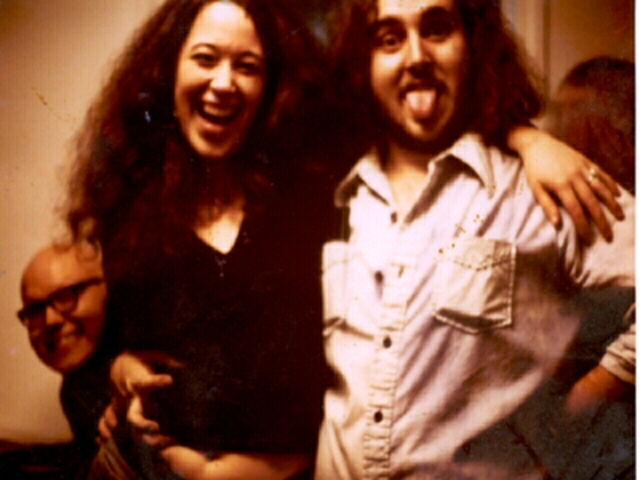
My photographs are also constant reminders of my mortality. Every birthday reminds me that I now have less time ahead of me than I have behind me. That knowledge makes each day more precious than the last. I will not die an unlived life.
“eat mangoes naked
lick the juice off your arms
discover your own goodness
smile when you feel like it
be delicious
be rare eccentric original
smile when you feel like it
paint your soul”
—SARK
What happened to the 16 year old? What happened to the 20 year old? They are still here but the package has changed, the ribbons are torn and frayed and the wrapping paper yellowed and weakened in spots.
I see these old photos and am reminded that I almost died at my own hand when I was 16. I never thought I would live to be at the party where my friend grabbed me with gusto around the waist. I could have left this earth a long time ago in more ways than one. I tried my damnedest for years to do just that. But I am still here, those girls are still around somewhere inside my head.
Those photos are also a reminder of the me I lost but found again once I got back on the yoga path. Life is a circle.
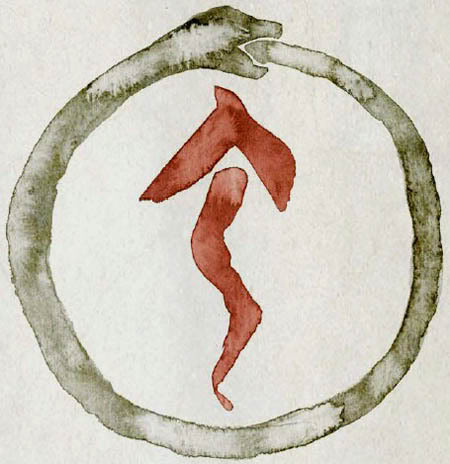
“The Ouroboros often represents self-reflexivity or cyclicality, especially in the sense of something constantly re-creating itself, the eternal return, and other things perceived as cycles that begin anew as soon as they end. It can also represent the idea of primordial unity related to something existing in or persisting from the beginning with such force or qualities it cannot be extinguished.”
The photos bring home the truth of the Five Remembrances and the truth of impermanence and they remind me to THINK. Birthdays are contemplations on what I would like to plant in this final season of my life.
What will it be?
What do I plan to do with this one wild and precious life?
2. I am of the nature to have ill health. There is no way to escape ill health.
Every day I wake up with pain. My freaky femurs that Paul Grilley uses as examples of extreme internal hip rotation are beginning to ache. My hair is thinning and I can see my scalp. My eyes have the beginnings of cataracts. But I thank the Universe for my physical yoga practice because without it I probably could barely move.
I thank the Universe for my yoga and meditation practice that allows me to know the truth of Buddha’s Fourth Foundation of Mindfulness: mindfulness of the dharma, of the true nature of reality that nothing is permanent, that each moment is constantly changing. Asana practice offers a great window into impermanence because our practice changes every time we step on the mat, from day to day, moment to moment. Is your practice changing as you change? And if not, why not? Get real.
3. I am of the nature to die. There is no way to escape death.
4. All that is dear to me and everyone I love are of the nature to change. There is no way to escape being separated from them.
These remembrances are the hardest lessons to learn. Thoughts of death of those near and dear to us and of our own death strike the most fear in our hearts. It is said that our only fear is the fear of death, all our other fears arise from that primal one.
We know things change but we put so much effort and energy into trying to live life as if that were not so. This is what Patanjali wrote about in chapter 2 of the Yoga Sutra-s: he described the qualities necessary to change the mind effectively and gradually from a state of distraction to one of attention, one of the qualities being avidya which is literally “not seeing.” This willful denial of reality, this willful not seeing the truth of impermanence perpetuates our suffering and misery. We so want things to never change – our hair, our skin, our supple spines, the people in our lives – that clinging to things that are by their very nature impermanent causes our suffering.
The suffering of change is what gives us the most gut wrenching pain in our lives. It is not our physical pain, but the pain of pain.
But when this truth of reality sunk deep into my bones it was liberation. I am not responsible for anyone’s happiness, I am only responsible for my own. No one is responsible for my happiness, I am only responsible for my own.
It’s a law of physics that energy can neither be created nor destroyed. We are energy bodies, filled with chi, prana, Life Force, whatever you want to call it. This body is merely the vessel that will eventually crack open and fall apart like an old terracotta pot. But the essence of me will live on. What is born dies but what is never born can never die. We truly are billion year old carbon.
We shall not cease from exploration.
And the end of all our exploring
Will be to arrive where we started
And know the place for the first time.
-T.S. Eliot
5. My actions are my only true belongings. I cannot escape the consequences of my actions. My actions are the ground upon which I stand.
Like everyone else, my life is composed of losses and gains. My losses have been due to neglect, poor judgment, ego, recklessness, selfishness. My gains have been through hard work, grit, determination, and intuition. Other gains have simply come through the blessings of the Universe. Karma. I’ve been graced with a fortunate birth despite going through things back in the day that would have killed a weaker person. I should never have become this old. The cards were stacked against me. Or were they? I truly am a survivor.
The Five Remembrances keep me awake to the human condition. My spirituality has brought me closer to Spirit, have helped open a heart that was closed for so long, and has taught me to have gratitude for whatever comes my way. My dharma wheel is turning and it tells me to embrace the inevitability of life’s changes.
Life is a constant series of movements that change from one form to another — just like asanas. I have reached a deep sentient awareness that nothing is truly lost in the end. We meet who we are meant to meet in this life and people come and go and return again in a constant dance and flow — like a vinyasa. We meet ourselves and each other over and over again in this spanda until we find our way home.
What will you do with your one wild and precious life?

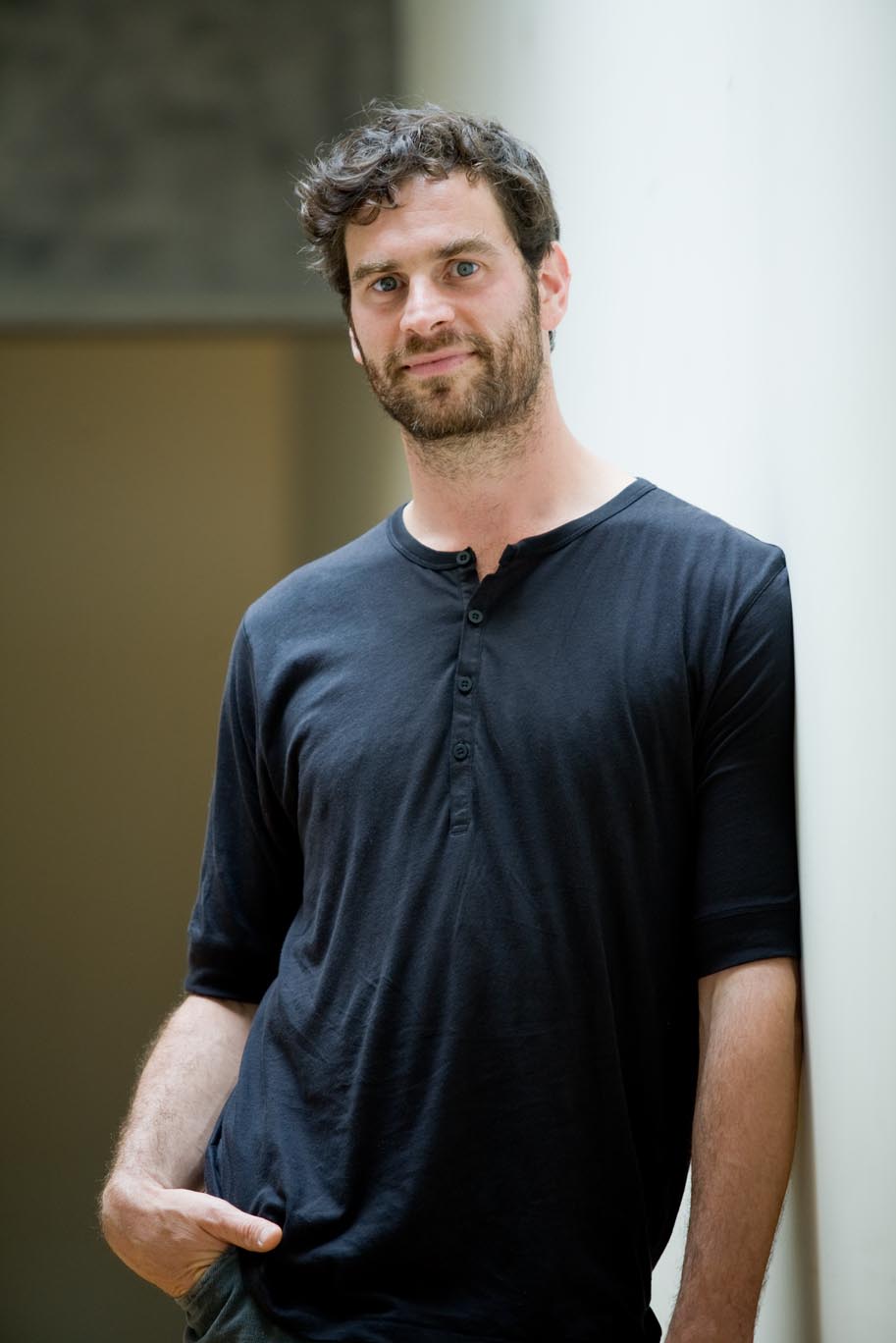
Many thanks to Michael Stone for sending me this passage from his book Yoga For A World Out Of Balance: Teachings on Ethics and Social Action and allowing me to use it for a blog post. This excerpt resonated with me on such a deep level that it gave me pause, especially the sentence: “Yoga teaches us that everything is connected to everything else in the ongoing flux and flow of reality, beginning in the microcosm of the mind and extending all the way through the myriad forms of life.”
Sometimes the seemingly most simple insights are the most profound. Over the course of my yoga life I have had more than few epiphanies where the realization of the above sentence sent shock waves through my cells. Once at the Monterey Bay Aquarium where I sat transfixed before the tank containing the kelp forest and having such a deep visceral knowledge of interconnectedness that I felt it in my bones. And in my heart.
Again at the bottom of Ngorongoro Crater in Tanzania in March as I watched the wildebeast migration.
Yesterday as I was gardening when I pulled up an oak tree seedling and found the acorn still attached to the root. As I studied the oak in my hand I remembered the words from William Blake’s poem: “To see the world in a grain of sand, and to see heaven in a wild flower, hold infinity in the palm of your hands, and eternity in an hour.”
There is knowing…and then knowing that you know.
In joy…..
************
“The human world is continually speeding up while the non-human world of plants, insects and animals, with its once vast range of ecological diversity, is rapidly declining, causing irreversible symptoms throughout the web of life. A spiritual practice exclusively concerned with my enlightenment, my transcendence, or my emancipation from this life, this body or this earth is not a spiritual practice tuned into these times of ecological, social, physical and psychological imbalance. The declining health of our ecosystems and the call for action in our cities, economies, communities and families remind us that we don’t have time to wait for enlightenment in isolated caves or interior sanctums; instead, it’s time to consider action-in the world and inner practice as synchronistic and parallel. Action in the world is not an externally imposed duty or simply a preliminary stage on the path to greater awareness but is in itself a valid spiritual path and an expression of interdependence, freedom and awakening.
By seeing the inseparability of psychological change, ethical action and spirituality, we can avoid the common fragmented and problematic view that spiritual practice takes us away from the world, excluding the body, householder life and pressing contemporary issues like poverty, injustice, environmental degradation or other forms of inequality and suffering. Yoga teaches us that everything is connected to everything else in the ongoing flux and flow of reality, beginning in the microcosm of the mind and extending all the way through the myriad forms of life. Yoga also claims freedom from suffering as its primary objective. It is from these realizations that our spiritual, ethical and contemplative practices originate and mature. Wherever there is imbalance and suffering, yoga shows up.
Because of the sweeping changes of the modern era – including genetic research, the telephone, internet, high rates of literacy, swift air travel, two column accounting systems and faster and faster lifestyles – the iron-age world view out of which yoga teachings began to be described and refined can only offer us a partial platform, path and set of truths. We begin in this culture at this time, so we must begin now to articulate and re-envision a yoga that is responsive to present circumstances – rooted in tradition yet adaptable and alive in contemporary times. Yoga has always represented a radical path that leaves behind stiff metaphysics and doctrine and instead turns the practitioners’ attention inward to the immediate experience of mind and body. The yogin studies the nature of reality as it presents itself here and now. As we turn toward the mind-body process we begin to open to the temporary nature of our lives as well as the fact that we are inextricably woven into the very elements that constitute everything else – we are the natural world. For too long, yoga has been mischaracterized as an inner practice without understanding the teleology of practice. Yoga practices tune us into reality by waking us up to the inherent transience of earthly life, the freedom that arises when wanting is relinquished, the truth that no thing is “me” or “mine,” and the basic intelligence of the mind, body and the life that supports us. The term “yoga” connotes the basic unity and interconnectedness of all of life including the elements, the breath, the body and the mind. The techniques of yoga – including body practices, working with the breath and discovering the natural ease of the mind – reorient the practitioner to the very deep continuity that runs through every aspect of life until we realize that mind, body and breath are situated in the world and not apart from worldly life in any way.
Beginnings
When I began practicing yoga my primary focus was the physical practice of yoga postures and every morning for the first six years, I woke up to practice at five o’clock , six days a week. I sat in meditation for an hour, followed by standing postures, twists, forward bends, an hour of back bending and inversions and finally breakfast. When I had any free time, I attended academic lectures on Indian philosophy, completed two degrees in psychology and religion and studied Sanskrit; but the formality of my practice began to feel separate from the world I moved through and I felt that formal practice and daily life had little in common. The connection between meditation, the physical practice of yoga, and the spiritual discipline to which it belonged became ambiguous and vague and though I could intellectually grasp the connection between waking up the body and stilling the mind, I didn’t understand how to put these practices into action in everyday life. While I was having significant insights in meditative practices, I felt formal practice and daily life were not seamlessly woven.
This is true for many contemporary yoga practitioners, and as I now teach extensively, the most common question I hear is how to integrate philosophy, body practices, meditation and daily life together with one’s role in relationships, concerns about the world around us, and the desire to take action in a world out of balance. Even when students begin having genuine experiences of insight or meditative quietude, I always ask them how they are going to incorporate these experiences into their daily activities. How does spiritual practice support and motivate our choices and ambitions? How can my personal enlightenment be the goal of practice if there is so much suffering around me? If the domain of any spiritual tradition is the relief and transformation of suffering, what does yoga, one of the great spiritual traditions, have to say about contemporary forms of suffering and existential disorientation ?
For the practitioner of hatha yoga – the meditative practice of waking up to present experience in mind and body – the link between yoga as a “practice” and a “spirituality,” is often realized through an intuition rather than through intellectual articulation. However, intuition is not enough; nor is it enough to imagine that yoga offers a complete set of codes or truths that can, like mathematical equations, tell us what to do in every given situation. The world is too complex, too nuanced, and is always shifting, therefore we need to investigate the practical ways that yoga practice matures both in formal study and in everyday life. Today, our personal, ecological and social situations present unique and direct challenges to each and every one of us to respond to the great existential questions of life and death, to look deeply into interdependence, and to fully actualize our awakening in a world distressed and in need. How is our awakening going to contribute to the world-at-large? Why is our spiritual path important for the great rivers, the butterflies and the architecture of our cities?”
addthis_pub = ‘yogagal60510’;
I received an email today from Yoga Journal asking my permission to publish my email to them as a letter. This is what I had to say about their ad choices:
“On page 53 of the latest Yoga Journal there’s an ad for Slim Quick Ultra Calorie Burner to lose weight. In the same issue there is a story that the healing power of yoga will cure what ails America without pills or surgery.
Some magazines don’t accept advertising for products that are anathema to their magazine’s philosophy.
Apparently Yoga Journal does not have those same advertising ethics.
I think that Calorie Burner is for everyone who wants to look better in those naked yoga classes.
Just sayin'”
Yoga Journal may not consider moi as having one of the best yoga blogs (but YogaDawg stuck up for me), but they love my letters! Years ago they also published one of mine about how yoga is not one size fits all.
Somebody’s gotta do it…..
What a surprise it was to receive an email from Michael Stone, author of Yoga for a World Out of Balance: Teachings on Ethics and Social Action.
Michael told me that he likes this blog (and it always does this old English major’s heart good when published authors tell me they like my writing – he thinks LYJ is “not simply the repetition of familiar yoga cliches”) and asked whether I wanted to contribute to the conversation about his book.
I am sorry to say that I have not yet read the book, but I’m getting a copy from the publisher. When read, I will review it here. I am especially interested in his book that will come out in September Freeing the Body, Freeing the Mind. The subject is one that is near and dear to my heart, the yoking of yoga and Buddhism:
“Buddhism and yoga share a common history that goes back centuries. But because yoga and Buddhism came to North America from Asia as two separate traditions, their commonalities in the West often seem invisible. Most people choose to study either yoga or Buddhism and generally don’t combine the practices. Michael Stone brings together a collection of intriguing voices to show how Buddhism and yoga really do share the same values and spiritual goals.”
In my humble opinion, Patanjali could not have written the Yoga Sutra-s without being a bit influenced by the wandering Buddhist monks during his time. When I sat in my Sutra-s classes I would think “yes! and Buddhism says….” Then in any Buddhism classes I would think, “yes! and the Sutra-s say….” In my own mind, there was never any separation of the two philosophies. As they say in India, “same same but different, madam!”
For those of you interested in this idea, read Chip Hartranft’s translation, The Yoga-Sutra of Patanjali: A New Translation with Commentary.
Here is an exceptional video of Michael Stone. It’s about 30 minutes long, so make some tea, pull up a comfy chair, and listen to a dharma talk on things such as the Self, karma, transcending patterns, and meditation. I like the reference to “heat” in the title since I always tell my students how yoga marinates and cooks us!
Michael Stone Dharma Talk: Let the Heat Kill You from Centre of Gravity on Vimeo.
addthis_pub = ‘yogagal60510’;

©Linda-Sama, 2010, Kolkata Botanical Garden
“If only it were all so simple. If only there were evil people somewhere else insidiously committing evil deeds, and it were necessary only to separate them from the rest of us and destroy them. But the line dividing good and evil cuts through the heart of every human being, and who among us is willing to destroy a piece of their own heart?” — Aleksandr Solzhenitsyn
addthis_pub = ‘yogagal60510’;
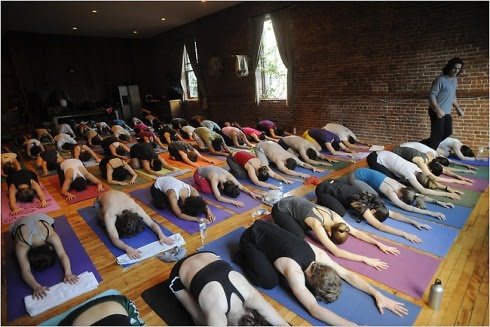
The New York Times article A Yoga Manifesto has really made the rounds of the yoga blogs with each blogger approaching the story a bit differently.
As I wrote here there is a new movement in yoga — moving away from the rock star yogi mentality to donation-based classes. Yoga to the People in New York City is riding the crest of this new wave.
On the surface I think it’s a great idea and I give YTTP founder Greg Gumucio mucho credit for what he has accomplished. I’ve always thought that yoga should be accessible for everyone and even more so for people in the lower-income bracket. But Roseanne raises an interesting question in her post about YTTP. Roseanne tried a YTTP class and has this to say about it:
“Their “manifesto” sounds good in theory ~ but my understanding of it changed when I actually experienced one of their classes in NYC last month. As I noted, the final effect was “discount” yoga, complete with fluorescent lighting and classic rock radio, rather than the DIY proletariat experience I had expected. After reading this article, I now know where the problem lies: ‘High volume is the key to [YTTP founder Greg Gumucio’s] business model — he says up to 900 people may go to a Yoga to the People studio in a single day….’
Sure, more people doing yoga is a good thing, but herding hundreds of them through a rotation of anonymous teachers in crowded studio classes… how does that improve the world? Especially when the spirituality, teacher-student relationship and, in my experience, quality are sacrificed in the name of economy.”
As I read her post some thoughts popped into my head: how many of the people going to the inexpensive classes can easily afford to pay the standard prices at a yoga studio, such as $15 or $17 a class? Are these inexpensive classes taking away from a small, independent, non-franchised studio that can not afford to price their classes at $8 or another lower rate? And if that small studio closes because of the cheaper competition and yoga teachers lose their jobs because cheap yoga put the studio out of business, how is that a good thing? Should we just chalk that up to good ol’ American marketplace economics? Cheaper will always bring in more people but is it really better?
I would rather see people doing donation-based yoga who truly can not afford standard yoga studio prices than the ones who only want a deal.
Living in my suburban area where it is difficult for a yoga studio to survive raised these questions for me. People live in $500,000+ houses (which in my area is a “starter home”) and drive Hummers, but many go to health clubs or gyms or park districts for yoga because it’s “free” (i.e., part of the membership) or the price is less than $10 a class. I’ve been teaching a long time and I’ve heard the rationalization of “why go to a studio when the gym yoga is free?” That attitude is one of the reasons that has kept me from opening a yoga studio — because there’s lots of cheap yoga around. A yoga studio is a business just like any other business and that would not be a good business decision.
Just throwin’ the questions out there…talk amongst yourselves.
addthis_pub = ‘yogagal60510’;
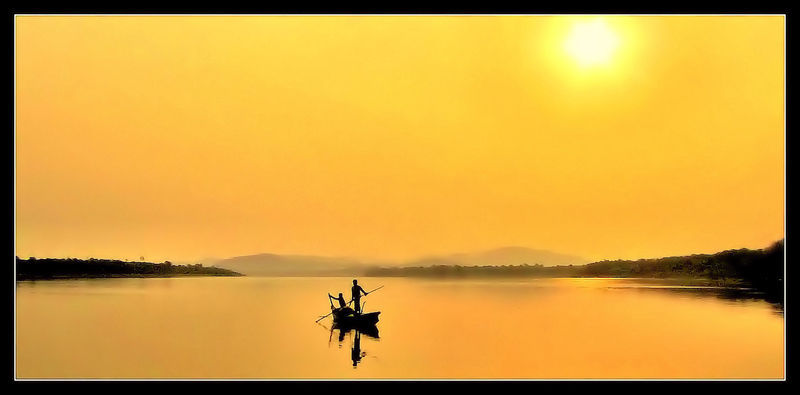
Photo by omtapas, 2010, Krishna River, the Lord of Love. from Piduguralla to Malkangiri (Orissa)
in om’s words: “I start at 6:30am and after maybe one hour I reach the Krishna River. There is no bridge so I have to wait for the little ferry to reach my side and then the other side. My energy level on those first two days is incredible, I feel as if I am in complete love and that I will see my beloved one at Malkangiri.”
addthis_pub = ‘yogagal60510’;
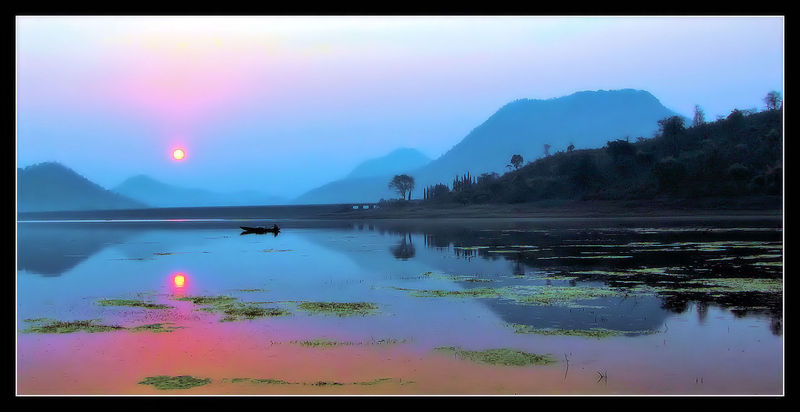
Photo by omtapas, 2010. Taken at Malkangiri Lake in Orissa, India.
The photo says peace and serenity. In om’s words: “the picture is a nice reflection of Peace to meditate on.”
A picture of shanti for Sunday.
addthis_pub = ‘yogagal60510’;

 Linda's Yoga Journey
You must be logged in to post a comment.