yoga teachers are the new waiters

They say that every restaurant server in Los Angeles is an actor or actress waiting for their big break. So are yoga teachers the new wait staff?

This post over at YogaDork makes one think:

“…many aspiring teachers who hear the call will follow the dream no matter what it takes (meaning, lots of odd jobs and stretching the dollar). For some it’s not worth the stress. Caleb Asch teaches 6 classes a week, but it’s not enough to pay the bills. “The stress of not having enough to live on is a killer,” he said.

JG wrote this comment: “This quote – “The stress of not having enough to live on is a killer” – really hit home for me. I’ve been teaching full time for over five years and I’ve never made a fortune, but I always made the bills. This year has been the exception. With 30+ “one-month-intensive” YTTs in my city churning out teachers and the studios offering increasingly low pay to teachers (after all, why pay when there are people willing to teach for free?), I’m beginning to question my decision to teach, as much as I love it. 2009 may be the year I throw in the towel.”

I’ve written more than a few posts about the economics of yoga teaching and about the plethora of yoga teacher trainings in the Chicago area. The fact of the matter is that there are too many yoga teachers and not enough students, yet studios keep cranking out newbie teachers because teacher training programs pay the bills. A studio doesn’t make money teaching group classes and a yoga teacher certainly doesn’t, not when a studio owner pays a teacher anywhere from $4-$7 per student. I don’t know anyone in the real world who is willing to work 90 minutes to make $4. Yet yoga teachers are expected to and to accept it with a smile and no complaints. And if you don’t like it then you can get out because there are 10 more newly minted yoga teachers waiting to take your place, some who are more than willing to teach yoga for free just for the thrill, uh, experience. This is real world yoga stuff that Yoga Journal does not write about.

Yup, yoga teaching sure has become a funny business in this here Om-mera-ka. In fact, I had a moment last week when the thought popped into my head, “why am I doing this?” The longer I teach, the more yoga nutbars float to the surface. As a yoga teacher friend told me about the following email, “the longer we all hang around this USA, the weirder this yoga tribe is gonna get.”

I received an email with the subject line “private yoga instruction.” I receive more than a few emails like that because I have a website, but it made me suspicious because this was the entire email:

“Hello!

How much do you charge for private sessions? How long are they usually?

Thanks!”

It made me suspicious because when most people ask about private instruction they tell me where they are, what injuries or conditions they have, how they found me, what they are looking for, among other things. Their emails are not two sentences. What also made me suspicious was that it came from a [first and last name]yoga.com. I don’t want to give the name because I don’t want to give this woman any type of publicity.

I googled her name and found a very professional looking website that was, in my opinion, too slick and a bit over the top, a website that buried you with information. The young woman bills herself as “Teacher * Scholar * Consultant * Yoga * Transformation * Sustainability.”

Uh, me too.

I responded: “Why do you want to know that when you are a yoga teacher yourself and not someone in my local area looking for private yoga instruction?”

Ms. Yoga Expert immediately emailed a one sentence reply:

“I am looking to hire Yoga teachers, and gauging further inquiries and
potential offers according to responses to the questions I asked you.”

When I read that sentence I thought “yogabot.” Now is it just me or is this woman disingenuous? Why wasn’t she up front about her real intentions in the first email? Why wasn’t her subject line “yoga teachers wanted” instead of “private yoga instruction”? As far as I’m concerned, she lied and she’s dishonest. As a “scholar”, shouldn’t she know how to word an email so as not to make the person receiving the email suspicious? But what do I know? I only graduated summa cum laude so I don’t know if that makes me a scholar.

Something about the tone of her emails and even her very professional looking website made my skin crawl. I really wanted to email her back and tell her that and some other things, but of course, that would not be very yogic of me.

I don’t belong here. I need to find my own yoga tribe.

yoga in the real world


When I told a well-known and well-respected yogi who shall remain nameless that sometimes I teach in places where there are no props, she said with a sniff, “I don’t teach in THOSE places anymore.”

Well, now.  Maybe one of these days I will have permanently traded up my yoga teaching venues sans any dysfunctional yoga studio owners of course.  But in the meantime I look upon my teaching experiences with great affection because I learn from all of them.

This morning I was teaching my private class in my house and the security system’s alarm started screaming.  There had been a thunderstorm with a huge lightening flash over my house (talk about raising the kundalini) and shortly thereafter the alarm went off. And when I say screaming, I mean the sound feels like a drill going through my ears into the middle of my brain.  My students looked at me with that WTF look and I ran downstairs and tried to shut it off.  No luck.  Still screaming.  I went back up to my home yoga shala and told them not to worry, no one is breaking in and nothing is on fire.  Then it stopped. Then it started again.  By this time all I could was laugh.

I ran back downstairs and called the security company.  They told me that the power must have gone out momentarily or there was a power surge and the system was rebooting itself.  As I talked to the security company the message on the control box showed everything back to normal.  I could stop grinding my teeth.  I told the security person that the alarm had gone off while I was teaching a yoga class.  She thought that was hilarious.

Good thing I practice mindfulness meditation: “screaming alarm feels like this…”

Yesterday afternoon I taught to 20 musicians of a symphony orchestra in the massive basement of their auditorium.  As they sat in stillness before savasana I heard massive doors open.  I watched a janitor come in pulling a massive industrial size garbage can behind him on a platform with wheels that obviously needed massive amounts of of oil.  I saw the janitor and smiled, thinking back when I used to teach regularly in THOSE places.

Two other people walked in and opened the doors of a massive closet, the size of a room. The storage closet was lined with shelves of liquor bottles and the man and the woman rolled out two bars which I’m sure were for the audience for last night’s performance.  By this time the students were in savasana.   After class I told them that this was the first time anybody set up a bar in back of the room while I was teaching.

Years ago I taught for a park district.  I taught in their community center in a large a multi-purpose room with a stage.  Saturday morning class, all the women up in downward facing dog — “BREATHE, WATCH YOUR BREATH….”  In walk two uniformed policemen.  I was the only one who saw them because everyone had their butts in the air, eyes closed. “Everyone come down into child’s pose…hello, officers….”  Twenty heads jerk up.

“We’re just here to get the lectern,”, i.e., the one that was up on the stage.

“That’s nice, officers. I thought you were here to strip-search us.”

The men in blue laughed as they hustled the lectern across the stage, down the stage steps, across my teaching space, and into the room next door, the door slamming behind them.  Of course.  Door slamming.

Yoga teacher trainings don’t teach you how to handle these things.

Do you want to hear about teaching next to bagpipe practice and above a dog obedience class?  Fortunately these two things did not occur at the same time.

There is no sound on earth worse than bagpipe PRACTICE, not even a screaming burglar alarm.

A day in the life of a yoga teacher.

Oh, yeah. I’ve paid my dues.

I must not be livin’ right


Seen at YogaDork’s place….

“Beth June Shaw, marketing guru and captain of the YogaFit ship, must’ve had $1.349 million burning a hole in the hidden pocket of her Lululemon pants, because that’s what she paid on Jan. 22 for a three-bedroom, two-bath at 736 Calle De Arboles Dr. in Torrance (California)……”

Beth Shaw, Down Dog Millionaire!

Hmmmm….I bust my yoga butt (oops, I hope that phrase is not trademarked by Beth because I can’t afford to hire a lawyer) with all my yoga continuing education, travel to India to learn from Desikachar himself, and I’m still living in an area where houses haven’t sold for over a year and yoga studios struggle to survive. DAMN, WTF am I doing wrong?

I guess cranking out “yoga teachers” who learn all about teaching yoga in a weekend must be very lucrative.

I must not be livin’ right.

addthis_pub = ‘yogagal60510’;

my teacher’s wisdom

“Charles Darwin’s 200th birth Anniversary has indirectly energized many to restart the debate about God, Creation and Evolution. This kind of discussion, though, has been going on from time immemorial.

Sayana, the well known commentator on the Vedas, starts his commentary by pointing out that several of the sayings of the Vedas on Heaven and the less favorable place and the details of how to get to the former and avoid the latter can never be proved or disproved. Even if they debate for a billion years (sata koti varsa) the believer can not prove to the nonbeliever the existence of these worlds and God, nor can the non-believer disprove their existence to the believer. Recently, several Darwin believers have put up graffiti billboards, etc., proclaiming, inter alia, “Probably there is no God, so go out and enjoy life”, drawing an equally telling response from a believer, “God exists, so go out and enjoy life”.

The most popular theory of creation of modern science is the Big Bang theory. Great minds have propounded this theory. Basically it asserts that the present Universe we experience evolved out of a dime sized entity called “Singularity” that the universe has expanded from this primordial hot and immensely dense initial condition at some finite time in the past, and continues to expand to this day. The mathematicians would say that this singularity has no dimension and infinite density. Then the Universe evolved out of it. I understand that the Big Bang theory does not address the question whence the Singularity was formed and how. Some speculate that these are formed from matter and energy sucked by the Black Hole(s), which is the end chapter of the previous evolution. Implicitly there is no mention of the need for an intelligent cause (Nimitta Karana) for the creation. It evolves by itself. Of course there are many scientists who believe that there could be an intelligent principle behind it—though they may not call it God. This view that the Universe evolved without God or an efficient cause has been there along with the theistic view from time immemorial. An orthodox philosophy, Samkhya avers that the entire Universe evolved out of a singular non-dimensional entity called Mula Prakriti, without an efficient cause (nimitta karana) called God.

Both these views hold that the Universe, the macrocosm that we experience has a real, material cause. And theists believe in a material cause which is also efficient/intelligent cause, which is God. This macrocosmic view that out of the huge macrocosm, countless individual entities like us have sprung up or were created, or evolved, is generally accepted. But there is a third view less known, less straightforward, which tries to understand the whole evolution from a different point of view, from the point of the individual microcosm.

Yoga looks at it from the individual viewpoint, as briefly explained below, which will help and lead us to understand the third viewpoint about Creation propounded by the Advaitic School of the Upanishads.

All my life I am the subject and the world around is the object. I see objects, hear sounds, smell things etc. When I am awake and see an object, the sequence as all of us know is as follows. Light falls on the object that I see, the light is reflected by the object, and the light particles, reach my eyes and then the retina. The retina
converts them into electrical impulses and they reach some part of my brain. Then there may be some chemical changes in my brain cells and communications among the brain cells resulting in my seeing the object. But in physical terms all the information reaches my brain and is absorbed. With this the physical phenomena end. After these reach my brain, how do I see the object, outside of me, in front of me? The information is in my head physically but how do I see it outside of me? Nothing goes out of my head. The brain projects an image, not outside but in the mental space according to Yogis, because the projection does not and cannot take place in the physical space. My mind projects it and there has to be some awareness or consciousness in me which sees or experiences this mental projection. The yogis call
the projection a chittavritti. The chittavritti is the projection of the mind made out of the information received through the eyes.

Of course the projection is a little more involved. The mind not only gets information through the eyes but also through the ears and other senses, and the mind collates the information and makes a composite presentation which I see in the mental space, just as the objects appear to be outside of me. I not only have the outside picture reproduced in my mind but also me, the subject, as part of the experience. I am also aware that I am in the midst of the total picture as the ‘subject’ experiencing the outside world. I also feel emotions attached to the mental picture. I also react to the experience, sometimes with a happy or sometimes an unhappy
disposition. Anyway there is a composite picture I experience. The totality of what I experience including that I am the observer, I like it, I don’t like it, everything — this is the chittavritti at a moment. In the next moment, the chittavritti changes. Moment after moment there is a new chittavritti and the non-changing Self, the pure consciousness keeps observing this changing flux of chittavrittis.

The chittavritti is not confined to objects outside that I see directly. Sometimes, I infer from partial sensory perceptions or occasionally I try to picture on the basis merely of what I hear. Then there are occasions when I close my eyes and produce my own chittavrittis, without objects, like in dreams—day or night. Then I have chittavrittis produced purely from past incidents which I remember. Then of course my mind completely closes shop when there is an ‘experience of sleep’. So I have a variety of chittavrittis, all taking place in my head. My chittavritti which is the totality of my experience at any given moment takes place not in physical space but in mental space or in virtual space. So even though the objects I
perceive may be real, what I experience is virtual. This is what happens in all of us all the time. But even as the experience may be with virtual objects, the objects of the outside world are real according to Yogis.

But the Vedantins especially advaita vedantins ask a further question. If the experience we have takes place in mental space or chitta akasa, the experience of the prior moment also should be taking place in virtual space. So the objects that reflected light particles for my eyes to perceive themselves are virtual objects. Thus going back they aver that our entire life experience is only virtual and not ‘really’ real. We can extrapolate this to the entire outside world and say the Universe is not really ‘real’, it is an illusion.

So we have three possibilities, following this line of reasoning. Firstly the universe is real even though our experience, known as chittavritti is virtual. This is the position of the Yogis, and we would agree with that. The second view is that it is not possible to say for sure if the outside world exists or not (anirvachaniya) since our experience is limited to our virtual chittavrittis. The third view is that there is no real outside world, there is no real creation and the experience is virtual and the universe is illusory. But, one may assert that the objects are real, we can see, we can feel them. But the Mayavadins or those who say that the world is only an illusion, aver that just as we feel the dream space, dream objects and the dream self to be real during dream but they are found to be an illusion when we wake up, likewise the waking state experience also is virtual and there is no real world outside. They say that there is no real creation, all our life we have a succession of virtual experiences.

Let us get back to the ideas at the beginning of the article. So we have now three views about creation of the universe. One is that it evolved from “Singularity” and that is the material cause of the Universe. Like the modern scientist, Samkhya does not feel the need to agree to an efficient cause like God, the creator. The second view is that God created the Universe and He is both the material and the efficient cause. The third view is that the creation itself is an illusion and hence there is no need to subscribe to a material cause, like the Singularity or the Mulaprakriti. However since there is an experience, the experiencer (Atman or drashta), which is non-changing pure consciousness alone exists which observes the illusionary experience. Some Buddhists schools find no need for even postulating the constantly observing Self.

So, the Upanishads aver that there is an origin of the Universe, like the Singularity of the Scientists or the Mulaprikriti of the Samkhyas, which ‘origin’ the Upanishads call as Brahman, literally meaning “the principle that expanded into this Universe’. But the comparison ends there. While the Singularity is inert, without consciousness, Brahman is pure, non-changing consciousness. It is the considered view of the vedandins that matter cannot produce or become consciousness; the object cannot become the subject. The advaita vedantins further aver, likewise, Consciousness cannot produce or become matter, it can only be an observer. So they postulate the theory that what evolved out of the Brahman is not really real, but only an illusion. Brahman does not expand like the Singularity does as postulated by the Big Bang Theory. In fact it is said that the zero dimension Brahman contains the entire universe within itself, but the Universe appears to be outside of it–like during our dream state the dream objects are within our consciousness but appear to be outside us. Or, it is like the thin film of the reflecting surface of a mirror giving the impression of having the three dimensional space and objects behind it.

One may therefore examine theories of creation other than the most popular views of “God created the Universe” or “the Universe evolved on its own”. The third view is that there is no real creation. Uncomfortable? But this obviates the need to answer the rather difficult questions, “Whence did all this material come to make this
Universe.” Or “Why God created this Universe” and many other questions. The theory of illusory evolution is plausible and tantalizing. Some traditional theists (astikas) who are drawn towards the logic of this third theory of Virtual Creation (maya vada), call the Lord a Mayavin, or the Creator of the Grand Illusion.”
Srivatsa Ramaswami, March 2009


addthis_pub = ‘yogagal60510’;

books for your Buddhist path

In a comment to this post Kristen asked for book suggestions to start exploring a Buddhist path.

I first read books on Buddhism and the other Eastern wisdom traditions when I was in high school and college over 30 years ago. I put them down and picked them up again when I started back on the yoga path. I was in a different place so they resonated with me in a different way. I can not separate my spirituality from yoga although the yoga teacher trainings that I know of rarely mention Buddhism. I think that’s unfortunate, but that’s me. Here are my suggestions:

Of course, a good translation of The Dhammapada. I recommend Eknath Easwaran.

Whenever a beginner asks me what book they should start with I always recommend Awakening the Buddha Within by Lama Surya Das. Clear, concise, simple but not simplistic. I’ve read the book about five times.

What the Buddha Taught by Walpola Rahula. A great book for the traditional teachings.

Buddhism, Plain and Simple by Steve Hagen. Classic.

Any book by Jack Kornfield, especially Seeking the Heart of Wisdom: The Path of Insight Meditation and A Path With Heart: A Guide Through the Perils and Promises of Spiritual Life (my favorite.)

I’ve studied both Theravadan and Tibetan Buddhism, so in the Shambhala tradition, books by Chogyam Trungpa: Journey Without a Goal: The Tantric Wisdom of the Buddha and Shambhala: The Sacred Path of the Warrior. My two favorite phrases that Trungpa uses are “spiritual materialism” and “idiot compassion.” You can google those.

Being Dharma: The Essence of the Buddha’s Teachings by Ajahn Chah, Jack Kornfield’s teacher.

Loving-Kindness: The Revolutionary Art of Happiness by Sharon Salzberg.

Buddha Takes No Prisoners: A Meditator’s Survival Guide by Patrick Ophuls. One of my favorites.

Dancing with Life: Buddhist Insights for Finding Meaning and Joy in the Face of Suffering by Phillip Moffitt (which I have to finish before returning to Spirit Rock at the end of April!)

Good Life, Good Death by my teacher, Gelek Rimpoche. Contemplating my own death made me feel so much more alive and in a way liberated me because I know that what is never born can never die. That realization is freedom.

This a very short list but I believe these books contain the essence, at least for me. Some of these books will not resonate with you because we are all different. Search amazon.com or any book store and you will find hundreds more books and a hundred more authors. Just as there are different styles of Christianity, there are different styles of Buddhism: Zen, Theravadan, Mahayana, Vajrayana, Pure Land, etc. Walking my own path I’ve found that it all boils down to the same thing, the essence of Buddha’s teachings: The Four Noble Truths and the Noble Eightfold Path, nothing more, nothing less.

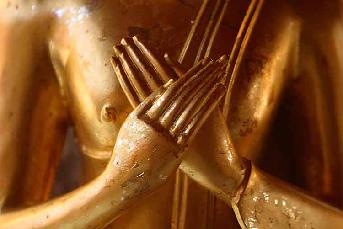
The picture above is Prajna Paramita, the Mother of All Buddhas. Here is the most well-known quote from the Heart Sutra, an essential discourse on Prajna Paramita:

“Form is emptiness,
Emptiness is form,
Form is not other than emptiness,
Emptiness is not other than form.”

Simple.

OM MANI PADME HUM

addthis_pub = ‘yogagal60510’;
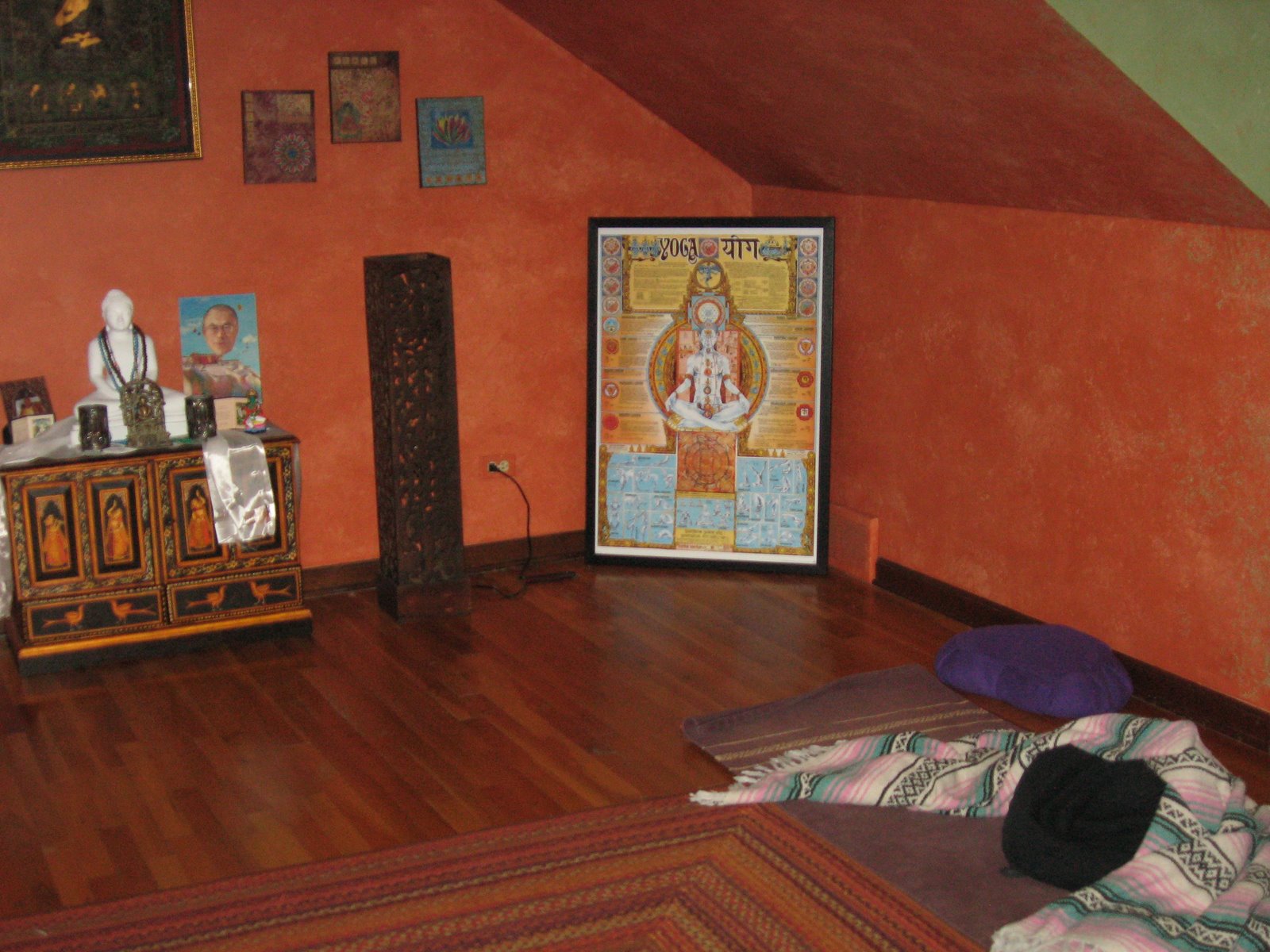
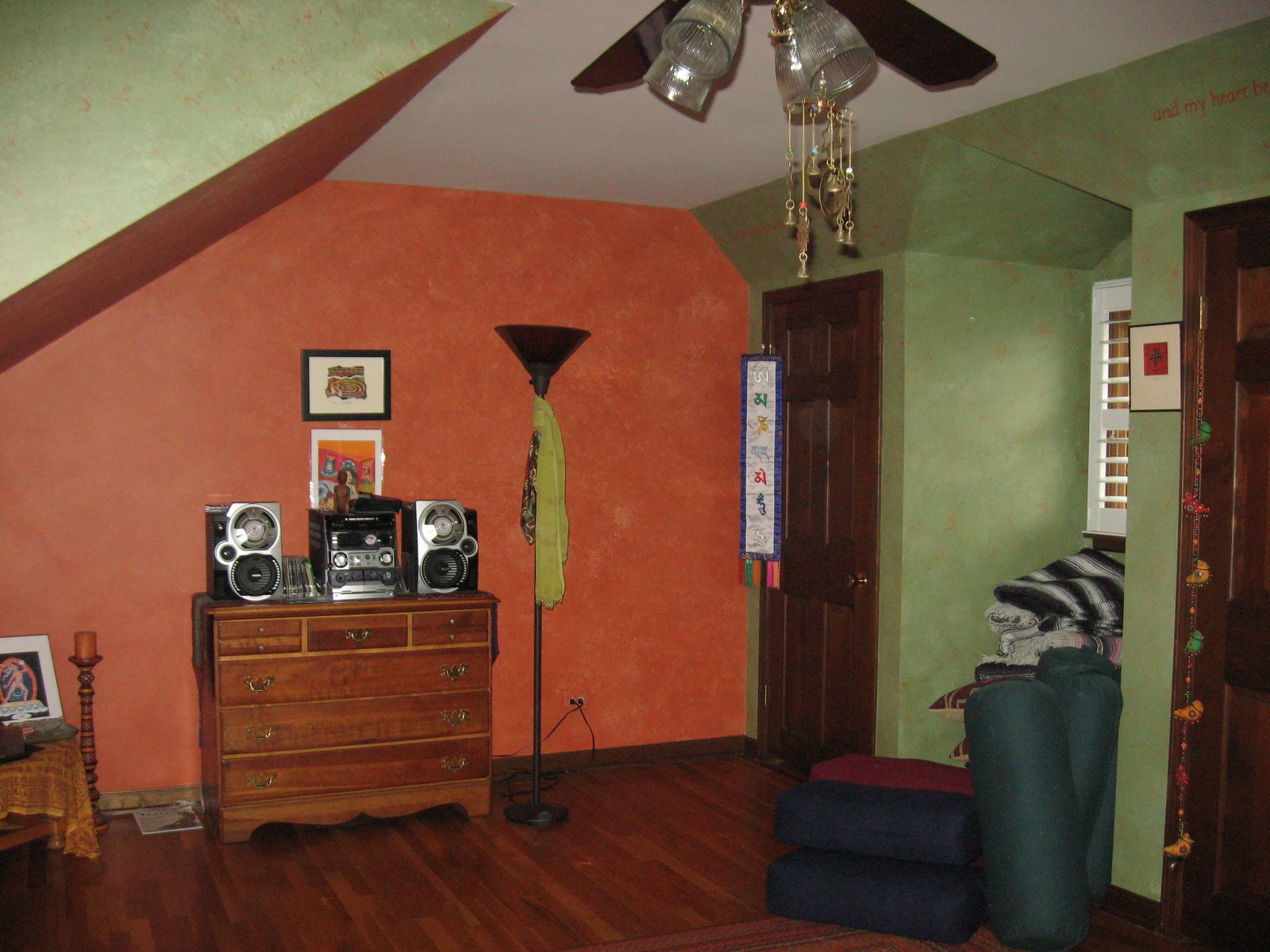
my yoga room is a very very very fine room


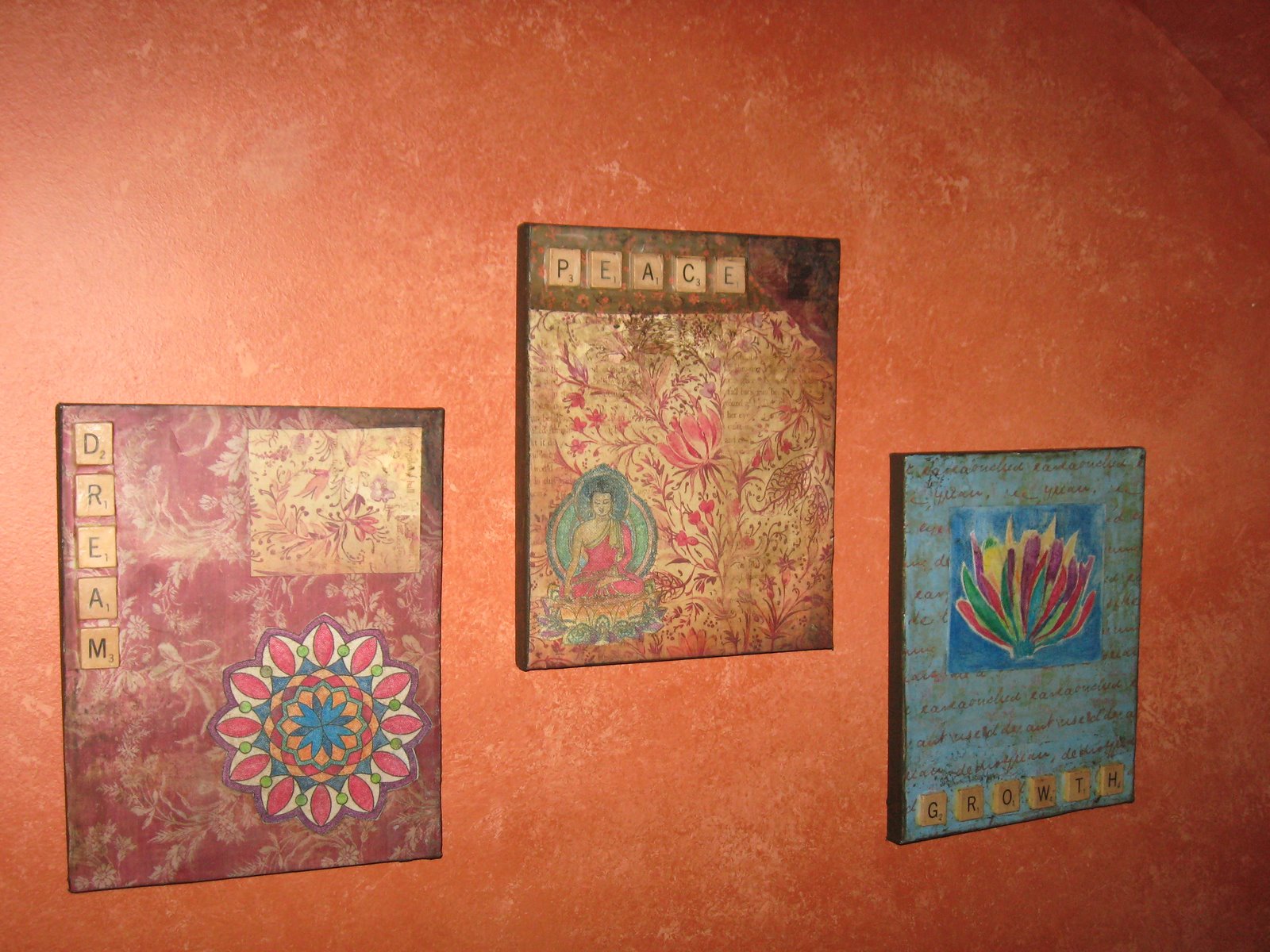
yoga art by sweetmango. sweetmango was surrounded by the fires in Australia. buy her art!


a place to teach, a place for props


a place to sit


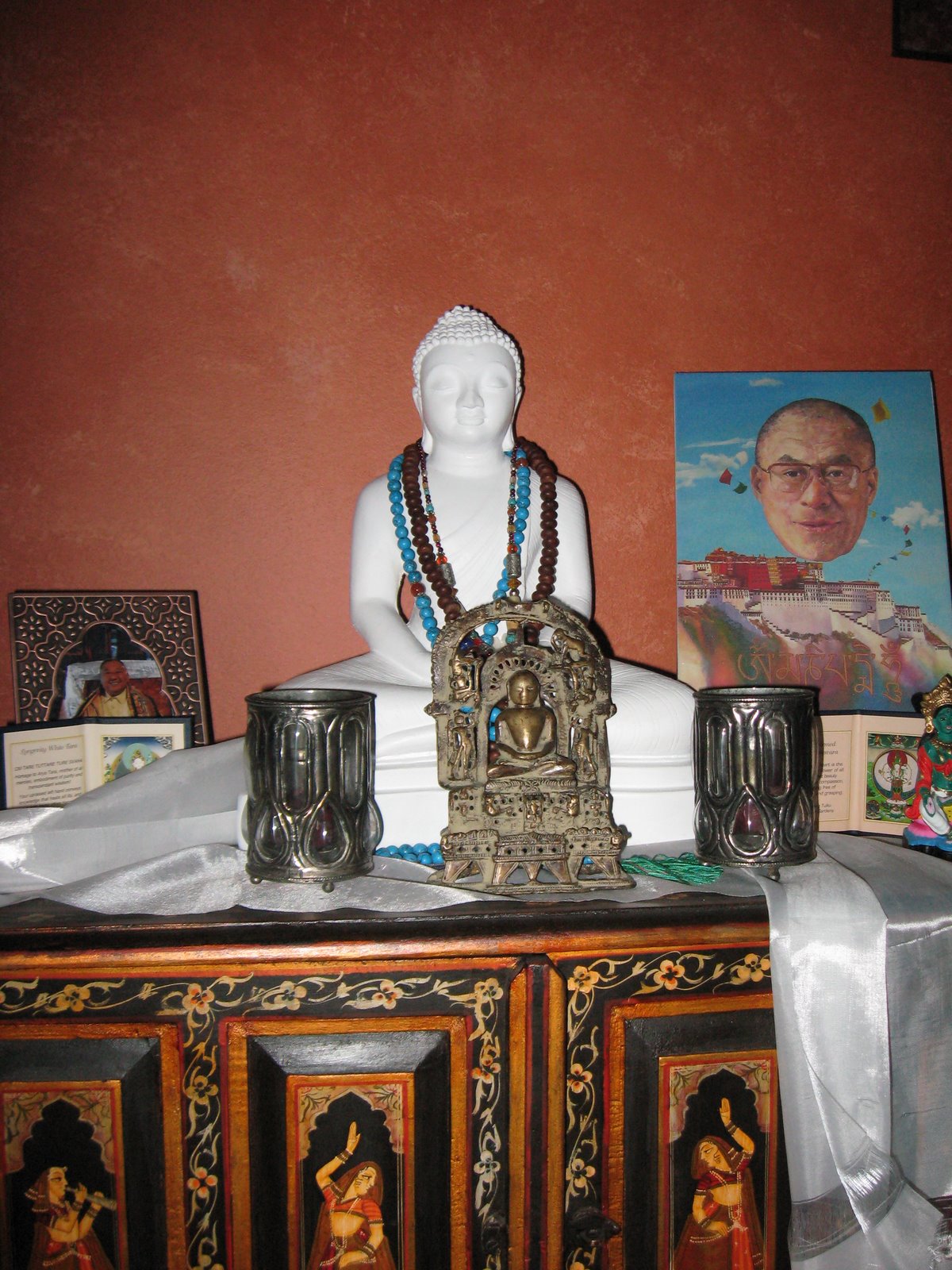
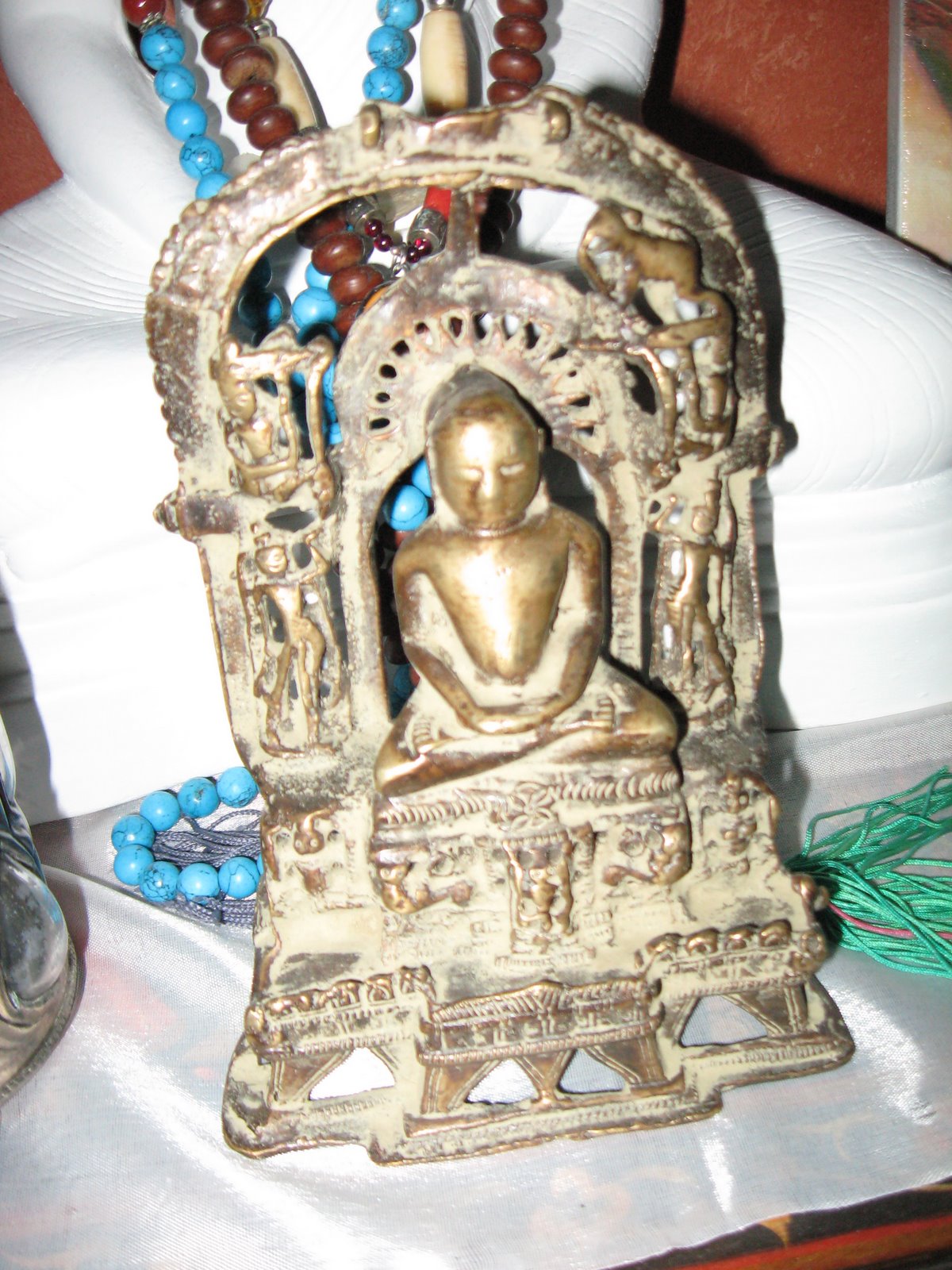
Buddhist altar with Buddha statue given to me when I first took the Five Precepts; giclee of the Dalai Lama bought in Santa Fe, New Mexico; framed picture of my teacher Gelek Rimpoche; antique bronze Buddha bought in Chennai, India


close-up of antique Buddha — it’s heavy!


Hindu altar with bronze statue of Kali standing on Shiva, bought in Chennai, India. It is rare to find a statue of Kali in Tamil Nadu. Front row left to right: bronze statue of Parvati, bought in Pondicherry antique store; wooden statue of Kali bought in Varanasi, sent to me by a friend; picture of Shiva and Parvati; clay statue of Ganesha; mala on Kali bronze is over 30 years old, given to me by a dear friend.

These words from the Taittiriya Brahmana are painted on the walls:

“Let my life force be linked to my heart,
and my heart be linked to the Truth that lies deep within me.
Let that Truth be linked to the Eternal
which is unending joy.”

********************

UPDATE:

When we came to look at the house I saw this room and said “this is my yoga room.” I also immediately “saw” those colors — I wanted a deep orange (since I’m a second chakra gal) and grass green. You can’t see it very well, but on some of the walls there’s a “plastic bag technique” with the paint. The only down side to the room is how the roof slants — I can only fit so many people for a vinyasa class, not good for raising the arms overhead!

But I love the space, it has good energy, all the time.

addthis_pub = ‘yogagal60510’;

books to start your yoga journey


Sandra, a new reader, wrote:

“I want to thank you for a great blog. It is truly an inspiration. I hope you are rid of your trolls. They are a pain.

I am wondering if you could recommend two books as I stand here in the beginning of my yoga journey. I would have liked to email you but couldn’t find any email address on your blog (which is understandable considering your troll visits).”

Sandra, thanks so much for your wonderful compliment, I am blessed to receive such kind words from global readers. Yes, trolls are a pain; I’ve had to make my other blog by invitation only and I now see the same troll is skulking around this blog. This blog may also go the way of invited readers only.

Sandra, I will give you more than two books to help get you going on your yoga journey. Remember that these books may not resonate with you at this time — the operative words are “at this time.” When I got back on the yoga path I bought a ton of books some of which I put down after reading a few chapters. I picked them up again a few years later and I devoured them because I was at a different stage in my yoga development. You will find this true for you, too.

In no particular order, these are books I find invaluable. Remember that these are the books that shaped my teaching; someone on a different yoga path such as Iyengar or astanga will have their own favorite yoga books….

The Complete Book of Vinyasa Yoga — Srivatsa Ramaswami
Yoga Beneath the Surface — Srivatsa Ramaswami
Yoga For the Three Stages of Life — Srivatsa Ramawami
Bringing Yoga To Life — Donna Farhi
Enlighten Your Body: Yoga for Mind-Body Awareness — Linda Christy Weiler
Mindfulness Yoga — Frank Jude Boccio
Yoga of Heart — Mark Whitwell
Yoga for Transformation — Gary Kraftsow
Yoga for Wellness — Gary Kraftsow
Yoga and the Quest for the True Self — Stephen Cope
Yoga: The Spirit and Practice of Moving Into Stillness — Erich Schiffmann
Aligned, Relaxed, Resilient: The Physical Foundations of Mindfulness — Will Johnson
The Heart of Yoga — TKV Desikachar

Of course you must get a good translation of the Yoga Sutra-s and the ones I like are The Yoga-Sutra of Patanjali by Chip Hartranft and Reflections on Yoga Sutra-s of Patanjali by Desikachar, however, I don’t think this is available in the United States. Hartranft’s book blends Buddhist thought with the Sutras, writing from the perspective that it was impossible for Patanjali not to be influenced by Buddhism when he wrote the Sutra-s.

The ancient yoga texts are also not to be forgotten:

Hatha Yoga Pradipika — Swami Muktibodhananda
Pure Yoga (a translation of The Gherandasamhita) — Yogi Pranavanadna
Nathamuni’s Yoga Rahasya
Yogayajnavalkya Samhita: The Yoga Treatise of Yajnavalkya

The last book will most likely be the most difficult to find. It is one of the oldest texts on Yoga and it is a dialogue between the sage Yajnavalkya and his wife Gargi, who was considered one of the most learned women of all times. The book is dedicated to “all great women.”

Last but not least, The Bhagavad Gita, translation by Easwaran.

If you were in my teacher training, I would ask you to start off by reading these three books: Yoga Beneath the Surface; The Heart of Yoga; Yoga and the Quest for the True Self.

Happy reading!

addthis_pub = ‘yogagal60510’;
Valentine’s Day 2009: practice loving-kindness — for yourself

Love After Love

The time will come
when, with elation,
you will greet yourself arriving
at your own door, in your own mirror,
and each will smile at the other’s welcome,

and say, sit here. Eat.
You will love again the stranger who was yourself.
Give wine. Give bread. Give back your heart
to itself, to the stranger who has loved you

all your life, whom you ignored for another, who knows you by heart.
Take down the love letters from the bookshelf,

the photographs, the desperate notes,
peel your own image from the mirror,
Sit. Feast on your life.

— Derek Walcott, Sea Grapes

addthis_pub = ‘yogagal60510’;
impermanence

Finally, I got it: a heart that is open to the world must be willing to be broken at any time. This brokenness produces the kind of grief that expands the heart so that it can love more and more.
–Stephen Cope

I had the great fortune of spending 10 days with Stephen Cope at my training retreat at Spirit Rock in 2007. I think he’s brilliant.

And this is a quote that rings so true for me.

addthis_pub = ‘yogagal60510’;

every picture tells a story

Thanks, YogaDawg!

and this is why I am not a yoga superstar like Shiva Rea, Seanne Corn, et. al.

That pup looks drugged. Have you ever seen such a lifeless puppy? And I hope Ms. Doga did not get that puppy from a pet store — pet stores buy puppies from puppy mills!

Please feed shelter animals! Click the link in the sidebar — my three former street cats thank you!

I also want to give a shout out to my new favorite yoga blog, Yoga Dork. Any yoga blogger who can hold Lululemon’s feet to the fire is OK in my book!

addthis_pub = ‘yogagal60510’;