Happy Saga Dawa!

In the Tibetan tradition, June 7 was Saga Dawa, a remembrance of the birth, enlightenment, and death of the Buddha. Saga Dawa is the entire fourth month of the Tibetan calendar which this year began on May 25 and ends on June 22. The seventh day of Saga Dawa, May 30, is the day of the historical Buddha’s birth for Tibetans. However, the Buddha’s birth, enlightenment and entry into Nirvana at his death are observed together on the 15th day of Saga Dawa which was June 7.

A faithful reader sent me this link to a series of gorgeous photos and pithy dharma quotes in the blog of a very talented photographer: Gritz Photo Blog. One bit of wisdom from the blog:

“Conflicting emotions come from within this mind, this inner security we have set up for ourselves, where we think of our emotions as legitimate. For the world to function it is not necessary to have a belief that it is real or permanent. If I am convinced that all phenomena are impermanent I am convinced that my distractions will be reduced. We have to give up wrong views, an improper attitude towards others, that everyone is ever lasting …There is a discrepancy between how things are and how we see them.

We know everything is impermanent but we would rather see it as permanent.”
–Jigme Khyentse Rinpoche

Tomorrow I am off to Vermont for seven days to attend Level 2 training of Phoenix Rising Yoga Therapy. I’m excited about seeing Vermont as the only place I’ve been out east is Washington, DC. Funny how I’ve been to India three times and never to New England. Here is what I wrote about how I resonated with the Level 1 training. We shall see what Level 2 brings.

may all beings have happiness the causes of happiness.
may all beings be free from suffering and the causes of suffering.
may all beings never be parted from freedom’s true joy.
may all beings dwell in equanimity, free from attachment and aversion.


addthis_pub = ‘yogagal60510’;

home is where the heart is


I have been reading this blog occasionally but have recently been hitting on it more and more (I’ve blogrolled it.) I like to go back and read the very early posts of a newly discovered blog just to get an introduction to the blogger. When I read what I’ve quoted below I thought, oh my god, thank you, thank you, thank you…

The thing is, I belong here. It claimed me, India. The first time I smelled it in the Delhi airport at 1am on a cold January morning; the first time I slid into the back seat of an Ambassador taxi, booked into a true-blue Indian darmashala, sipped chai from a roadside stall, got gut-wrenching dysentry, cried in a temple because I found myself, laughed with a crazy local villager who insisted he was Krishna and dressed like him every day, put my back out on a rickshaw ride from hell, slid into the purifying waters of a holy pond at Govardhan Hill, and bent down and touched the soft, powder-like dust on the ground of the spiritual centre of the universe, Radha-kunda…all these things claimed me and made me their own. Those holy towns left images in my memory; as I paid my obeisance in temples, the ancient floors left impressions in my body that leaked into my heart and remain there still. Home is where the heart is? Yes…

I had never been overseas in my life until I went to India, alone, at age 51, to study at the Krishnamacharya Yoga Mandiram in Chennai. As soon as I stepped onto Indian soil as I walked out of the Chennai airport at 2 AM, it hit me: I had come home. The feeling was primal. Crying in temples because deja vu overwhelmed me? Oh, yeah.

Thank you, Braja, for bringing back my first night in India. There has not been one single day since September 2005 that I do not think about Ma India and count the days until I can run into her arms again.


addthis_pub = ‘yogagal60510’;

the beauty of India

Originally uploaded by snonymous at IndiaMike.com

snonymous said:

“Beautiful and unexpected performance by a pair of white peacocks at the Byculla zoo in Mumbai, April 2009.

Repeat performance on 3 May 2009.

I usually do not look at the caged animals at the zoo which I visit purely to enjoy the rare and varied flora, for which it is a treasure house.

This spectacle however, earned my rapt attention.

The green hue is due to the strong mid summer morning sunlight filtering through the green fiberglass translucent roof of the cage.”

We’re so accustomed to the brilliant colors of India that seeing something absent of color is shocking! The peacock’s full performance is here.

Beautiful albino peacock!

addthis_pub = ‘yogagal60510’;

In Memoriam: Sri K. Pattabhi Jois

Sri K. Pattabhi Jois died this morning in Mysore after a year of declining health. He was 93 years old.

While I am not an astangi and the only time I did astanga was 6 years ago when Guruji’s son Manju did a workshop at the Chicago Yoga Center, I know many people who have gone to Mysore to study at his shala. My own teacher, Suddha Weixler, studied in Mysore three times.

It is a great loss for the entire yoga world, not just for the astanga community.

Energy can neither be created nor destroyed. What is never born can never die.

Those of you who knew Pattahbi Jois or studied in Mysore, feel free to leave your remembrances in the comment section.

OM SHANTI

addthis_pub = ‘yogagal60510’;

shadow self

I found this wonderful photo at one of Sindhu’s blogs and thought it was a brilliant interpretation of the shadow self. It is entitled Devi and was originally uploaded by Mandar Sengupta.

The photo is also a beautiful reminder of where I’ll be next year: I’m flying from Chennai to Kolkata (Calcutta) where worshiping the Divine Mother is supreme. I plan on spending lots of time at Sri Ramakrishna’s home, the Dakshineswar Kali Temple.

My gut is telling me that I will love Kolkata as I do Chennai.

OM KALI MA!

addthis_pub = ‘yogagal60510’;

I am my shadow self

Scott from Scott’s Thott’s posted this Seane Corn video and I wondered what your thoughts were about it.

A long time ago I did a workshop with Corn where she said almost exactly the same thing. When she mentioned the junkies and the whores I looked around the room and saw more than a few eyebrows go up and eyes go down. While the asana practice was good, I loved what she had to say even more.

Corn says that the teachers she is most attracted to are the most human, the realists who are honest about their history and path. In my last workshop with Sarah Powers she said the same thing: that her favorite teachers are the ones whose “humaness” shines through. I agree.

Last weekend I became 55, a fit, fabulous, “woman of a certain age.” While I have my aches and pains I don’t allow my body or my thoughts to define me — I am not this body, I am not my thoughts. And on my birthday I realized: I should be dead. There was a time when I and others thought I would not live to see 21. I tried to kill myself when I was 16. Ask me if I care who knows that.

And now I’m planning my 4th trip to India. I’ve come a long way, baby.

I teach at a domestic violence shelter and the ladies told me that they appreciate me so much more because I’ve been where they are now, that I am not a “white suburban do-gooder” (their words) trying to tell them how to be.

I question how some show biz yogis can teach me because I wonder if they’ve been where I’ve been — abuse, rape, addiction, and domestic violence. I usually do not trust the om namah shivaya types with the ethereal smiles and the wispy, breathy voices. I am a survivor, so what can they teach me? I’d rather get down and dirty.

I loved Scott’s comment:

“A friend and I joke about the “Om Shanti” and “Namaste” crowd. These people who say Yoga is all about love and light, peace and happiness are deluding themselves. It’s so pretentious – just say hello, how are you, have a good day… whatever. I would no more say Namaste to someone (outside north India) than I would say bonjour or auf wiedersehen.

If Yoga isn’t pushing you outside your comfort zone, it ain’t really Yoga. Leave the frills off for me, mama, and gimme an extra dose of darkness.”

“If Yoga isn’t pushing you outside your comfort zone, it ain’t really Yoga.”

Why do you yoga? Not “do yoga” because yoga is about undoing, not doing. Yoga does us. I’ve always thought that the reason more people don’t yoga is because stepping into yoga takes courage and many of us (most?) are afraid to see what might come up, we’re afraid of our shadow selves. It’s so much easier to push that shit down and resist our truths.

Roll around with your demons and become uncomfortable until it hurts. Set yourself on fire because that fire will either kill you or transform you.


my brother from a different mother

While I was at my final retreat for the Mindfulness Yoga and Meditation Training at Spirit Rock in California, YogaDawg sent me this video saying “this one’s for you, couldn’t help but think about ya….”

Thanks, Y Dawg, I LOVED IT!

I also received another blog award from Grace over at Graceful Yoga, a lovely and gentle yoga blog — she lists her favorite yoga blogs so check them out. Thanks for the blog love, Grace!

As for my final retreat, I will write about it soon. I will say that the retreat and the entire training was amazing. It truly was a groundbreaking training in the western yoga world. It was a never before offered training that combined Buddhism and yoga, the twins separated at birth, so to speak. If you think Buddhism can be separated from hatha yoga, think again.

There were 88 retreatants from around the world, but my “dharma buddy” and I were the only two yoga teachers from Illinois (there were only four teachers from Midwest America.) Out of all the yoga studios in Chicagoland, both of us came from the same studio in Chicago. We think that says a lot.

Enjoy the video and dance to the music — I will give you a little preview about my Spirit Rock retreat post….we ended the retreat (after a solemn graduation ceremony) with a yoga rave dance….Shiva Rea doesn’t have anything on the Spirit Rockers, believe me.

addthis_pub = ‘yogagal60510’;

India stories: It’s a mad mad mad mad Madurai


The day I left for Madurai I went to a beauty salon to get mehndi on my feet. The salon ladies were fascinated by my tattoos and they were admiring them when the owner walked in. She was a big woman wearing a beautiful hot pink sari and heavy with gold jewelry — her personality matched her appearance. She shoved her way through the crowd saying, “I want to see everything!” She stuck her finger in the air and announced, “I want to learn this!”, as if learning the art of tattooing is the easiest thing in the world.

They caught a glimpse of my shoulder tattoo. I did not plan to take off my clothes but the owner commanded, “Take off top, BE FREE, BE FREE!” I wore a camisole underneath so I removed the top of my salwar kameez. Everyone gushed over the intricate flower vines surrounding a colorful butterfly.

Then they saw the large sun/moon tattoo peeking above the waistband of my salwar and two women began to pull it down. The moon has eyes and a Nepali woman loved it so much that she kissed her fingers and touched my tattoo. “The eyes is talking to me, the eyes is talking to me,” she said as she repeatedly kissed her fingers and touched the eyes of the moon.

Women took pictures of my tattoos, the mehndi was started, and the Nepali woman drew my tattoos in a sketchbook. She told me that she loves tattoos and wants to become a tattoo artist, but there is no place in Chennai to learn. The women asked if I wanted to get my nose pierced and the Nepali woman confided that some Indian women get their nipples pierced. “But only married ladies after one baby,” she said very seriously. I loved that she was so open with me, a westerner whom she would never see again. I was just one of the girls that afternoon.

That night I left on the 9:30 train to Madurai and as I sat alone in my berth two young men in their 20s came in. When they saw me they looked as if I had lifted up my kurta to flash them. Their mouths dropped open in unison and they did not say a word. I thought their reaction strange and I felt like saying, “Hello, boys, you’ve never seen a woman before?” I said hello in Tamil and smiled. They sat across from me and as I sat across from them with a half smile on my face they tried to look anywhere but at me.

I’ve been told that sometimes this is typical male behavior when so close to a woman, especially one as strange as me — western, a tattooed ageless hippie chick, dressed in Indian clothes, and bold enough to look them in the eye. I’ve also been told that some young Indian males are starved for any kind of interaction with the opposite sex — usually there is no premarital sex and there is hardly any communication between boys and girls at school. Growing up like this leaves men clueless as to how to behave and some also believe the misconceptions about western women.

At the last minute an older man sat next to me and I said, “We’re all going to be just cozy now, aren’t we?” The young men again looked like I had not only flashed them but also blew them a kiss. At least the older man had the manners to say hello to me. These boys looked so nervous I felt sorry for them. They finally got their act together, i.e., making sure they never looked at me, and we all settled into our berths for the overnight train ride.

As the train pulled into Madurai in the morning, the older man wished me a nice day and the boys tripped all over themselves in a rush to get out. I was sure that this was the first time they had slept so close to a woman.

After a nine hour train ride I was in no mood for nonsense, but I was instantly accosted by a dozen auto rickshaw drivers, so much so that a station security guard told them to leave me alone. I chose one driver and as we walked through the phalanx of drivers they started to laugh and yell, “here madam, here madam, you want ride, madam?” “That’s it,” I said as I threw down my bag. I spun around and yelled loud enough to make the street dogs run: “ENOUGH OF THIS BULLSHIT!” That got everyone’s attention and I never saw a gaggle of drivers shut up so quickly. “No tension, madam, no tension, come with me,” my driver said. That was more like it and when we got to the hotel I paid him more than what we agreed to.

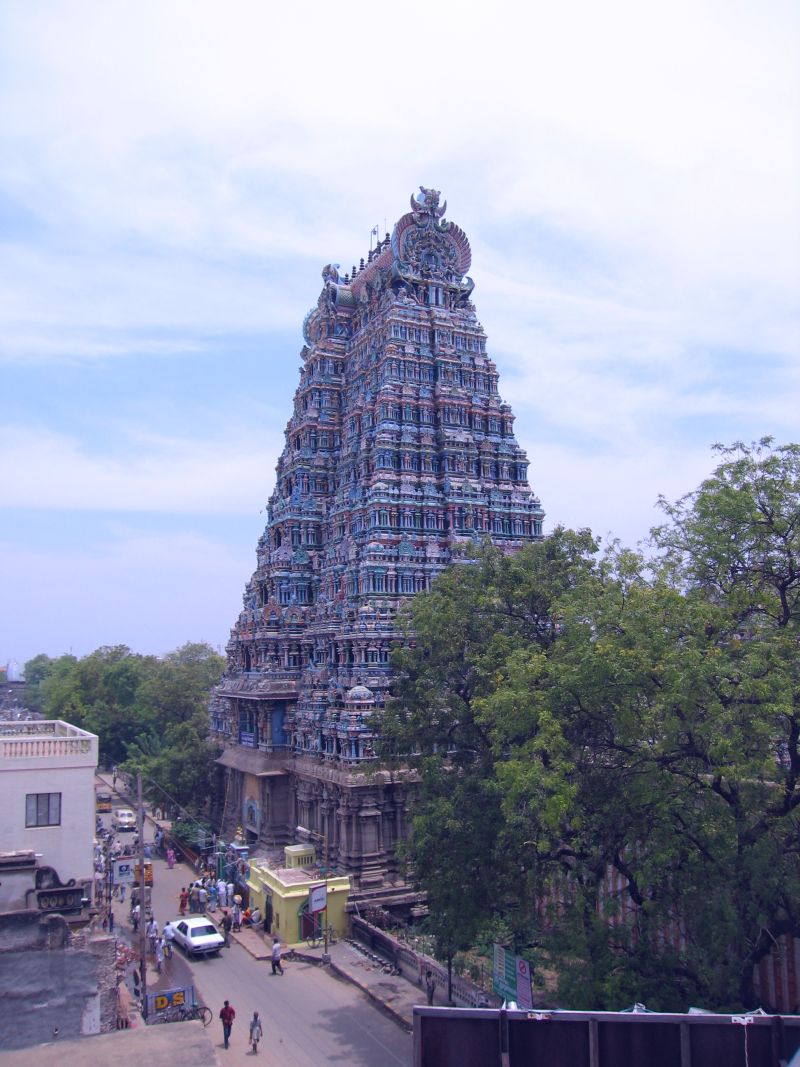
I stayed exactly 90 minutes at the guesthouse that was closest to the great temple. I took the recommendation of a well-known guide book and I decided that the writer must have been hallucinating from too many bhang lassis when he wrote the review.

I don’t mind cheap hotels in India but I draw the line at towels that looked like they were used to wash a car and greasy hair stains on the pillows. The place was disgusting. It looked like a room for serial killers to hold up during their rampage. The guts hung out of the air conditioner in the “deluxe AC room.”

The room was considered “deluxe” because you could walk out onto the roof of the floor below for a fabulous view of the temple. However, the window did not lock so anyone on that roof could crawl into your bed. The room also had a frosted glass door so it was not safe for a solo female traveler. When a man tried to get into my room about a hour after I checked in, I asked for another room but it had the same greasy towels and pillow cases. I got out, losing 500 rupees, and moved to a better hotel. I learned a valuable lesson for future trips to India: always look at the room before you hand over the rupees.

My first day in Madurai and now I knew why some westerners had that glazed “dead man walking” look in their eyes. It’s a defense mechanism – act deaf, dumb, and blind and maybe you’ll be spared from the incessant touts. I met nice old men who told me their life stories, and how America is a great country, and how their brother/uncle/son/cousin/sister’s husband has a clothes/jewelry/art/silver shop with a great roof top view of the temple, “just look, madam, no buy.”

The market across from the temple was filled with stalls of all types of merchandise and a great place to see those dead men walking. I ended up telling shop keepers and touts, “I’m a poor yoga teacher, no money” or “YOU buy ME something?” or “It’s against my religion.” The last story always worked. I also ended up with a screaming migraine headache from the constant harangue of “just look, no buy” and the heat and the closeness. I went back to my room, turned up the AC, put a cold cloth on my head, and didn’t wake up until the evening.

My second day was spent at the Gandhi museum, an inspiring and peaceful place where about 100 schoolgirls were more interested in me than in learning about their own history. The girls were sitting on the floor listening to the curator as I walked in. He immediately stopped talking and all heads turned around at the same time to look at me. I smiled and brought my hands to my chest and bowed. Everyone said hello to me in English, and I responded with a loud vanakkam. They exploded in laughter and with a big smile the curator asked, “What country, madam? America or UK?” “America.” “Ah, America!” Bigger smiles all around. Their teachers had their hands full trying to keep order all because of me.

As I walked around the exhibits I felt the schoolgirls’ eyes on me. I turned around and the girls would giggle. “Shhhh,” I said, putting my finger to my lips. “Read your history, don’t look at me.”, I told them with a wink. Occasionally I would feel a light touch on my back and I would turn around and a hand would cover a mouth, a giggle unsuccessfully suppressed.

My last day in Madurai was spent on a tour bus. An Indian tour bus is usually not decked out with plushy seats, air-conditioning, and a restroom – most of our seats were ripped and frayed but adequately comfortable. Sometimes you have the pleasure of listening to music played full blast through a shabby speaker, driver’s choice of music of course. I settled in and waited for the day’s adventures.

Once again I was the only westerner and I noticed that everyone had the same reaction to the condition of the bus. They walked up the stairs, stopped, looked around at the frayed seats, and either gulped or sneered. Off we went, all windows open to the Madurai heat and dust.

I don’t remember exactly what was on the tour, I just enjoyed riding around with a bus load of Indian tourists. Every time we stopped the driver would announce in Tamil where we were and how long we would be there. At the first stop I asked him how long and he sneered at me and grunted. I was on my own. I knew that if I did not get back in time, I would be left in the street. Finally a man told me in English “20 minutes” and at every stop I would look at him and he would smile and tell me how long we would be.

I loved the vignettes framed by the bus window. I saw a huge ram with massive horns sleeping peacefully in the gutter while a woman carefully swept the street around him; two flower sellers with their carts, talking quietly, engrossed in conversation as only women can be, as a street goat happily munched the flowers from one cart.

It was a lazy day and the only excitement we had was when the driver took a curve too fast and I felt the tires on my side of the bus lift up for about three seconds. People started to scream and the woman next to me flew out of her seat. She would have landed in the aisle had I not caught her sari and pulled her back down. I practiced equanimity — if I die in India so be it. I started to doze as the passengers yelled at the driver.

At one stop we were besieged by begging children, girls and boys. I saw that Indians rarely gave to beggars, so when a beggar sees a feringhi it’s an onslaught of constant cries for money. Trapped on a bus, I was ripe for the picking. I sat next to the rear door and it was the perfect place for a little girl to plant herself on the steps in front of me with her hand out with a constant cry that sounded like “ma” over and over and over again.

You need a thick skin to handle the beggars in India, even if they are children. I was not in the giving mood so I ignored her and stared out the window. Occasionally I would look at her and shake my head and tell her no in Tamil, but she never stopped. Every Indian also ignored her, but I had an idea. I pointed to each person on the bus and told her “ask him” or “ask her” and rubbed my fingers together, the universal sign for money. I said, “They give rupees, I give rupees”. She left me and went over the Indians. That finally got everyone’s attention, and when she started harassing the Indians, a woman said something and she left. The bus finally started and as we left I looked back to see the begging children swarm the next group of tourists, like yellow jackets to fresh meat.

Late at night when everyone was tired, hungry, and complaining we stopped at a Murugan temple, our last stop, and most of the passengers did not get off the bus. The temple would have been the highlight of my day because it is a very important temple, one of the six abodes of Lord Muruga, an important Hindu god worshiped in south India. It is huge temple carved into rock, but it was impossible to explore in the time we had, so I had to be satisfied with a quick walk-through. I should have planned my last day more carefully, but I wanted to leave the planning to someone else, even if it was a bus driver who spoke no English. Go with the flow, there will be a next time, and I remembered the words of the Chennai beauty shop owner, “be free, be free.”

We headed back to Madurai, everyone quiet now for the ride home. Despite the heat, the dust, a migraine headache, and the incessant touts that I experienced over the last few days, I again felt at peace here on a bus with strangers in a strange city in a strange land and I almost fell completely asleep.

We were in Madurai and I woke up to people screaming at the driver again. Apparently he wasn’t dropping people at their hotels, he was dropping people off wherever he felt like it. It was late, and the streets were crowded with people walking to the temple so the bus driver had trouble getting through the streets. I watched everything with detachment, watching group dynamics and mentally placing bets on who would win.

Every few blocks he would kick people off the bus, and the people would complain as they flagged down autorickshaws. Finally it was me and an older couple. I got off the bus and the husband started to argue with the driver. There was much hand waving and head wobbling, but the driver won and the husband finally got off. The bus left and the three of us stood in the middle of the street. Suddenly they spoke to me in perfect English, complaining about the bus and the driver. How funny that they never said a word to me all day yet we had sat across the aisle from each other.

I returned to my hotel and spent the rest of the evening in the roof-top restaurant, looking out over the temple complex and thinking about what India had taught me so far – more patience, how to be in the present moment, and detaching from the outcome. Anyone on the yoga path knows that these qualities sink a bit deeper into the consciousness the longer one does the work. But somehow, being in Ma India, my heart could open more fully, just as the lotus opens its petals as it rises out of the mud to reach for the glorious sun.

Goodbye Madurai. OM MURUGA, lead me from the darkness and into the light.

addthis_pub = ‘yogagal60510’;

India stories: I Heart Rameswaram

Writing the last post made me think of my own India stories. I leave for Spirit Rock this weekend and will be gone for 15 days so I decided to re-post one India story a day for your reading pleasure.

I entered these stories in a travel writing contest sponsored by a travel website (I didn’t win so I’m not mentioning the name!) The grand prize was a trip to Machu Picchu and the other prizes were bags — I would have been happy with a bag! I wasn’t bummed out when none of my stories were selected because I know they kick ass anyway.

India is definitely not for everyone, but it must be in my DNA because as soon as my foot hit Indian soil (my first overseas trip, alone, at the delicious age of 51), I felt like I had come home. There has not been one single day since 2005 that I have not thought about Ma India. Not one. Not even when I returned from my third trip in January 2008 with virulent salmonella food poisoning. I flew 18 hours from India sicker than a mangy Indian street dog — I almost passed out in the Chennai airport before I even got on the plane.

I used to be a moderator of the best India travel website in the world , a site with over 30,000 members, each one with their own story about India, and most, I’m sure, with a love/hate relationship with India. Last year one of my teachers told me that I’m a native now — that the first time you go to India you’re a little scared and apprehensive; the second time you love it and you want to stay forever because nothing is ever wrong; the third time you begin to see things as a native does — the good, the bad, the horrible, the indifference, the enthralling, and the enchanting. India in all its glory. Last year instead of people asking me “what country, madam?”, people asked me, “do you live here, madam?” Ahhhhh….I had finally arrived.

In an old post I wrote: “India has her hooks in me like an old lover — an old lover who you’ve told yourself that you never want to be with again but who keeps re-appearing like a hungry ghost tapping on your shoulder, and no matter how fast you run you can never escape him because he is a part of you forever. You know this and you hate it but you love it all at the same time.”

India nourishes me and I need to visit Ma India as much as I need the air to live. One of my favorite bloggers once wrote: “…if I don’t follow my Heart, I will lose a piece of my aliveness. It doesn’t take too many compromises to become a walking dead person…”

So these stories are not about your India or her India or his India. This is MY INDIA and I count the days until I am in her arms again.

Shanti.

_________________________________________________________


I arrived in Rameswaram about 3 pm on a Saturday after a 7 hour car ride from Kodaikanal. The ride was interesting as I watched India flash by. . .caught in a cattle crossing, eating lunch for 10 rupees at a tiny restaurant in the middle of nowhere where the proprietor took me in his kitchen to show me what he was cooking since he did not speak English. I can’t remember what it was called, all I remember is that it was delicious. I was starving and inhaled the meal as all four people in the restaurant stood around my table with big smiles watching me eat.

I arrived at the Hotel Tamil Nadu, showered, and took a nap. I woke up about 5 pm and planned to walk to the temple and find dinner. The phone rang and being alone in India, getting a call was shocking. A man told me “if you want to see the temple, I can take you.” Still groggy from my nap, I thought how did he know that’s what I’m going to do? I babbled something like who are you, who’s calling, where are you, whaaaat….? The man said he was downstairs at the desk, and I said, yeah, whatever, and hung up.

I got downstairs, still trying to wake up, and the clerk was behind the desk with another man. I had my torn out page from the Rough Guide that said “R. Kannan, who can also be contacted through the Hotel Tamil Nadu, happily gives foreigners advice, even if they do not use his services.” I asked the clerk if he knew R. Kannan, and he pointed to the man who appeared to be waiting for me and said, “this is Kannan”. Wow. He materialized out of nowhere. But how did he know exactly what time I was going to leave? Ah…delicious serendipity. No….most likely he got the call, “feringhee in da house, come on over!” I stood there, thinking go with the flow, whatever happens tonight, happens.

As it turned out, I spent four hours with Kannan that night. We went to the Gandhamadana Parvatam, where I took pictures of a beautiful sunset, and to the Nambunayagi Amman Kali Temple, where I saw a man with a pet egret, and sat with him as he fed it worms he dug out of the sand. Kannan and I planned my weekend all within one hour — I was to spend it with him.

As we were driving back, Kannan asked me if I wanted to see the children dance — of course I did! We stopped at what looked like a school, the yard filled to the brim with people — local business people, politicians, parents, and children. The little girls were dressed in their beautiful South Indian dance attire, their hair and makeup perfect. One little girl was so beautiful I wanted to take her picture, but there were so many people, I got pushed along with the crowd. We ended up at the back of a long, narrow lot.

So many people, and me, the only westerner, once again. But the difference between where I was now and Kodaikanal in the morning was amazing. The energy, the attitude, the graciousness, was totally different from Kodaikanal. I did not feel claustrophobic here, even in this crowd of people.

We sat down and after a number of speeches, the show began. Little girls and boys dancing beautifully, carefully, with a few missteps that added to the charm, music that blasted my ears. Unfortunately I was sitting too far back to take any decent pictures. Then one group of kids dressed in street clothes started dancing to music I recognized from a Vijay movie. The only Vijay movies I had seen were on the Lufthansa flights from Germany to Chennai, but I know who Vijay is — a very popular Tamil actor. You’ve heard of Bollywood? Tamil movies are Kollywood with their own set of popular stars.

There was a group of boys sitting behind me and as soon as the Vijay music started, they got up on their chairs, and started clapping and dancing, hooting and hollering. I got up and started to take pictures and of course that started a riot. “Madam, Madam, take me, take me!” I yelled “dance like Vijay!”, and put my hand to my forehead in the gesture Vijay uses in his movies. All their eyes got wide and suddenly I was in the midst of hip shaking, pelvic thrusting Vijays. It could not have been choreographed any better. As soon as I took a picture, they ran over wanting to see it, then ran back to dance again. I loved it. Kodaikanal was already a distant memory. The people in the immediate area weren’t watching the stage anymore, they were watching all this commotion and laughing.

We all sat down again to watch the show, and by this time of night, I was exhausted. Kannan asked me if I was OK, and I said we should go back, since I was dead on my feet, and we had an early morning walk to Danushkodi the next day. We started walking toward the front, but people were sitting on the ground, shoulder to shoulder. It was packed and not an inch of space between them. There was no way we could walk out through the front without doing major damage to someone’s hand or foot on the ground. It was also hard to see because it was pitch black with only the lights on the stage.

We turned around and Kannan asked, “can you jump?” “Jump?” “Yes, climb and jump,” and he pointed to the brick wall topped with three strands of barbed wire that was our enclosure. “Sure, why not, what choice do we have?”

Kannan jumped over the wall and I threw him my camera. The wall was about four feet high with barbed wire on top. This woman of a certain age is very flexible so I put one foot on top of the wall. Suddenly I heard a low “ooooohhhhh” coming from all the young Vijays. I grabbed a corner pole as I pulled myself up and put the other foot on top of the wall, straddling the barbed wire. A louder “ooooooohhhhh” now, mass rumbling coming from the Vijays. Louder and louder whispers in Tamil. How often did these boys see an American woman straddling barbed wire on top of a brick wall? Making sure my salwar kameez would not catch on the barbed wire, remembering that I had my tetanus shot, and hoping that I would not land in a big pile of whatever, I lept over and landed on my feet in a beautiful squat on the other side.

The young Vijays exploded. Laughing, clapping, cheering me on, fists pumping in the air yelling “Yes, madam!”, as the music blared and the little girls danced on stage, swirling around in a rainbow of colors.

I turned around, curtsied, and ran into the Rameswaram night.

addthis_pub = ‘yogagal60510’;

Yoga School Dropout

I am not particularly adept at book reviews. If I like a book I tell people “just get it, you’ll like it” and they usually do. So I’ll tell you, get Yoga School Dropout, you’ll love it. I couldn’t put the book down and for any of you thinking of going to India to study yoga, this book is a must read because Lucy names names!

Yoga School Dropout is Lucy Edge’s travel memoir of going to India to study yoga (much like my India travel stories here) so I could totally relate to what she was writing about, especially when she gets to Chennai to study at the Krishnamacharya Yoga Mandiram for a month.

I’ve read most of the books in the yogini-goes-to-India-to-find-herself genre (or you might call it the angst-ridden-yogini-in-general genre) such as Enlightenment for Idiots, Holy Cow, The Yoga Teacher, and Eat Pray Love, and I think Lucy’s book tops them all. Lucy is authentic and insightful and her authenticity will strike a chord with a certain type of yoga practitioner. One reviewer wrote that Lucy is “neither boringly cynical nor stupidly gullible, she’s open minded, warm, and funny.”

Lucy is a former advertising executive in London and travels to India for a yoga school pilgrimage. She went to Pune for Iyengar yoga and Osho, Mysore for astanga, Chennai for viniyoga, Amma’s ashram in Kerala, Auroville (built by Sri Aurobindo and The Mother) in Pondicherry, and other places along the yoga version of India’s Silk Road. She thought she would return from India a Yoga Goddess, but when she got there she found the western obsession with self-perfection shallower than expected (particularly in Mysore with the astangis). Lucy went to India to conduct her personal yoga experiment but ended up writing a book that is love letter to India.

I have no experience with the yoga schools that Lucy visits other than the Krishnamacharya Yoga Mandiram but I can tell you that her writing about Chennai and KYM is spot on, as the British say. What struck me is that Lucy had the same ephiphanies about yoga and India as I did.

At first Lucy calls the yoga at KYM “Pensioner’s Yoga”, “every movement so slow my granny could have done it.” I felt Lucy’s frustration because while I was already familiar with the KYM style before I arrived, when I was there I could see how westerners accustomed to a more dynamic yoga style would view it as yoga for old people until one understood how deeply transformative the style is. I met more than a few former astangis at KYM who told me that the style healed their bodies and now it was the only practice they did.

Lucy thought she would definitely become a yoga school dropout because of KYM — the yoga was too slow, there were too many questions, she didn’t understand the Sutras classes, and she had a hard time understanding “Tamglish”, the combination of English and Tamil syntax that Tamils speak.

It was not until Lucy is in her Sutras class one day that her mind becomes crystal clear (her words.) The Boss (as we called Mr. Sridharan, KYM’s manager and Desikachar’s friend for over 25 years) was talking about duhkha (distress or suffering) which is caused by one of the five kleshas (obstacles.) Lucy suddenly realizes that she has been laboring under avidya, suffering under some severe misapprehensions. She realized that her problems were her own expectations, not KYM or the teachers. She had set up all types of goals for herself (like performing advanced postures) that she was totally unaware of what was going on in her own body (she had a neck problem that started in Mysore when she spent a lot of time trying to perfect headstand.) She remembers what Kausthub (Desikachar’s son) had taught in his class:

“‘Today asana has been made into a photograph. There is no difference between this and gymnastics. We see calendars with photographs of someone balancing on a rock in a headstand…even naked yoga. But asana is not a performance, asana is what happens in the posture and afterwards. A circus man can do many postures — this is not asana.'”

Kausthub encouraged them to cultivate sthiram (stability) with sukham (being comfortable in the pose.) I remembered these teachings very well — that if a practitioner is not 100% in each, you are not practicing yoga. And if you do not have both qualities in the breath and the mind as well as the body in practicing yoga, you are merely doing acrobatics, not yoga.

Months after she first arrived in India for her yoga journey Lucy finally realizes at KYM that she had only been operating on 1% sthiram and sukham, that she needed to start practicing this at all times. She says, “I had to learn ‘to be’, to be patient, to be here, content with where I found myself, both on and off the mat.” It is only then that Lucy begins the slow process of arriving. As Sir (Desikachar) told her class (and my class), “We begin to open our eyes only when we are in trouble.” With this ephiphany Lucy spends the rest of the course with a different attitude and after KYM travels to Auroville and Ramana Maharshi’s ashram in Tiruvannamalai.

After five months in India Lucy realizes that her yoga quest is over. She asks herself what her motivations were, wasn’t it all just an escape from real life? Wasn’t being that Yoga Goddess with 18% body fat an escapist fantasy? She realizes that the transformation she was looking for wasn’t going to be had by enrolling in yet another yoga school, buying another yoga book, or getting another certificate. Lucy realized she had to change her perspective. She remembers what someone told her that “change only occurs when we become what we truly are, not when we are trying to be something we are not. Change can’t happen when we are trying to escape our true nature.” She realizes that the most inspirational people she met in India were the ordinary people like the railway workers, the teachers, the government workers. She found these people so inspiring because their yoga practice stretched beyond their mat. Yoga for them was a way of living, not a physical goal, and if being “ordinary” could make one happy, she wanted it. Lucy fell in love with India and its people and decided to concentrate on the small stuff, just like she learned from her “ordinary gurus” — trying to increase the moments of seeing clearly and choosing wisely in everyday life.

Like Lucy, I also found my yogic inspiration in the people of India. When I attended the month long intensive at KYM in 2005 I did not go to the tea that was scheduled for us on the last day but instead went off on my own — you can read about my inspiration here. Like Lucy, I returned home a different person and in my opinion, a better person.

Lucy did not return to London as the Yoga Goddess she thought she would become but she did not feel like a failure. In fact her “failure” at achieving yoga perfection (whatever that meant) had set her free into being content and knowing that happiness is always available, you merely have to look inside.

I emailed Lucy after I finished YSD and told her how much I enjoyed it. YSD has not yet been published in America and Lucy told me that she is working on getting it to the American market. I bought YSD from an online bookstore in England. Lucy has a website and also has a new book coming out in August.

Krishnamacharya said that “yoga is about Life” and in Yoga School Dropout Lucy Edge wrote a travel memoir that personifies his words.


addthis_pub = ‘yogagal60510’;