
Lots of good discussion here expressing some of the reasons why my future teacher training program will be 300 hours and include modules that are not usually taught in a standard 200 hour training (i.e., in my area.)
re-inspired for #realyoga
 This year has been on-again, off-again for me insofar as yoga. While I am always grateful for the small, group classes I teach out of my house, the private yoga biz, i.e,. one-on-one yoga/yoga therapy, sucks. The highlight this summer was helping one of the top-ranked college hurdlers in the country rehab from hip surgeries. Her mother found me online and the funny thing is she lives down the street from me. Small world. I worked with her twice a week and it was a joy. But a consistent income from that? A student increase in my small group classes? No. This is the first year I’ve spent more money on my yoga biz (such as trainings) than I brought in. Someone tell me again how popular and mainstream yoga is.
After 10 years of teaching I seriously considered quitting this year. “My yoga” is not popular because I am not mainstream, status quo. Because I have been burned by yoga studio owners and am tired of all the drama yoga studios generate — and I will add IN MY AREA, but from what I hear, it’s not that different in other parts of the country and sometimes even worse — I no longer teach weekly classes in studios. The style of yoga that I teach is not about kicking your ass and making you sweat, and if you bust out a handstand when I say “child’s pose”, I’m going to call you out. I love traveling to teach workshops but as for teaching weekly classes, no thanks. I suppose I would return to teaching classes depending on the studio AND the owner, but I have to say that even thinking about it brings up a physical sensation that is similar to PTSD. Seriously. That’s how badly I’ve been abused treated. Don’t even get me started about the “yoga community.”
I became certified in teaching Trauma Sensitive Yoga this year, a training that I consider one of the most influential that I’ve ever taken, but getting people such as counselors to even consider it has been like pulling teeth. As I was with eco-garden design with native plants (I am also a garden designer and a certified horticulturist) and thai yoga massage, I am once again ahead of my time. Then I decided to to finally conduct a teacher training and went through the Yoga Alliance rigamaroll. Instead of being energized about finally being annointed an EXPERIENCED REGISTERED YOGA TEACHER, I became even more depressed. Finally seeing all my training hours in 10 years — literally 1000 hours — written down in black and white made me think, “what the fuck am I doing? why bother?” All my training doesn’t mean shit to a tree, as Grace Slick sang, when it seems that all people care about is getting their ass kicked in a hot yoga class. It is a rare person in my area of far west suburban Chicago who is willing to pay for private yoga classes — and I live in an upper middle class area.
And please don’t tell me that I am “manifesting” this. If I hear one more person tell me to “let go of negativity”, “be open”, “throw it out to the Universe”, or any other New Age Secret clap-trap, I’m going NeNe Leakes on your asana.
The fact of the matter is that when one is passionate about yoga as a path of transformation and all you get are closed doors and little interest, it is very discouraging and frustrating. My private students understand my frustration and are extremely supportive. They know I need to go to India because it is there that I am renourished, it is there that real yoga renews me. Yeah, you read it: “real yoga” — and I don’t care if you don’t like the phrase because I am sick of the political correctness of modern yoga, yoga blogs included.
In all this mix, when I was at my lowest, once again someone whom I’ve never met lifts me up. A new blog reader — yoga student for 20 years, teacher for 5 — emailed me and told me her story of frustration and indeed, hate, of yoga as it is now taught. She told me that my writing here is an answer to a prayer and she wanted to express her gratitude. She told me how her yoga mojo vanished and she entered the dark night of the yoga soul….as what is happening with me now. She wrote:
“…living in the land of the yoga OBscene, southern california, made matters much worse. i began to loathe and even used the word hate in re: to yoga. i officially declared DIVORCE in june of this year. what had it become? where are “they” taking it? who are all these 200 hr YA stamped people who know nothing about, nor care less about, living the yoga?? a friend suggested i stop cursing the dark and light a candle. and lindasyoga.com arrived.”
Her email overwhelmed me. I started to cry. Maybe I am doing something right, I thought, if my writing about yoga can have such an effect. Aside from my regular weekly students, the support that I receive from those near is practically nil. Almost all the support in what I do comes from people whom I’ve never met, YOU, out there, globally. And that amazes me.
This August I finally met a long-time blog reader from Texas and we are collaborating on a yoga project that is going to rock the yoga world, IMO. I got an email from another reader with a yoga contact in Nova Scotia. I have another contact for yoga in Cuba.
So should I be depressed that hardly anyone gets me where I live? Don’t we all want validation, approval from our community, isn’t that human nature? After I read the above email to my husband, even he said that my home is OUT THERE, NOT HERE. I just reside here, but I live OUT THERE. As my friend in Texas reminded me, a prophet is never appreciated in their homeland. Not that I consider myself a prophet, but I get the analogy. A long ago private student told me that it’s hard being a pioneer because the pioneers get the arrows shot up the ass.
Ouch. That’s what that is.
yoga in OMerika: what $95 buys
$95 bought that logo.
I don’t consider my posts about the Yoga Alliance as rants, although I am sure some would consider them as such. I consider them a public yoga education. I am reporting my own experience in order to help any newbie teachers make their own informed decisions.
I gave my reasons in this post as to why I renewed my registration with Yoga Alliance. $150 later I am now officially an E-RYT 200 — “EXPERIENCED REGISTERED YOGA TEACHER.” I know, I was such a hack before YA’s official blessing. I can now conduct a 200 hour yoga teacher training after YA’s approval of my curriculum, of course. After paying the requisite fees. Of course.
I decided to upload more teaching and training hours to the YA site, so I pulled out my four inch thick folder with my teaching and training records. I was amazed to finally see it all laid out in black and white, all the time and effort I’ve put into my yoga teaching since 2004 when I first registered with YA — over 2000 hours of teaching and almost 900 hours of advanced training. I did not even count each and every three hour workshop.
I thought what the hell, I will try to upgrade to E RYT 500 – 500 because one day I might want to conduct a 500 hour training. The upgrade is another $95. Piece of cake with all my hours, right? Wrong, wrong, and WRONG. This is the email I received from YA:
“In order to upgrade to an ERYT 500, one must first meet the criteria for an RYT 500, having graduated either from a YA registered advanced 300 or complete 500 hour program (please see standards below).
RYT 500-
A yoga teacher with a minimum of 500 hours of yoga teacher training, either:
o 500 hours from one school, or
o 200 hours plus 300 hours of advanced training from one school (training that requires participants to have a 200-Hour certification.
As you have not completed a YA registered training, but have spent many hours of in depth study with Sri Desikachar, I would recommend that you complete the “graduate of a non-registered school” application (attached) for your RYT 500 upgrade.”
Out of my 800+ hours of training, my three intensives at KYM plus private classes with Desikachar’s senior teachers total 300 hours of advanced training. Apparently the Krishnamacharya Yoga Mandiram is NOT a registered school with YA. AS IF that would stop me from studying there.
I am sure Sri Desikachar stays up at night wondering whether the school he started to honor his father, the Source Scholar of Yoga, the Grandfather of Modern Yoga, should be registered with the Yoga Alliance. Please. Really? The YA can’t cut KYM any slack? Let them “grandfather” in as a registered school? Seriously? By the way, someone who certifies you in “Goddess Yoga” IS an approved school of the YA. Right.
Here’s the kicker: in order for me to upgrade to a 500 level teacher, the “graduate of a non-registered school” application costs $150 together with the $95 to upgrade to E RYT 500. So another $245 over and above the $150 I already paid to renew and upgrade to E RYT 200.
Oh my Goddess, I am in the wrong business. I need to be in the certification game. And can someone tell me why YA is officially a non-profit organization? I said “no thanks.” I don’t want to pay another dime to YA especially considering all that dough is a lot of rupees in India which I will need starting in January. But eventually I will have to pay it if I ever want to conduct a 500 hour level training in the future. AS IF I could not do that RIGHT NOW.
Of course I can conduct teacher trainings without being “Yoga Alliance approved” but how realistic is that? With the current mentality of yoga in OMerika, would anyone sign up for my trainings? I doubt it, because even the most staunchly anti-YA teachers (Ganga White – a must read; Lex Gillan; and my teacher in Chicago, to name a few), ALL ended up registering their schools with YA. Because that is what people look for.
So here is my question, good readers: the curriculum being equal, if you had a choice of a non-YA approved 200 hour teacher training with someone like me, with all my hours, 5 times at KYM OR with someone who is YA approved but does not have the hours of training and teaching experience that I have, which would you pick?
And I will say this before anyone else does: yes, I know hours of training does not automatically make one a “good” teacher, the same way inexperience does not automatically make one a “bad” teacher. There are always variables.
Yoga in OMerika. Travel at your own risk.
in my humble opinion
 Sergio DiazGranados of the Yoga Teacher Training website contacted me for an interview when I wrote the “babies teaching babies” post. He also published an interview with David Frawley so I am in good company! Maybe my thoughts will benefit someone out there so I am posting a few of my pithier answers. You can read the entire interview on his site next week.
Sergio also has an opportunity for someone to win a yoga scholarship for a 2012 teacher training program by teachers such as Rod Stryker, Rolf Gates, Shiva Rea, or David Swenson, among others. The deadline to apply is November 18.
********************************
What was your biggest challenge during your teacher training process?
I think my biggest challenge during my first yoga teacher training was doing chatarunga dandasana! I had never done that pose in a beginning yoga class and I felt intimidated by the younger students (I did not become a certified teacher until I was 48) who could do it without thinking twice. Fortunately I’ve come to realize that real yoga is not about the asana!
What has been your biggest challenge in continuing your craft as a yoga teacher?
I think my biggest challenge is teaching the style of yoga that I teach. I must qualify this by saying “in my geographic area.” My yoga is informed by my spiritually which is Buddhism and by my vipassana practice. The yoga that I teach is grounded in the Krishnamacharya lineage and mindfulness practice. My style of yoga is not what you would call mainstream. I call it the Yoga of Awareness and many times it seems that people are only interested in yoga as a workout. My yoga will make you sweat but not because you’re doing 100 chatarungas. It’s one of the reasons I no longer teach in yoga studios, only privately. I let students find me.
What do you think makes a good yoga teacher?
Someone who is always a student first and a teacher second, no matter how long they have been teaching. Authenticity. Walking your yoga talk even if you stumble. And if you stumble, then owning it instead of making excuses. Practicing what you preach, especially meditation. Compassion and empathy. Constant self-inquiry. The ability to say “I don’t know” if a student asks you a question instead of letting your ego answer for you. And the ability to laugh and not take yourself too seriously. We are always laughing in my classes. I tell my students that laughter is the best pranayama! Notice I said nothing about asana — because asana knowledge is a given!
Do you feel that teachers are doing a disservice to the Yoga community if they only focus on the physical asana practice and leave out the spiritual component?
I used to think it was a disservice, but I now believe “you do your yoga and I’ll do mine.” I only know what’s right for me and most of the students to whom I teach have been with me since Day One of my teaching, 10 years ago. If someone comes to me and doesn’t like what I teach, that’s fine, they will find a teacher better suited for them. I would not exactly call it a “disservice” because any type of movement is beneficial for the body.
But I also do not believe what many teachers believe that everyone will come to know what “real yoga” is, i.e., with the spiritual components, if they practice long enough. Yes, of course that happens with some people, but I don’t believe that’s true for everyone who starts out with yoga as a purely physical practice because not everyone is on the same path. That is like saying everyone who runs a marathon is on equal footing. They’re not. There will always be someone in front, running with you, and behind you. Again, everyone is different and we all have our karma to work through in this lifetime.
For me, yoga is ALWAYS asana + pranayama + meditation and yoga always was a spiritual practice. I’ve heard Desikachar say that yoga contains X, Y and Z, and anything else is acrobatics. The bottom line is that you can call a dog a cat all you want to, but that doesn’t make it a cat. Calling your morning stretches yoga without having X, Y and Z doesn’t make it yoga. Would you still call it a chocolate cake if you left out the chocolate? It might still be good, but it’s not a chocolate cake.
What is Yoga to you?
Yoga to me is about personal transformation. You can only change the world by changing yourself, a day, a moment, a breath at a time. Through our inner work and self-inquiry, yoga teaches us to treat each moment as brand new, to be present with whatever arises in our lives, pleasant and unpleasant. It teaches us to observe and listen to the inner voice that bubbles up that is our connection to whatever it is we believe to be greater outside ourselves.
WITH METTA…..
yoga chick lit: Downward Dog, Upward Fog
 I know some might not like the term “chick lit”, but I place Meryl Davids Landau’s first book Downward Dog, Upward Fog in that genre because it reminded me of a yoga version of Sex and The City. Not that there’s a lot sex, but because the main character Lorna is a young woman with a great job and a hunky boyfriend, but finds herself questioning “is that all there is?” after she gets involved in yoga. It’s a sweet story about a woman’s transformation after drinking the yoga kool-aid.
A woman with a great marketing job, Lorna realizes that what she really wants is to stay on the spiritual path she keeps falling off of. Landau’s depiction of Lorna is realistic because she depicts Lorna as a person who loves what yoga and meditation can do for her, but she questions how to successfully walk the talk, especially when it comes to her not-so-spiritual boyfriend and co-workers. Lorna jump-starts her efforts at a silent yoga retreat, but like many of us — maybe all of us — she quickly loses her yoga mojo when dealing with daily life and especially in dealing with her negative and cruelly critical mother. Lorna wrestles over her future with her seemingly perfect boyfriend, but the more she gets into yoga, the more she realizes that she wants something more out of her man, something more than great sex and dinners at fancy restaurants. She wants a soul-mate.
Lorna’s ultimate test of her yoga path is when her sister, the perfect New Age spiritual teacher in Lorna’s eyes, suffers a tragic car accident. By the end of the book Lorna comes to understand that yoga is not about the pretzel poses but is about how you deal with the pretzel twists of daily life, mindfully and with joy.
The best thing about this book is that many women will be able to relate to it. As someone who travels to India to study yoga, I actually found it refreshing that the main character did NOT go to India. I am bored with angst filled white women in yoga lit books going to India to find themselves. In my opinion, that’s become cliche. Rather than running off to India in an attempt to find herself, Landau has Lorna find herself at home, working at her job, going out with her girlfriends, getting on the mat every day, and reading spiritual books by familiar New Age writers such as Eckhart Tolle and Deepak Chopra.
Landau’s Lorna is a “regular” person attempting to live a yogic life in a non-yogic world. Yoga practitioners in Modern America will relate to Lorna who realizes that she is plowing “through my days unmindfully. Nine o’clock morphs into six o’clock without much awareness of what’s happened in between.” Sound familiar?
I think every reader will find a little bit of themselves in Lorna as she tries to meld her yoga life with her daily life, sometimes successfully, sometimes not, as only an imperfect perfect yogi can try to do.
the further adventures of yoga in OMerika

Yoga in OMerika. Things here always get curiouser and curiouser.
Over the years I have written a lot about yoga teacher trainings, babies teaching babies, and registering with the Yoga Alliance. As of today I am officially an RYT…again.
I did two teacher trainings in 2002 and 2003 and at that time my teacher was not Yoga Alliance approved. Suddha was one of the first yoga studios to open in Chicago in the mid-1980s. He brought astanga yoga to Chicago. He lived and studied with his guru Swami Narayanananda for years, studied with Pattabhi Jois three times, studied at an Iyengar institute, did his own teacher trainings, and he was never YA registered. He later grandfathered into the Yoga Alliance after I trained with him because he said that’s what people started looking for in teacher trainings. But he still thought YA was a bunch of horse manure.
I registered with the YA in 2004 just because. I started studying with Paul Grilley and Sarah Powers and Srivatsa Ramaswami in 2004 and in 2005 I started going to India and studying with Desikachar and his senior teachers at the Krishnamacharya Yoga Mandiram. After my first month long intensive at KYM, I returned to India exactly 6 months later and have been blessed to be able to return every year. Right now in 2011 I can say that I have over 1000 hours of training and about 2000 hours of teaching experience — but I stopped counting the exact number of hours years ago.
After my first few trips to India people started suggesting I should train teachers so one day I called YA and inquired as to whether I could apply for E-RYT 500 before being at the 500 level. I was told no, I had to be a 500 level for a certain amount of time. I said, yeah, but according to your own standards I am ALREADY an E-RYT 500, why should I pay FIRST for 500 level then pay AGAIN for E-RYT 500? Sorry, no go. That’s when I let my registration lapse.
I’ve gone back and forth on the YA registration for years. The only reason I started exploring registration again this year was because two studios where I teach workshops wanted to include my workshops into their YA registered teacher training programs. I guess technically they can’t if I’m not YA registered. This yoga iconoclast had never thought about that stuff before.
Then I had two conversations with teachers who train teachers. One said that I would not be compromising my personal yoga morals if I was YA registered, it’s only a formality — just renew and I can do my own thing like she does. I would still be a yoga outlaw, just one who’s registered with YA. She said if I was YA registered I could train teachers anywhere in the world, and isn’t that what I want to do, travel and teach?
Another teacher whom I met during the Erich Schiffmann weekend put it to me this way over dinner: she considers teacher training as a way of spreading yoga dharma, putting it out into the world. She told me she registered at only the E-RYT 200 level just to train teachers, she’s not interested in giving YA any more money merely for the privilege of having a higher designation. I recalled the words of a KYM teacher: teach what you learn here or else we are nothing more than thieves. Besides, she said, what’s wrong with the picture that “people with not even half your training are training teachers?” Babies teaching babies. She said if I was YA approved my TT program would draw more students than without it. She told me that where she lives the first thing people ask is whether her TT program is YA approved.
Valid arguments. So I called YA today and officially reinstated my registration at the 200 level. Now the studios can include my workshops into their TTs. I was told I could do teacher trainings at the E-RYT 200 level, after my TT program is approved, of course. I again asked about the 500 level telling the YA rep that I’ve studied in India five times, I have over 1000 hours, etc. Now here’s where it starts getting stupid. I mean, real stupid.
I can not register at the 500 hour level without having an “advanced training” 300 hour certificate from an approved yoga school. All my time with Desikachar and his senior teachers (including private classes), Paul Grilley and Sarah Powers (being one of the first certified yin yoga teachers in the Chicago area), Srivatsa Ramaswami, Mark Whitwell, my Mindfulness Yoga and Meditation Training at Spirit Rock, the Trauma Sensitive Yoga training, and every workshop I’ve taken since 2004 does not “officially” count. Yeah, I know what you’re thinking because I’m thinking the same thing.
No more piecing together trainings to add up to the required hours, no more being grandfathered in, and letters from people (like if Ramaswami wrote a letter saying I’ve studied with him since 2004) don’t count. “I’m in the wrong business,” my husband said. “I need to be in the certification racket.”
A yoga teacher friend called me not more than five minutes after posting my complaint on my Facebook page. “THAT SUCKS!”, was the first thing she said after I said hello. She said, “You of all people?!? Someone who has spent all that time not to mention money in your training?” Yup. I know. The irony is that with the right design software I could print up my own “official” certificate for that 500 hour designation and submit it because YA does not check credentials. But would I? Of course not. Yoga morals indeed.
Why does something that is supposed to be right feel so damn wrong?
From the original Karate Kid:
Daniel-san: Hey, what kind of belt do you have?
Mr. Miyagi: Canvas. JC Penney, $3.98. You like?
Daniel-san: No, I meant…
Mr. Miyagi: In Okinawa, belt mean no need rope to hold up pants.
********************************
Addendum: Comment from Facebook:
“When are they going to go after the charlatans? We had a woman show up at our studio, recently released of her corporate duties due to cutbacks, very saleswomany and self-promotional, wanted to know how to open a yoga studio cuz she thought it was a good way to make money but had never done yoga, and didn’t have “time” to do a full training. In the wink of an eye she had opened a studio, was promoting herself as an E200RYT (don’t even know how that is possible after a weekend workshop training) and get this: was offering teacher trainings at $3000/per. Checked her out on the Alliance and she was there, E200RYT. BULLSHIT is all I can say. I don’t think they check anything. It’s not worth a damn thing and its too bad that it seems to set the industry standard.”
1st Yogathon for Victims of Domestic Violence
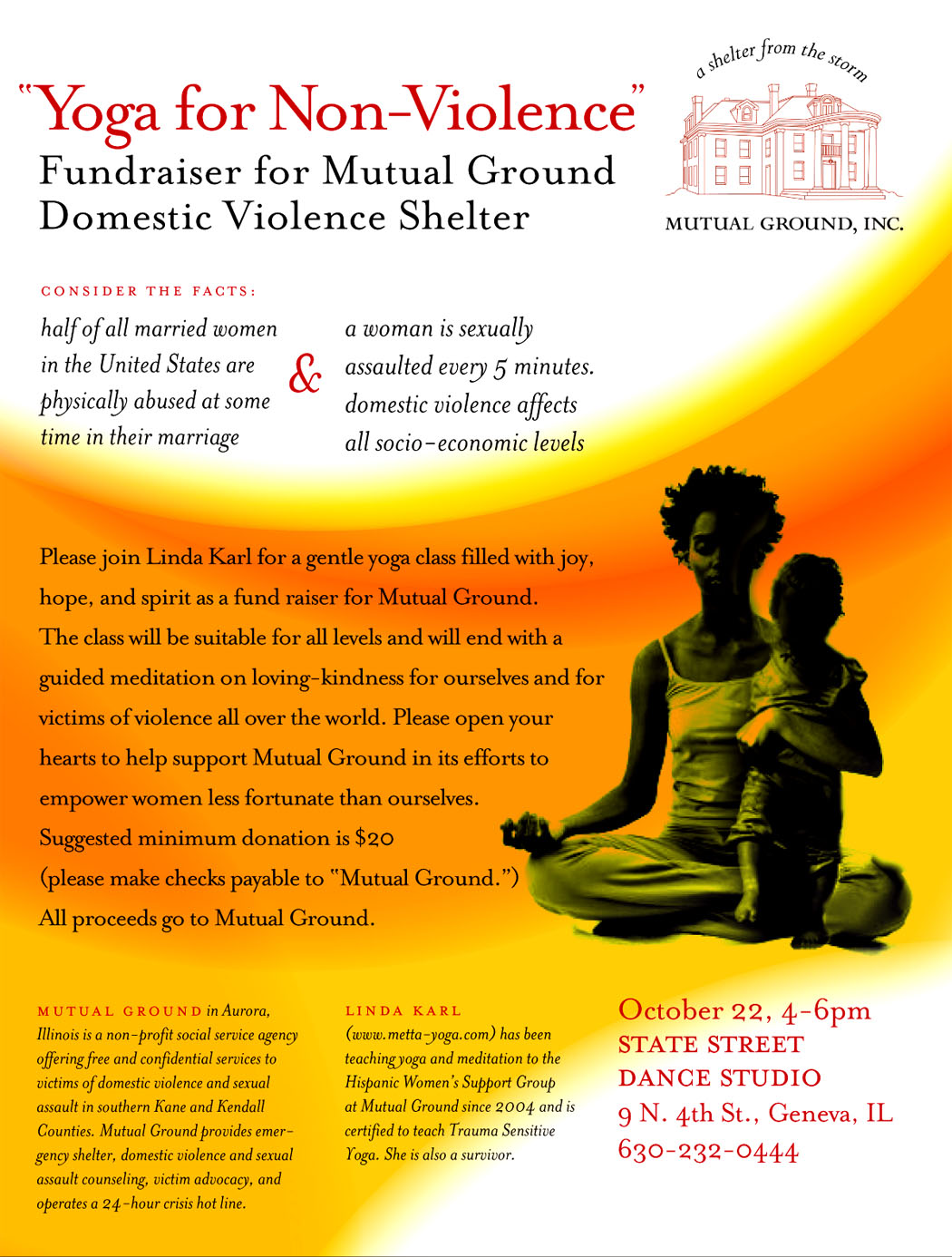 My long-time readers know that I have taught yoga and meditation at a domestic violence shelter as a volunteer since 2004. October is Domestic Violence Awareness Month so I have always tried to do a yoga fundraiser for the shelter. Many of you also know that I no longer teach at yoga studios so I have not been able to do this fundraiser for a while due to lack of a space. This year the director of the dance studio where I do Nia has generously offered her studio so I am back on track.
Getting local newspapers to take any interest in this has been close to impossible. In fact, getting ANY local people to take any interest in this is close to impossible.
So I am going global and I’m asking for money. Big money….because I want to start a consistent trauma sensitive yoga program at the shelter. If yoga bloggers can ask their readers for money to fund their teacher trainings or travels to yoga fests, I can also ask for some do-re-me. The money does not even have to go to me, it can go directly to the shelter to be specifically dedicated for a yoga program.
I am looking for socially-minded corporate sponsors, whether in Illinois or anywhere in the world, to help fund my proposed Trauma Sensitive Mind-Body Program. I study yoga therapy in India; I’m certified in Trauma Sensitive Yoga….I got the goods, people! All my yoga tools are for the women at the shelter.
My TSMB program will provide structured yoga sessions for domestic violence survivors to give them tools to address their habituated patterns and symptoms that lead to relapse into the cycle of trauma. I will offer a research-based yoga curriculum based on the ways in which mind-body practices facilitate traumatic stress recovery.
The shelter depends on grants and donations and the money goes toward keeping the doors open for the women. After 7 years of teaching only once a month, I finally sat down last month with the director to talk about starting a dedicated weekly or twice weekly yoga program. She said they would look for grants for money to fund my teaching but it will be a long process. I said that I was patient because after all, I’ve already been teaching there for 7 years.
I am not a non-profit organization (although I am looking into re-organizing as a “low profit” corporation, a new business entity) so I can not apply for grants on my own. Once I tried Kickstarter to help raise money, but they refused my project because it had nothing to do with the arts, it was not “creative” enough. Even the local yoga magazine has refused stories in spite of two of my students contacting the editor over the years. I’m calling you out, Yoga Chicago.
I admit it — I get a bit down when I see others get featured for their karma yoga projects. Not jealous because they are doing valuable work…just depressed because I’ve been doing the same thing for a long time and maybe if I got some news flash, some local money would flow into the shelter to start a program. Or maybe just some help or advice. Whatever. I just keep plugging away.
As naive as this sounds, I am looking for a benefactor for this program. A sugar daddy. Or mommy. An anonymous benefactor or maybe a rich person can leave us some money in their will. Another Oprah. Hey, Oprah! You had Rodney Yee on your show years ago and talked about how wonderful yoga is…so help a sister out, will ya?
Blech. I’m just tired of banging my head against the wall. It’s very tiring when you’re the only one doing this without any emotional support.
I know a lot people from all over the world read this blog. If you can help us out, contact me.
But in the meantime, if you are in the Fox Valley area of far west suburban Chicago, consider attending the First Yogathon for Victims of Domestic Violence. Nearly three out of four (74%) of Americans personally know someone who is or has been a victim of domestic violence.
Help some sisters out.
moving into joy

JOY: ETYMOLOGY:
Middle English joie, from Old French, from Latin gaudia, pl. of gaudium, joy, from gaud re, to rejoice…
Erich Schiffmann told us that it took him 12 years to write his book, Yoga: The Spirit and Practice of Moving into Stillness. It took us only 10 hours to move into joy in Yellow Springs, Ohio.
Erich’s book was one of the first yoga books I bought when I started my yoga journey and I had not looked at it for quite some time. His Moving Into Stillness workshop was this past weekend (his11th in Yellow Springs), so I pulled it off the closet shelf to remember to take it with me for his autograph. I wasn’t looking forward to a 6 hour ride to Ohio by myself so I thought reading some of it again would re-energize me for the trip — I ended up reading some excerpts to my class last week and I was right…I was rarin’ to go to Ohio and finally practice with Erich.
I must say that after all these years of yoga-ing, I have never attended such a joy-filled yoga weekend, and that’s saying a lot. My long time readers know with whom and where I study yoga but this weekend was very different. I’ve been to many trainings that are heavy on technique and philosophy but there hasn’t been a lot of pure unadulterated joy.
I recalled the trainings and sits I’ve done with Buddhist teachers and I can’t say there has been very much joy involved in those teachings either. While I am grateful for the buddhadharma in my life and it has liberated me more than I can explain, there is so much emphasis on suffering. Yes, I get it: life is suffering, pain is optional. In Buddhist meditation retreats, there is usually a lot of crying in the small discussion groups that one is always a part of — those tears are those of fear and grief and pain. I’ve never heard the word “joy” uttered in those situations and I almost feel guilty for embodying joy. But as for this weekend, it has been a very long time since I cried soul tears of joy in a yoga class — unless it’s my own solo practice at home.
Erich’s Freedom Style Yoga is described as “an intuitive approach to life and yoga that can be summarized as, ‘Do not decide in advance about what to do or not do. Instead, listen inwardly for guidance and trust into what you find yourself Knowing.’ This is not an inherently strenuous practice, but it is advanced. It requires that you be brave enough to follow your deepest impulses about what feels right and what doesn’t.”
Erich’s classes consisted of: him talking, meditation, a guided asana practice, a free form (“freedom style”) asana practice set to cool music (everyone from Alicia Keys to Pattabhi Jois chanting OM SHANTI), then savasana or more meditation, your choice. Choice!…instead of rules and “shoulds” and enough technicalities to choke a sacred cow.
Erich studied with both Iyengar and Desikachar and said that over time he morphed into his “freedom style” yoga. I loved that because the same has happened with me over the years for my own personal practice. I told Erich that I think I channeled him without ever having practiced with him or watching a video. Erich said that at first he did not know how to teach Freedom Style in classes, that when he asked people to do their own thing they were stuck and didn’t know how to do something that felt so natural to him. That was my first blown away moment during the weekend because as I later told Erich, the same thing happened to me. Once in a workshop I invited people (who were not beginners) to do their own yoga and everyone stood there and stared at me.
Erich does not throw out alignment rules but he believes that where your yoga training should culminate is where you flower into YOUR OWN YOGA. All the techniques and rules of yoga should lead you to YOUR YOGA. He compared learning yoga to learning music. Just like a beginning musician learns the rules of music and the notes and then creates their own song, so should we learn the notes of yoga to create our own practice. Make your yoga as simple as possible but that is easier said than done.
I laughed when Erich said that “advanced poses are overrated” and that we should be happy where we are in yoga, wherever we are at a certain point in time. He believes that yoga is about “being in your own space” and that we “need to get as strong as we need to be to be able to SIT.” Because yoga is not some type of “exotic P.E.” — yoga is and always was a spiritual discipline and some of the greatest yogis had little asana practice. For Erich, Yoga is an “inquiry into truth and the nature of life.”
Don’t decide in advance what you THINK you’re supposed to do. Listen inwardly for what to do and then dare to do what your most inner impulses tell you to do in yoga. Your practice should open you up to a willingness to trust yourself and to the realization that the Totality — the “Big Mind” as opposed to our “Small Mind” — is us. This is similar to what Mark Whitwell (another student of Desikachar — any wonder why I naturally connect with certain teachers?) speaks about, Yoga as the connection to the Nurturing Source, the Infinite. In yoga we learn to settle into ourselves in order to let go of our conditioning and to become the REAL YOU. We should dare to give expression to what is bubbling up inside us and again, this involves letting go of our biases and conditioning.
Erich emphasized again and again how we should think less and listen more. I recalled how I was chastised here for telling people to “shut up and do your practice.” That’s just another way of saying “Silent mind it”, as Erich calls it. Pause, ask God, Jesus, Buddha, or whomever your favorite Awakened One is for guidance, and then listen. Our deepest impulses, our intuition, our gut feelings…all of those are our connection with the Big Mind, the Totality, the Nurturing Source, the Infinite. Meditating is like clearing the mist or cleaning a foggy mirror, but we need to be clear that we indeed want a clearer perspective. Because if we have an unclear perspective it will be harder to interpret things as they come into our consciousness and we will respond to life inappropriately.
I loved it when Erich told us to just take moments each day to be still, to sit, to silent mind it. You don’t have to sit in lotus to think less and listen more. Stop the chatter, stop the analyzing. Just stop and engage in the old-fashioned advice of taking a minute to smell the roses. I thought about all the people I see who are walking in nature and playing with their smart phones. STOP! I was struck at the age range of the students — I would say most were 40+, even 50+, and I thought that the students who need to hear this yoga wisdom were the 20 and 30 somethings starting out in yoga.
Erich’s guided asana practice was not what some would call “advanced” with fancy pretzel poses. The emphasis was on working the spine and hips and I think the only standing pose we did was triangle. The difference was that the poses were repeated with various changes, going deeper each time. Just the way I like it, wringing it out.
It was in the free style practice where I blossomed. Erich played three or four songs and it was our own practice. Some sat, some took savasana, and I have no idea what those closest to me were doing, my intuition guided my movements. It was the perfect combination of movement and music that caused the soul tears of joy to flow. It has been a very long time that someone else’s class affected me like that: I was free to be me. When I sat after the practice my body literally vibrated from crown chakra to my feet, each day I felt like one huge glowing ball of prana. Interestingly enough, I developed a bad headache and nausea the first day which I attributed to experiencing a tremendous detox. I needed that practice.
Erich left us with the four sentences that he repeats daily. He said that when we wake up, before we get out of bed we should say these to ourselves in order to facilitate the connection with Big Mind:
- “Today I will make no decisions by myself” (this recognizes our limitations.)
- “I will make no decisions today because it is no longer intelligent to do so.”
- “I will make decisions in silent counsel with the Infinite.”
- “I will do what You have me do.” In other words: THY WILL BE DONE…because THY will is OUR will when we listen deeply.
Erich’s teaching resonated with me in a profoundly potent way because it was a validation of my own core yoga values. I have to say that the only other teaching I have felt that way about is Mark Whitwell’s: “The ancient wisdom of yoga teaches that Life is already given to you, you are completely loved, you are here now. It teaches that we are not separate, cannot be separate from nature, which sustains us in a vast interdependence with everything. The universe comes perfectly, and is awesome in its integration and infinite existence. This union is our natural state, this union is Yoga.”
I have studied with excellent technical teachers and those who can recite yoga philosophy chapter and verse, but there are few who touch the heart and the core of your Consciousness, the precious few who leave you weeping those soul tears of joy.
“Humans are More Than Hardware”
I always welcome guest writers at this blog, and today’s writer is Alex O’Malley whom I connected with when we did the Trauma Sensitive Yoga training together in Boston — and it’s always cool to meet your Facebook friends!
We both have an interest in yoga therapy so when she said she was attending SYTAR (Symposium on Yoga Therapy and Research) that is put on by the International Association of Yoga Therapists, I asked her to write about her experience this year.
Thank you, Alex!

“Aerin Alex O’Malley is a graduate student in Somatic Psychology at JFKU, CA. Having traveled extensively, she has practiced and taught yoga in many parts of the world and is currently based in San Francisco, CA, teaching privately. In the spirit of yoga she is excited by all styles and teachers, therapeutic uses of practice, and the power of conscious change. You can contact her at alex [AT] meeturfeet [DOT] com – www.meeturfeet.com ”
______________________________________________________
In September, 2011 I attended the International Journal of Yoga Therapy Symposium. Hosted by the International Association of Yoga Therapy (IAYT), it was an awesome event full of some of the brightest minds and yogis from around the world. It was held in Monterey, CA. at the Asilomar conference center. The gist of the symposium was to share empirical research that impacts not only how the established medical community is beginning to embrace yoga as a healing modality but also how the yoga community is beginning to recognize the power of the practices we share to make a somatic impression on every individual we encounter. What follows is a smattering of some of what I learned.
There are numerous studies in the works and recently published regarding the efficacy of yoga as a prescription for preventative healthcare, depression, anxiety, lymphedema, PTSD, ADD, insomnia, pain relief, and stress. The IAYT Journal has recently been accepted into the WEB MD publications as a source for healthcare alternatives. The IAYT itself is a member of the Academic Consortium for Complementary and Alternative Health Care (ACCAHC) and the National Ayurvedic Medical Association (NAMA). These relationships are important because they demonstrate the commitment to science within the Yoga Therapy community in order to more wholly blend ancient knowledge from the east with current western practices. As Yoga translates from the Sanskrit, to yoke, this blending represents a real time example of the changing paradigm from conventional mind-body dualism towards integration.
Doctor Rajmani Tiguanit, PHD, the spiritual head of the Himalayan Institute, addressed the symposium about the importance of defining therapy. He stressed the need to incorporate philosophy, psychology, and Metaphysics in training and treatment. As therapists, he said, it is our job to combine the components for treatment. There were a number of variations on this theme throughout the weekend. A woman from the Bible Belt talked about the gigantic church in her town which has denounced Yoga as devilish and asked for suggestions about how to present her work. Gary Kraftsow from the American Viniyoga Institue, suggested that in place of the word “yoga”, she introduce the use of “breath and stretching for relaxation.” This idea, that the use of language can reach an audience who would not be open to yoga is beautiful and again, incorporates all that is the essence of Yoga!
Technology has jumped by leaps and bounds over the last 25 years and has provided a window into the functions of the brain and connections between the brain and body. The key concepts that drive many of today’s researchers are that of neuroplasticity and awareness of the basic structure of the brain. Neuroplasticity refers to the capacity of the brain and the nervous system to “reprogram” messages/stimulation and interaction with the body and mind. Understanding the structure of the brain plays a crucial role in the ability of therapists to make choices about appropriate treatment. Here are some of the ways in which yogis, doctors and psychologists are incorporating the science to create more efficient, holistic treatments for patients with any number of emotional and physical challenges.
Shoosh Lettick Crotzer specializes in developing yoga practices for the prevention and treatment of Lymphedema, arthritis, MS, and fibromyalgia. At the symposium she shared a practice for breast cancer survivors, approximately 38% of who develop lymphedema.
Matt Fritts and Mona Bingham presented the work they are doing with the U.S. military to create a system called Total Force Fitness. This system incorporates yoga and mindfulness training into the traditional requirements for military readiness in order to build emotional stamina as well as physical. [“Humans are more than hardware” comes from Matt Fritts’ presentation: Yoga for Military and Veteran Populations, International Journal of Yoga Therapy Symposium. Asilomar, Monterey, CA. Sept, 2011.]
William Hutschmidt discussed his weekly yoga classes with homeless vets. One of every 4 veterans is homeless in the US. Hutschmidt’s yogic practice manifests as a relief from the constant stressor of homelessness and the emotional, physical, and psychological toll it can take.
Bo Forbes discussed the role of yoga as therapy in the treatment of mental health. She emphasized that yoga and psychotherapy are in the business of transformation and spoke to the need to narrow the gap between understanding the process of emotions and the real experience of change.
What each of these practitioners add to the working pool of knowledge is the connection of yoga to the treatment of physical ailments, preventative health care, and mental health respectively. It is exciting as a yoga teacher and practitioner to realize that so much of what has been only a felt sense of the power of yoga is being studied. The general takeaway from this symposium is that we can “change” our minds and in turn have an impact on our biology. In the age old argument over nature vs. nurture, it is becoming more and more evident that it is wise to include both and to nurture what we can on both the physiological and emotional levels for the most positive outcomes. Yoga Heals!
admit it…
…you know you’ve always wanted to say it.
 Linda's Yoga Journey
You must be logged in to post a comment.