the yogini cult — JAI MA!

The other day I read a misinformed comment on another blog about ancient yoga in India. The commenter said, in essence, that classical yoga would not have been taught to women because of India’s patriarchal society, that yoga in ancient times was for men only. I shook my head.

For one thing, I don’t think it’s a good thing to make such sweeping statements about Indian culture unless you’ve been there, more than once. Even then it would be hard to generalize. For another thing, it’s simply not true.

Krishnamacharyga taught Indra Devi. He was a strict Brahmin, but he taught vedic chanting to women believing that it was women who would carry on the vedic chant tradition, not men.

A difficult book to find, the Yogayajnavalyka Samhita written by the sage Yajnavalkya, is one of the oldest texts on yoga. It is a dialogue between the sage Yajnavalkya and his wife Gargi, who was considered one of the most learned women of those times. Gargi poses questions to her husband on how to reach the highest truth. The manuscript, translated by Krishnamacharya and then later translated into English by his son, Desikachar, is dedicated to “all great women.”

Yajnavalkya is considered one of the most important teachers in the Vedic tradition. His works are so vast that it can only be compared to those of the Veda Vyasa. He contributed to the Vedas through the Sukla Yajur Veda and the Brhadaranyaka Upanisad. His wife Gargi is mentioned in the Brhadaranyaka Upanisad as “a scholar in all the sastra-s”, as one of the women seekers of truth, and one who was very proficient in logic.

The only asanas mentioned in the book are: svastiknasana; gomukhasana; padmasana; virasana; simhasana; bhadrasana; muktasana; and mayurasana — because that one “removes all internal diseases and even the effect of poison.” You will note that all poses except peacock pose are seated poses.

So as for the statement about how yoga was only for men in the ancient times…uh, no. I think it behooves any yoga scholar or historian to move beyond what is traditionally taught and to investigate the rich yogini tradition of ancient India. Remember that there is both shiva-shakti, the lingam and the yoni.

I had read about the Temple of the 64 Yoginis (also called the Temple of the 64 Dakinis) in Hirapur, a village outside Bhubaneswar in the state of Orissa, and I knew I had to see it. These small temples were for tantric practices, for the acquisition of siddhis or “supernatural powers.” Yogini worship was seen predominately between 800 and 1300 AD.

From The Hindu:

“The cult of 64 yoginis as well as its occult and secret practices and philosophy are methodised by Matsyendranath (8th to 10th century AD) in his magnum opus, Kaulajnananimaya. He is associated with religious movements of medieval India and is revered in neighbouring countries like Nepal and Tibet.

The number of yoginis differ from one source to another but 64 appears to have been generally accepted. The principal yoginis, also known as Mother-Goddesses, are Brahmani, Mahesvari, Vaishnavi, Kaumari, Varahi, Indrani and Chamunda who according to the myths were created to the drink blood of demons….

A circular wall, hardly 2 metres in height, containing 64 niches within its inner circumference encompass this hypaethral yogini shrine. All except one of these contain an image of a yogini goddess. Some of them are delineated with voluptuous bodies, some with horrific shrunken features, still others with animal heads.”

I did not take any photos as sometimes I don’t feel right about doing that, depending on the temple. I wanted to experience things without being behind a lens. When we arrived we were told the significance of each yogini and then a puja was done for us. We were the only visitors and it was very special for me — I felt the energy of the little Kali behind me. Unlike the huge Tamil Nadu temples I am so familiar with, there are no soaring spires here. Thousands of years ago this was the beating heart of a primeval society, open to the elements but hidden from outsiders. Dedicated to worship of the Mother Goddess in all her forms, I felt safe. In one niche there was a female Ganesha, the yogini Ganesani. There were many others such a yogini with the face of a bear, and others wearing garlands of human heads or holding different weapons. There were also the familiar goddesses such as Lakshmi and Chamundi. The yoginis were regarded with both fear and awe.

An image of Shiva is also found here and there is a square slab that the priest told me is believed to have been used by wandering tantriks as a sacrificial altar. I climbed on top and immediately felt the urge to dance, the same way I wanted to dance when I felt the energy in the Park Street Cemetery in Kolkata. Something about those charnal grounds….

I’ve recently learned about the above book and I will definitely buy it to learn more about these powerful yoginis. “It appears that the worship of the Yoginis… was one of the significant, though less familiar, cults practiced by the Saktas who believed in the supremacy of Sakti or Power concentrated in the person of the Great Goddess.”

bhakti required

I find that the longer I practice, the longer I teach, and the more I meditate, the more I am drawn to bhakti yoga. maybe I should say that because of all of the above, my own bhakti has grown exponentially. I call myself Kali’s girl and when I was at a Krishna Das kirtan, he chanted the word “Kali” in a Durga mantra and at that moment it literally felt like I was hit right between my eyebrows and the tears started to flow. that’s bhakti. mantra chanting and kirtan are forms of bhakti yoga. I know a devout American Murugan bhakta who has never done one asana in his life, but he is a bhakti yogi.

I believe that bhakti, for the most part, is missing in Americanized yoga, at least in most of the classes I attend. I know that even chanting the single sound of OM can scare some people away from yoga — I’ve seen students leave classes if the teacher chants. I always open and close my classes with meditation and at the end recite the Four Immeasurables and chant OM MANI PEDME HUM. I would not be true to my heart if I did not teach this way.

So I give you the website Bhakti Collective. The Bhakti Collective is “composed of persons of various backgrounds with a common interest in bhakti, India’s tradition of devotional yoga. It is a non-profit organization based in New York, which serves as a medium for the exploration and sharing of the culture, philosophy and practice of bhakti.”

The Bhakti Collective has many interesting articles including this one, a critique on a Yoga Journal article about bhakti. in it, Kaustubha Das quotes Dr. Robert Svoboda’s feelings about bhakti in western yoga:

“Some Western yogis dabble in bhakti yoga through an occasional prayer or kirtan. But if you’re a serious practitioner looking to find union with the Divine, a more rigorous practice is in order.” Svoboda says the path of devotion involves total dedication and surrender.

Svoboda agrees that it’s good to sing bhajana (Sanskirt hymns) to get into a new space. But he cautions against thinking you can really engage in bhakti yoga by occasionally joining in a kirtan. “That in itself won’t be sufficient to have a transformative effect that will penetrate into the deepest and darkest parts of your being”, he says.

“I don’t think most people in the yoga community have a concept of the degree of emotional depth and intensity and texture that is necessary for bhakti yoga really to flower”.

Get out of your yoga body and get into some bhakti.

addthis_pub = ‘yogagal60510’;

my heart was torn open


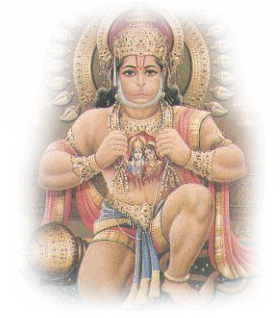
Hanuman

Last night I attended a kirtan by Krishna Das and my heart was torn open. I am still feeling the effects of the bhakti so excuse this writing as I am feeling a bit disjointed.

I sat listening with my eyes closed feeling the waves of his amazing voice pour over me. he sang a chant to Durga and when he chanted the word “Kali”, it felt like someone took their finger and hit me between my eyebrows, in my Third Eye, and tears started streaming down my face. immediately. uncontrollable. it is said that sometimes when a devotee merely sees a picture or hears the name of the Divine, the jolt is instantaneous. that is shakti.

When he chanted a mantra to Hanuman, all I saw in my mind was when I was in Rameswaram, India, standing on the roof of a small Kali temple, looking out into the ocean at sunset….

As I stood staring out into that ocean, I thought about Hanuman, the Monkey God, leaping across the ocean to rescue Sita in Lanka. I believed it was possible. pure compassion and love for Sita and for his lord, Rama.

I returned last week from sitting four days with the Dalai Lama in his teachings in Madison, Wisconsin. my heart was torn open by his compassion for a woman who discovered a lump in her breast on the last morning of his teachings.

During the afternoon sessions His Holiness took questions from the audience. his translator said that a woman wanted to ask a personal question. she said she had discovered a lump while bathing that morning and wondered whether she should tell her husband. she said her husband was a non-believer in anything and that two women in his family died of breast cancer. she wondered whether she should tell her husband because that would only create much suffering for him. she also said they had no health insurance.

His Holiness was visibly shaken. his concern was palpable, I could feel it from where I sat. he placed his hands together in the “namaste” gesture and said he was touched that the woman would ask him such a personal question. His Holiness said he did not know whether she should tell her husband, that it was her decision. he wondered if she could get government assistance. then he went back to the text he was teaching from, but I could tell that he was thinking about the question. he seemed distracted.

He stopped teaching and said, “about the woman with the lump….” and said that a doctor of Tibetan medicine was traveling with them for this trip. he said Tibetan medicine is very powerful and has been known to cure serious illnesses. he announced that if the woman was in the audience, that she should contact the doctor that is with His Holiness. pure compassion and love. the tears started streaming down my face. immediately. uncontrollable.

and my heart was torn open.

addthis_pub = ‘yogagal60510’;