more questions than answers


The New York Times article A Yoga Manifesto has really made the rounds of the yoga blogs with each blogger approaching the story a bit differently.

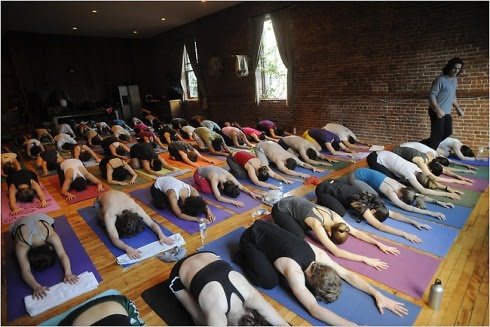
As I wrote here there is a new movement in yoga — moving away from the rock star yogi mentality to donation-based classes. Yoga to the People in New York City is riding the crest of this new wave.

On the surface I think it’s a great idea and I give YTTP founder Greg Gumucio mucho credit for what he has accomplished. I’ve always thought that yoga should be accessible for everyone and even more so for people in the lower-income bracket. But Roseanne raises an interesting question in her post about YTTP. Roseanne tried a YTTP class and has this to say about it:

“Their “manifesto” sounds good in theory ~ but my understanding of it changed when I actually experienced one of their classes in NYC last month. As I noted, the final effect was “discount” yoga, complete with fluorescent lighting and classic rock radio, rather than the DIY proletariat experience I had expected. After reading this article, I now know where the problem lies: ‘High volume is the key to [YTTP founder Greg Gumucio’s] business model — he says up to 900 people may go to a Yoga to the People studio in a single day….’

Sure, more people doing yoga is a good thing, but herding hundreds of them through a rotation of anonymous teachers in crowded studio classes… how does that improve the world? Especially when the spirituality, teacher-student relationship and, in my experience, quality are sacrificed in the name of economy.”

As I read her post some thoughts popped into my head: how many of the people going to the inexpensive classes can easily afford to pay the standard prices at a yoga studio, such as $15 or $17 a class? Are these inexpensive classes taking away from a small, independent, non-franchised studio that can not afford to price their classes at $8 or another lower rate? And if that small studio closes because of the cheaper competition and yoga teachers lose their jobs because cheap yoga put the studio out of business, how is that a good thing? Should we just chalk that up to good ol’ American marketplace economics? Cheaper will always bring in more people but is it really better?

I would rather see people doing donation-based yoga who truly can not afford standard yoga studio prices than the ones who only want a deal.

Living in my suburban area where it is difficult for a yoga studio to survive raised these questions for me. People live in $500,000+ houses (which in my area is a “starter home”) and drive Hummers, but many go to health clubs or gyms or park districts for yoga because it’s “free” (i.e., part of the membership) or the price is less than $10 a class. I’ve been teaching a long time and I’ve heard the rationalization of “why go to a studio when the gym yoga is free?” That attitude is one of the reasons that has kept me from opening a yoga studio — because there’s lots of cheap yoga around. A yoga studio is a business just like any other business and that would not be a good business decision.

Just throwin’ the questions out there…talk amongst yourselves.

addthis_pub = ‘yogagal60510’;

hand me that Anusara and a chicken wing


When a product with a well-known brand name is seen in a movie or television show, that’s called “product placement”: “product placement, or embedded marketing, is a form of advertisement, where branded goods or services are placed in a context usually devoid of ads, such as movies, the story line of television shows, or news programs. The product placement is often not disclosed at the time that the good or service is featured.” An example of product placement would be when the characters are drinking Budweiser beer and eating Kentucky Fried Chicken and the labels are featured prominately so you don’t miss them. Companies typically pay for product placement.

What a surprise then when one of the characters who was under suspicion for murdering his girlfriend in this week’s episode of Law and Order: Special Victims’ Unit (“Beef”) say he was an Anusara yoga teacher. Not just any old yoga teacher, but an ANUSARA yoga teacher. The writers made sure to have the character tell detectives Elliot and Oliva that his yoga teaching was all about “grace” (John Friend’s tagline for his trademarked style of yoga) so how could he possibly be a murderer? Wow. It’s usually cigarettes and booze that are product placements, but now yoga? Ah….yoga in America.

Sounds like someone on the Law and Order: SVU staff digs Anusara because why was character an ANUSARA yoga teacher, not just a plain vanilla yoga teacher? Being an ANUSARA yoga teacher added nothing to the plot, a non-branded yoga teacher character would have worked just the same. Of course, only someone who knows about Anusara yoga and who was listening carefully would have caught the reference. It would have gone over the head of someone who knows nothing about trademarked yoga, but it made me go “hmmmmmm…….” Just sayin’.

So it was a breath of fresh air to read the New York Times story A Yoga Manifesto about yoga’s “new wave” of “a brewing resistance to…the cult of personality,”, i.e., the rock star yogis. Years ago I did a weekend workshop with John Friend before he was filling up the huge halls and he had an entourage of yoga groupies students that would rival any rock star.

From the NYT article:

“And is it surprising that yoga, like so much else in this age of celebrity, now has something of a star system, with yoga teachers now almost as recognizable as Oscar winners? The flowing locks of Rodney Yee. The do-rag bandanna worn by Baron Baptiste. The hyper perpetual calm exhibited by David Life and Sharon Gannon, who taught Sting, Madonna and Russell Simmons. The contortions (and Rolls-Royces) of Bikram Choudhury.

…’The irony is that yoga, and spiritual ideals for which it stands, have become the ultimate commodity,’ Mark Singleton, the author of Yoga Body: The Origins of Modern Posture Practice, wrote in an e-mail message this week. ‘Spirituality is a style, and the ‘rock star’ yoga teachers are the style gurus.'”

The article speaks about the success of Yoga to the People, the New York yoga business that is at the forefront of the “no rock star yogis” yoga. While Yoga to the People has a contribution-only, pay-what-you-can fee structure, apparently it’s a cash cow for Greg Gumucio. He has three studios in New York (including two hot-yoga studios that charge $8 a class), one in San Francisco, one in Berkeley, and one scheduled to open in Brooklyn. He is considering expanding to Austin, Chicago, and Los Angeles. I say good for him because it’s a great idea.

The irony of success is that Greg Gumacio and his brand of “yoga for the people” will become as popular and as well-known as any rock star yogi.

What say you about the mention of Anusara yoga (albeit in an off-hand way) in a primetime television show? Does it go along with what Mark Singleton said in the NY Times article that “yoga, and spiritual ideals for which it stands, have become the ultimate commodity”, something to be sold just like a pack of cigarettes or a jeans label? Why not have commercials for all the name brands: Forrest, Jivamukti, Core Fusion, YogaFit, and of course, Bikram. I bet the ad agencies would line up to get a piece of that pie.

This post is not about Anusara yoga or John Friend. Replace those words with any other trademarked and name brand yoga and the post would be the same. The selling of yoga as a commodity.

As Tony Soprano would said, whaddayagonnado?

UPDATE:

uh oh….they’re on to me! from site meter: “Atlanta, Georgia arrived from mail.anusara.com on ‘linda’s yoga journey’.” I’d better lock the doors and pull the shades.

….wait…I hear a mob outside….instead of fire and pitchforks they’re all holding Shiva’s tridents that have been set on fire….quick! help me! they are banging down the doors yelling “GET HER!!” AAAARGHHHHH!! Save yourself!

addthis_pub = ‘yogagal60510’;