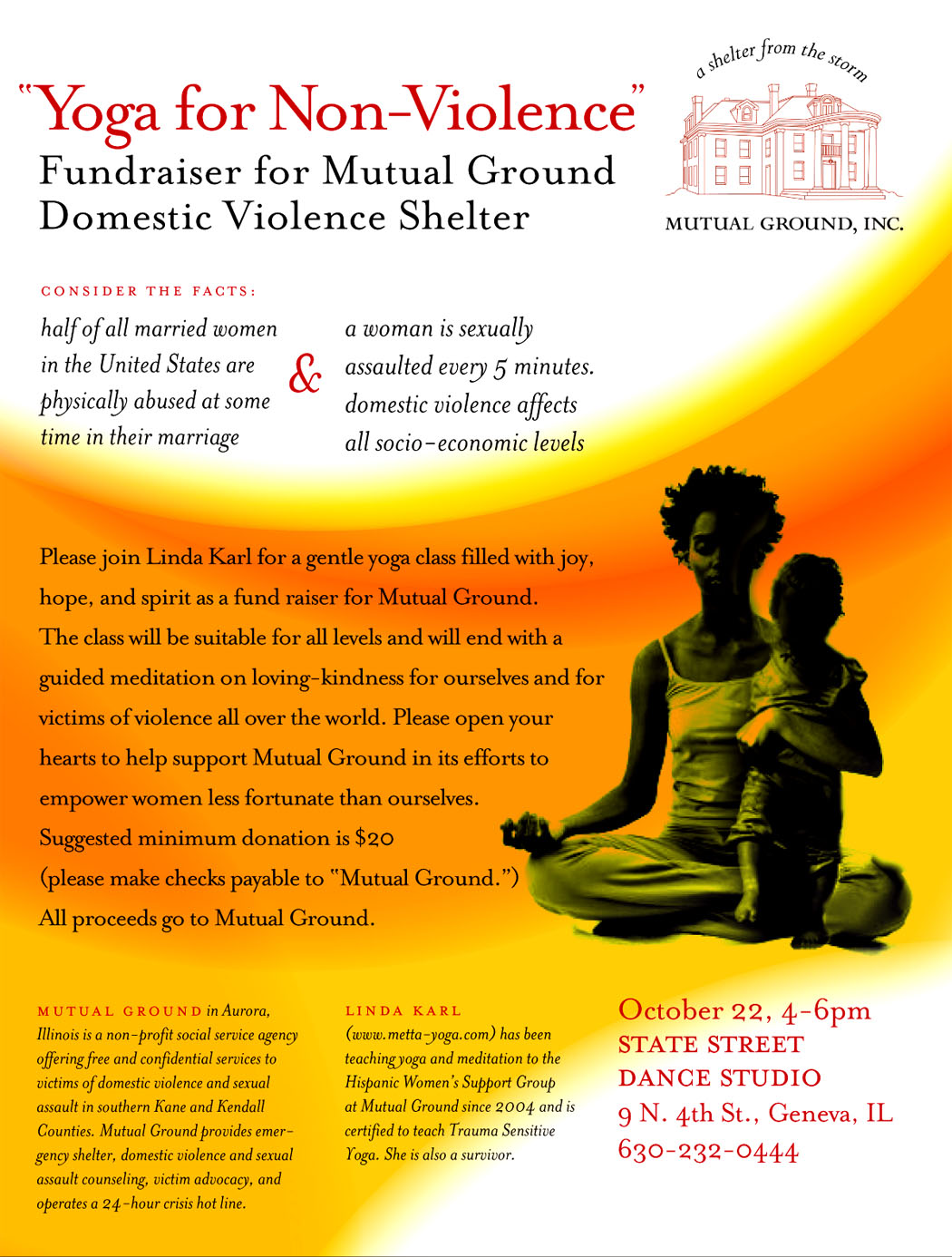
1st Yogathon for Victims of Domestic Violence

My long-time readers know that I have taught yoga and meditation at a domestic violence shelter as a volunteer since 2004.  October is Domestic Violence Awareness Month so I have always tried to do a yoga fundraiser for the shelter.  Many of you also know that I no longer teach at yoga studios so I have not been able to do this fundraiser for a while due to lack of a space.  This year the director of the dance studio where I do Nia has generously offered her studio so I am back on track.

Getting local newspapers to take any interest in this has been close to impossible.  In fact, getting ANY local people to take any interest in this is close to impossible.

So I am going global and I’m asking for money.  Big money….because I want to start a consistent trauma sensitive yoga program at the shelter.  If yoga bloggers can ask their readers for money to fund their teacher trainings or travels to yoga fests, I can also ask for some do-re-me.  The money does not even have to go to me, it can go directly to the shelter to be specifically dedicated for a yoga program.

I am looking for socially-minded corporate sponsors, whether in Illinois or anywhere in the world, to help fund my proposed Trauma Sensitive Mind-Body Program.  I study yoga therapy in India; I’m certified in Trauma Sensitive Yoga….I got the goods, people!  All my yoga tools are for the women at the shelter.

My TSMB program will provide structured yoga sessions for domestic violence survivors to give them tools to address their habituated patterns and symptoms that lead to relapse into the cycle of trauma.  I will offer a research-based yoga curriculum based on the ways in which mind-body practices facilitate traumatic stress recovery.

The shelter depends on grants and donations and the money goes toward keeping the doors open for the women.  After 7 years of teaching only once a month, I finally sat down last month with the director to talk about starting a dedicated weekly or twice weekly yoga program.  She said they would look for grants for money to fund my teaching but it will be a long process.  I said that I was patient because after all, I’ve already been teaching there for 7 years.

I am not a non-profit organization (although I am looking into re-organizing as a “low profit” corporation, a new business entity) so I can not apply for grants on my own.  Once I tried Kickstarter to help raise money, but they refused my project because it had nothing to do with the arts, it was not “creative” enough.  Even the local yoga magazine has refused stories in spite of two of my students contacting the editor over the years.  I’m calling you out, Yoga Chicago.

I admit it — I get a bit down when I see others get featured for their karma yoga projects.  Not jealous because they are doing valuable work…just depressed because I’ve been doing the same thing for a long time and maybe if I got some news flash, some local money would flow into the shelter to start a program.  Or maybe just some help or advice.  Whatever.  I just keep plugging away.

As naive as this sounds, I am looking for a benefactor for this program.  A sugar daddy.  Or mommy.  An anonymous benefactor or maybe a rich person can leave us some money in their will.  Another Oprah.  Hey, Oprah!  You had Rodney Yee on your show years ago and talked about how wonderful yoga is…so help a sister out, will  ya?

Blech.  I’m just tired of banging my head against the wall.  It’s very tiring when you’re the only one doing this without any emotional support.

I know a lot people from all over the world read this blog.  If you can help us out, contact me.

But in the meantime, if you are in the Fox Valley area of far west suburban Chicago, consider attending the First Yogathon for Victims of Domestic Violence.  Nearly three out of four (74%) of Americans personally know someone who is or has been a victim of domestic violence.

Help some sisters out.

moving into joy

soakin' in the shakti

JOY: ETYMOLOGY:
Middle English joie, from Old French, from Latin gaudia, pl. of gaudium, joy, from gaudre, to rejoice

Erich Schiffmann told us that it took him 12 years to write his book, Yoga: The Spirit and Practice of Moving into Stillness.  It took us only 10 hours to move into joy in Yellow Springs, Ohio.

Erich’s book was one of the first yoga books I bought when I started my yoga journey and I had not looked at it for quite some time.  His Moving Into Stillness workshop was this past weekend (his11th in Yellow Springs), so I pulled it off the closet shelf to remember to take it with me for his autograph.  I wasn’t looking forward to a 6 hour ride to Ohio by myself so I thought reading some of it again would re-energize me for the trip — I ended up reading some excerpts to my class last week and I was right…I was rarin’ to go to Ohio and finally practice with Erich.

I must say that after all these years of yoga-ing, I have never attended such a joy-filled yoga weekend, and that’s saying a lot.  My long time readers know with whom and where I study yoga but this weekend was very different.  I’ve been to many trainings that are heavy on technique and philosophy but there hasn’t been a lot of pure unadulterated joy.

I recalled the trainings and sits I’ve done with Buddhist teachers and I can’t say there has been very much joy involved in those teachings either.  While I am grateful for the buddhadharma in my life and it has liberated me more than I can explain, there is so much emphasis on suffering.  Yes, I get it: life is suffering, pain is optional.  In Buddhist meditation retreats, there is usually a lot of crying in the small discussion groups that one is always a part of — those tears are those of fear and grief and pain.  I’ve never heard the word “joy” uttered in those situations and I almost feel guilty for embodying joy.  But as for this weekend, it has been a very long time since I cried soul tears of joy in a yoga class — unless it’s my own solo practice at home.

Erich’s Freedom Style Yoga is described as “an intuitive approach to life and yoga that can be summarized as, ‘Do not decide in advance about what to do or not do.  Instead, listen inwardly for guidance and trust into what you find yourself Knowing.’  This is not an inherently strenuous practice, but it is advanced. It requires that you be brave enough to follow your deepest impulses about what feels right and what doesn’t.”

Erich’s classes consisted of: him talking, meditation, a guided asana practice, a free form (“freedom style”) asana practice set to cool music (everyone from Alicia Keys to Pattabhi Jois chanting OM SHANTI), then savasana or more meditation, your choice.  Choice!…instead of rules and “shoulds” and enough technicalities to choke a sacred cow.

Erich studied with both Iyengar and Desikachar and said that over time he morphed into his “freedom style” yoga.  I loved that because the same has happened with me over the years for my own personal practice.  I told Erich that I think I channeled him without ever having practiced with him or watching a video.  Erich said that at first  he did not know how to teach Freedom Style in classes, that when he asked people to do their own thing they were stuck and didn’t know how to do something that felt so natural to him.  That was my first blown away moment during the weekend because as I later told Erich, the same thing happened to me.  Once in a workshop I invited people (who were not beginners) to do their own yoga and everyone stood there and stared at me.

Erich does not throw out alignment rules but he believes that where your yoga training should culminate is where you flower into YOUR OWN YOGA.  All the techniques and rules of yoga should lead you to YOUR YOGA.  He compared learning yoga to learning music.  Just like a beginning musician learns the rules of music and the notes and then creates their own song, so should we learn the notes of yoga to create our own practice.  Make your yoga as simple as possible but that is easier said than done.

I laughed when Erich said that “advanced poses are overrated” and that we should be happy where we are in yoga, wherever we are at a certain point in time.  He believes that yoga is about “being in your own space” and that we “need to get as strong as we need to be to be able to SIT.”  Because yoga is not some type of “exotic P.E.” — yoga is and always was a spiritual discipline and some of the greatest yogis had little asana practice.  For Erich, Yoga is an “inquiry into truth and the nature of life.”

Don’t decide in advance what you THINK you’re supposed to do.  Listen inwardly for what to do and then dare to do what your most inner impulses tell you to do in yoga.  Your practice should open you up to a willingness to trust yourself and to the realization that the Totality — the “Big Mind” as opposed to our “Small Mind” — is us.  This is similar to what Mark Whitwell (another student of Desikachar — any wonder why I naturally connect with certain teachers?) speaks about, Yoga as the connection to the Nurturing Source, the Infinite.  In yoga we learn to settle into ourselves in order to let go of our conditioning and to become the REAL YOU.  We should dare to give expression to what is bubbling up inside us and again, this involves letting go of our biases and conditioning.

Erich emphasized again and again how we should think less and listen more.  I recalled how I was chastised here for telling people to “shut up and do your practice.”  That’s just another way of saying “Silent mind it”, as Erich calls it.  Pause, ask God, Jesus, Buddha, or whomever your favorite Awakened One is for guidance, and then listen.  Our deepest impulses, our intuition, our gut feelings…all of those are our connection with the Big Mind, the Totality, the Nurturing Source, the Infinite.  Meditating is like clearing the mist or cleaning a foggy mirror, but we need to be clear that we indeed want a clearer perspective.  Because if we have an unclear perspective it will be harder to interpret things as they come into our consciousness and we will respond to life inappropriately.

I loved it when Erich told us to just take moments each day to be still, to sit, to silent mind it.  You don’t have to sit in lotus to think less and listen more.  Stop the chatter, stop the analyzing.  Just stop and engage in the old-fashioned advice of taking a minute to smell the roses.  I thought about all the people I see who are walking in nature and playing with their smart phones.  STOP!  I was struck at the age range of the students — I would say most were 40+, even 50+, and I thought that the students who need to hear this yoga wisdom were the 20 and 30 somethings starting out in yoga.

Erich’s guided asana practice was not what some would call “advanced” with fancy pretzel poses.  The emphasis was on working the spine and hips and I think the only standing pose we did was triangle.  The difference was that the poses were repeated with various changes, going deeper each time.  Just the way I like it, wringing it out.

It was in the free style practice where I blossomed.  Erich played three or four songs and it was our own practice.  Some sat, some took savasana, and I have no idea what those closest to me were doing, my intuition guided my movements.  It was the perfect combination of movement and music that caused the soul tears of joy to flow.  It has been a very long time that someone else’s class affected me like that: I was free to be me.  When I sat after the practice my body literally vibrated from crown chakra to my feet, each day I felt like one huge glowing ball of prana.  Interestingly enough, I developed a bad headache and nausea the first day which I attributed to experiencing a tremendous detox.  I needed that practice.

Erich left us with the four sentences that he repeats daily.  He said that when we wake up, before we get out of bed we should say these to ourselves in order to facilitate the connection with Big Mind:

  • “Today I will make no decisions by myself” (this recognizes our limitations.)
  • “I will make no decisions today because it is no longer intelligent to do so.”
  • “I will make decisions in silent counsel with the Infinite.”
  • “I will do what You have me do.”  In other words: THY WILL BE DONE…because THY will is OUR will when we listen deeply.

Erich’s teaching resonated with me in a profoundly potent way because it was a validation of my own core yoga values.  I have to say that the only other teaching I have felt that way about is Mark Whitwell’s: “The ancient wisdom of yoga teaches that Life is already given to you, you are completely loved, you are here now. It teaches that we are not separate, cannot be separate from nature, which sustains us in a vast interdependence with everything. The universe comes perfectly, and is awesome in its integration and infinite existence. This union is our natural state, this union is Yoga.”

I have studied with excellent technical teachers and those who can recite yoga philosophy chapter and verse, but there are few who touch the heart and the core of your Consciousness, the precious few who leave you weeping those soul tears of joy.

“Humans are More Than Hardware”

I always welcome guest writers at this blog, and today’s writer is Alex O’Malley whom I connected with when we did the Trauma Sensitive Yoga training together in Boston — and it’s always cool to meet your Facebook friends!

We both have an interest in yoga therapy so when she said she was attending SYTAR (Symposium on Yoga Therapy and Research) that is put on by the International Association of Yoga Therapists, I asked her to write about her experience this year.

Thank you, Alex!

healing hands

“Aerin Alex O’Malley is a graduate student in Somatic Psychology at JFKU, CA.  Having traveled extensively, she has practiced and taught yoga in many parts of the world and is currently based in San Francisco, CA, teaching privately.  In the spirit of yoga she is excited by all styles and teachers, therapeutic uses of practice, and the power of conscious change.  You can contact her at alex [AT] meeturfeet [DOT] com –  www.meeturfeet.com

______________________________________________________

In September, 2011 I attended the International Journal of Yoga Therapy Symposium.  Hosted by the International Association of Yoga Therapy (IAYT), it was an awesome event full of some of the brightest minds and yogis from around the world.  It was held in Monterey, CA. at the Asilomar conference center.  The gist of the symposium was to share empirical research that impacts not only how the established medical community is beginning to embrace yoga as a healing modality but also how the yoga community is beginning to recognize the power of the practices we share to make a somatic impression on every individual we encounter.  What follows is a smattering of some of what I learned.

There are numerous studies in the works and recently published regarding the efficacy of yoga as a prescription for preventative healthcare, depression, anxiety, lymphedema, PTSD, ADD, insomnia, pain relief, and stress.  The IAYT Journal has recently been accepted into the WEB MD publications as a source for healthcare alternatives.  The IAYT itself is a member of the Academic Consortium for Complementary and Alternative Health Care (ACCAHC) and the National Ayurvedic Medical Association (NAMA).  These relationships are important because they demonstrate the commitment to science within the Yoga Therapy community in order to more wholly blend ancient knowledge from the east with current western practices.  As Yoga translates from the Sanskrit, to yoke, this blending represents a real time example of the changing paradigm from conventional mind-body dualism towards integration.

Doctor Rajmani Tiguanit, PHD, the spiritual head of the Himalayan Institute, addressed the symposium about the importance of defining therapy.  He stressed the need to incorporate philosophy, psychology, and Metaphysics in training and treatment.  As therapists, he said, it is our job to combine the components for treatment.  There were a number of variations on this theme throughout the weekend.  A woman from the Bible Belt talked about the gigantic church in her town which has denounced Yoga as devilish and asked for suggestions about how to present her work.  Gary Kraftsow from the American Viniyoga Institue, suggested that in place of the word “yoga”, she introduce the use of “breath and stretching for relaxation.”  This idea, that the use of language can reach an audience who would not be open to yoga is beautiful and again, incorporates all that is the essence of Yoga!

Technology has jumped by leaps and bounds over the last 25 years and has provided a window into the functions of the brain and connections between the brain and body.  The key concepts that drive many of today’s researchers are that of neuroplasticity and awareness of the basic structure of the brain.  Neuroplasticity refers to the capacity of the brain and the nervous system to “reprogram” messages/stimulation and interaction with the body and mind.  Understanding the structure of the brain plays a crucial role in the ability of therapists to make choices about appropriate treatment.  Here are some of the ways in which yogis, doctors and psychologists are incorporating the science to create more efficient, holistic treatments for patients with any number of emotional and physical challenges.

Shoosh Lettick Crotzer specializes in developing yoga practices for the prevention and treatment of Lymphedema, arthritis, MS, and fibromyalgia.  At the symposium she shared a practice for breast cancer survivors, approximately 38% of who develop lymphedema.

Matt Fritts and Mona Bingham presented the work they are doing with the U.S. military to create a system called Total Force Fitness.  This system incorporates yoga and mindfulness training into the traditional requirements for military readiness in order to build emotional stamina as well as physical.  [“Humans are more than hardware” comes from Matt Fritts’ presentation: Yoga for Military and Veteran Populations, International Journal of Yoga Therapy Symposium. Asilomar, Monterey, CA. Sept, 2011.]

William Hutschmidt discussed his weekly yoga classes with homeless vets.  One of every 4 veterans is homeless in the US.  Hutschmidt’s yogic practice manifests as a relief from the constant stressor of homelessness and the emotional, physical, and psychological toll it can take.

Bo Forbes discussed the role of yoga as therapy in the treatment of mental health.  She emphasized that yoga and psychotherapy are in the business of transformation and spoke to the need to narrow the gap between understanding the process of emotions and the real experience of change.

What each of these practitioners add to the working pool of knowledge is the connection of yoga to the treatment of physical ailments, preventative health care, and mental health respectively.  It is exciting as a yoga teacher and practitioner to realize that so much of what has been only a felt sense of the power of yoga is being studied.  The general takeaway from this symposium is that we can “change” our minds and in turn have an impact on our biology.  In the age old argument over nature vs. nurture, it is becoming more and more evident that it is wise to include both and to nurture what we can on both the physiological and emotional levels for the most positive outcomes.  Yoga Heals!

admit it…

…you know you’ve always wanted to say it.

wisdom from my teacher: “Spinal Exercise”

Here is the latest newsletter from my teacher, Srivatsa Ramaswami, the yoga master I met in 2003 who inspired me to travel to the heart of yoga.  Here also are links to his newsletters from 2009 and 2010, a wealth of yoga information from the longest standing student of Sri Krishnamacharya:

Ramaswami’s Newsletters Vol. 1

Ramaswami’s Newsletters Vol. 2

Each volume has a search function, so you can search for “mudra”, for example, and find 15 references.  Thanks to Krisztian Krutzler for preparing these downloadable docs.

If you are in the Chicago area and want to study with a true  yoga master, come to the Chicago Yoga Center, September 9-18.  Ramaswamiji will offer a two hour program on mantras on the 9th and a 10 hour program on the last two chapters of the Yoga Sutras on 10th and 11th. There is also a 25 hour certificate program on Core Vinyasakrama asanas and a 10 hour program on asana, pranayama and meditation on the 17th and 18th.

_________________________________________________________________________
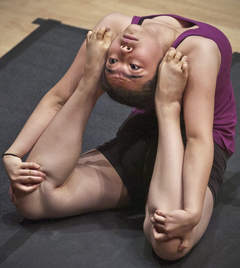
SPINAL EXERCISE, THE BOTTOM OF IT

I have not been writing about Asanas for quite sometime.  I have covered a lot of ground in my Vinyasakrama book and also in the earlier book, Yoga for Three Stages of Life.  I thought though I could write about asana again- of course, nothing entirely new but a
different angle.

It is said that one of the main aims of asana and pranayama practice (Hata Yoga) is to maintain the health of the backbone.  It is a common refrain that one is as old as the condition of the backbone.  And some of the most charming postures of yoga involve the many positions of the spine.  Parsva Bhangi, Matsyendrasana, Akunchanasana, Kapotasana.  Paschimatanasana and a host of other poses bring out the majesty and
the versatility of one of God’s marvelous engineering creations called the spine.

The spine has been the center of attention of several systems, like the chiropractics. Among Yogis, Kundalini Yoga and Hata Yoga can be considered to be spine centric.  The one bone assembly, the backbone is not straight but one that is curved back(kyphosis) and forward (lordosis) and the yogis try to make it straight at least during the time they sit and meditate so that the Kundalini is aroused and moved through the sushumna in the spinal column as per the Kundalini Yoga or the integrated prana moves through the sushumna as the Hatayogis explain hatayoga.

The spine can be divided into different sections for study and practice.  The bottom is the tailbone or coccyx which is curved and has three to five tiny vertebrae.  It stays beneath the pelvis.  There is some mobility in it but we do not pay much attention to it until one
falls on the butts.  A few years back, already an old man, I tried to carry a teapoy down the stairs in my house.  I was wearing hard slippers and as I overstepped a step I slipped (I had the slippers on, you see) and fell heavily on my butts.  The teapoy (tea table) broke and we had to discard it.  I was in great pain.  My wife took me to a hospital immediately for a precautionary X ray which did not reveal any damage (not broken like the furniture).  But the orthopedist warned me that I may have some recurring pain in the coccyx region when I sit for a long time.  For a period of time whenever I did long travel, like from NJ to Los Angeles, I used to feel a lot of pain sitting.  So I know where the tailbone is.

The backbone although it is one assembly has different sections each having its own idiosyncrasy, so when exercising the backbone one has to pay attention to each section. The tailbone/coccyx, sacrum, lumbar, thoracic and cervical sections have their distinct characteristics.  The muladhara chakra is associated with coccyx, the svadhishtana
chakra is linked to the sacral region, the manipuraka with the lumbar region, then we have anahata with the thoracic spine and the vishuddhi chakra is in the cervical region.  The spinal column descends from the occipital region and we have the aajna chakra in that region and the sahasrara is in the cranial region.  The tailbone is the baby of the
assembly at the bottom and tucked nicely but is surrounded by heavy muscles and tissues and protected well.  It has some mobility.  Since it is the root of the spine it is also known among Yogis as the Mula.  Since both Hata Yoga and Kundalini Yoga are predominantly connected with the spine the mula becomes an important aspect of yoga. When one wants to work with the spine, it, the coccyx, should be firmly anchored.

Let us consider the example of the fishing rod (old times).  It has a flexible pole, a string and the bait. (sorry I could not think of an ahimsa example).  One holds the pole at the far end and when the bait is taken, the pole bends. The fisherman will have to hold the pole firmly so that the pole can bend to the extent required, even though there will be some play or movement in the hand of the holder.  Further he has to hold at the farthest point, holding a bit inside the pole reduces the leverage and the pole will not bend sufficiently.

The coccyx and sacrum (sacro-coccygeal section) are at the bottom of the backbone. The coccyx is at the very end of the spine.  It represents a vestigial tail (hence the common term tailbone) and consists of three to five very small bones fused together. There is limited movement between these bones permitted by fibrous joints and ligaments. The sacrum is a large triangular bone at the base of the spine and at the upper and back part of the pelvic cavity and where it is ‘inserted’ like a bone wedged between the two hip bones. Its upper part  is connected to the last lumbar vertebra and the bottom part to
the coccyx.   In children it consists normally of five unfused vertebrae which begin fusing around 16 years and become completely fused around 26.  It is kyphotic (curved, concavity facing forward). Even so, it is now an established fact that the sacrum moves between the ilia by both ambulatory and respiratory motions.  It would therefore point to the
logic of the use of fuller breathing in vinyasa movements as in Vinyasa Krama.

So the mula or the tail bone will have to be held firmly during the spinal exercises.  And the yogis used the well known technique called mulabandha which is contracting a few groups of muscles surrounding the tailbone:  the perineum, rectum and the gluteal muscles.  All
spinal movements, the forward bend,the rounded back, the turn, the back bend, the side bend, all will be better if the mula is gripped firmly and engaged.

Now let us consider the different types of spinal movements.  The turning or twisting movement has to emanate from the mula and my Guru had a couple of asana vinyasas to provide for this movement.  The Jataraparivrittis efficiently engage the tailbone and the next
immediate section sacrum.  Please refer to my book The Complete book of Vinyasa Yoga (pages 105,106,119,121,122).  Tatakamudra (page 105) by anchoring the sacro-coccygial portion of the spine helps to stretch it. These are some of the very early exercises my Guru used to teach to almost all the students.

For the back bending exercises it is necessary to protect the lumbar spine. Towards that, the flexibility and the strength of the sacro-coccygeal region is to be necessarily cultivated. The pelvic push is efficiently facilitated by a simple but effective asana called dwipadapeetam (pages109-115) or desk pose.  This posture which is casually practiced with the feet apart and thighs spread out leaves out the the spine in the pelvic region. Hence it is necessary to keep the feet together, tighten the gluteal muscles, draw in the rectum and gently push the tailbone/sacrum up and feel a healthy stretch at the
bottom of the spine. Any back bending done without fully involving the sacro coccygial region is a less efficient back bend and tends to put more strain on the lumbar spine. Again my Guru used this posture to teach to almost anyone.  This upward pelvic push is to be done on inhalation generally but, it can be done while exhaling smoothly by the elderly, the obese, the pregnant, the highly strung etc.  Because the feet and back of the head are well anchored it becomes easy to control the back bend very well and one can improve the stretch step by step.  Other poses that are in this group would be catushpada peetam
or Table pose ( page79 ) and Purvatanasana or the anterior stretch pose (pages78,79). The other back-bends in the prone poses such as Bhujangasana, dhanurasana and salabhasana (pages 138-145) also may be done with the thighs and feet together to keep the sacrum and tailbone engaged and stretchered.  To ensure this condition, the teacher may ask the student to keep the feet and thighs together by placing a piece of paper between the feet  and not let the paper drop to the floor while raising the legs up in asana like Salabhasana.  In these prone exercises keeping the legs together enables to exercise all parts of the spine, especially the oft neglected sacro-coccygeal area.

The sacral/pelvic tilt also is an important movement in the context of forward bending.  This is achieved best in balasana or forward bend in Vajrasana (page 179,180) first and then in paschimatanasana (page 75-77) or the posterior stretch pose.  Those who are able to engage the muscles surrounding the sacrum and coccyx are able to achieve a good forward bend facilitated by the tilting or tipping of the pelvis. One procedure that will be helpful is for the teacher or a friend to support the sacrum with both the hands and push forward and down on exhalation and allow the subject to return to dandasana on inhalation while still maintaining the healthy pressure.  It may be good to maintain the pressure for a while in the posture pushing forward and down on each long exhalation and then holding it on inhalation.  Over a period the practitioner would be able to use the group of muscles at the base of the spine and stretch the muscles of the sacral region.

Then we have the important movement of lifting and holding the tailbone/sacrum up, by pulling up the waist and hips.  Here the muscles of the hip joints are brought into play.  This can be done in the beginning of tadansana sequence itself.  When the subject raises the
arms (page 4-5), he or she can get a partner to hold the pelvic girdle below the hip joints and push the pelvis up.  This helps to stretch the pelvic and hip muscles up and along with that the sacrum and tail bone also move up a little bit and it will be easy to stretch the
supporting musculature.  One can do the movements a few times with the helper holding the pelvis up a little while the arms are brought down on exhalation and pulling the pelvis up when one raises the arms on inhalation.  Over a period of time the practitioner, while raising the arms, will engage the hip muscles and gently pull the pelvis along with the sacro coccygeal portion of the spine. Sri Krishnamacharya would frequently exhort the student to pull up and hold the hips up in several seated postures like parvatanasana (page 196) and dandasana (page 39).  He would say in Tamil “iduppai thooki pidiyungo” or “Pull up the waist/hips and hold it up”.

I think it is good to use these simple asana and vinyasa procedures to prepare the bottom of the spine.  These simple procedures help to maintain a good flexibility and the tone of the supporting musculature at the bottom end of the spine. My Guru taught many of these simple and doable procedures almost to all levels of yoga abhyasis.  He would
appropriately alter the breathing to langhanakriya so that some of the overweight, older, tense and pregnant (except prone poses in pregnancy) abhyasis could do these procedures.  These are good preparatory exercises that will be helpful in getting a good control over the sacro-coccygeal spine that will help in doing some of the more difficult and charming spine-centric asanas like ushtrasana/kapotasana, triyangmukha uttanasana (backbends), paschimatanasana (forward bend), matsyendtasana (spinal twist), akunchanasana(rounding the spine), parsva bhangi(side bend) and other spine centric asanas and vinysasas.

The term Cakra is well known to Yogis.  Cakra means a wheel in normal usage.  The Samkhyas refer to the potter’s wheel as cakra while describing the post kaivalya time of the yogi. The seven cakras are usually represented as wheels.  Brahmananda, the commentator of the Hatayogapradeepika, refers to cakras as Nadicakra in the context of
nadis. He calls it a collection/group of nadis or nadi samooha.

Several contemporary yogis relate this concept of nadi samooha to ganglia or plexus.  A wheel also is an assembly of different parts, like the hub, spokes, rim and a tyre.  Since Nadis can also refer to blood vessels, the heart itself is referred to as hrdaya cakra.  The
Chaedogya Upanishad of Sama Veda mentions that there are 101 nadis that emanate from the heart.  It is possible then that cakra could mean an organ in this context.  The anahata cakra refers to a cakra that produces a sound without being struck by another agent.  The heart produces the sound by itself.  So anahata cakra could mean the heart cakra or the heart.  In the Suryanamaskara mantra of Yajurveda, there is a mantra which refers to the human body as “ashta cakra, nava dvaara.”  The nava or nine dvaaraas or openings are the two eyes, the two ears, the two nostrils and the mouth in the face plus the other two openings.  While explaining the meaning of the eight cakras, Sayana, the well known commentator of the vedas, refers to the cakras as different arrangements of cells or different tissues (humors) in the body as tvak (skin), carma (dermis), rakta (blood), mamsa (muscle), medhas (fat), asti (bone), majja (marrow), sukla (seman)/
sonita (uterine secretions).

Thus the term cakra could indicate a group, collection, village of some tissues or an assembly.  It is also suggested by some scholars that the cakra w.r.t the spinal column could refer to different parts of the backbone itself, each section having its own unique
arrangements of bones: the coccyx, sacrum, lumbar, thoracic, cervical and occipital.  And the entire spine with the cranium looks like a kundalini or a cobra with the beautiful wavy body curvatures.

enough’s enough

I’m sure by now many have read about the latest incident at elephant journal: the posting of a video entitled “Yoga for Black People” and what occurred when a black woman spoke her truth about it.  I won’t rehash the incident but you can read about what happened and the aftermath here and here.

Chelsea has written an eloquent open letter to Waylon Lewis.

While I don’t want to send more traffic to a site that I consider toxic, I feel I have to put in my two rupees because the way Chelsea was treated was certainly not the first incident of that kind for EJ.  I also had an incident with EJ and its yoga editor last year over the Tara Stiles controversy.  I also experienced a Waylon “apology.”  You can briefly read about it here.  I wrote:

“I felt blindsided and betrayed.  He did not feel it necessary to ask my permission or even to ask my opinion before he wrote about me.  While he apologized to me months later for writing the story, it did not matter at that point. Intention is everything and you can’t unring a bell.  To me his story brought to light what this modern yoga scene has become: us v. them.  The rightous v. the unrightous.  The purists v. the modernists.  Old v. young.  Thick v. skinny. The Lulus v. The WalMarts.”

Once again, the issue is not as simple as it appears on the surface.  Just like Judith Lasater’s letter to Yoga Journal was not about the Toesox ads with Kathryn Budig, and just like the whole Tara Stiles thing raised deeper issues to be questioned, the issues that Chelsea raised were not just about the posting of a one stupid video.

Once again, as with the Toesox and Tara Stiles’ incidents, someone who speaks out against the status quo is chastised, told to get over it, to lighten up, and OH MY GOD, the worst insult of all, “you don’t have a sense of humor.”

That’s what every guilty party yells when someone calls them out on their nonsense — “What?  Who me?  What did I do?”

Calling something a joke as Waylon did doesn’t make it any less important.  EJ is truly a dysfunctional household when an attempt is made to shame and embarrass the ones who are calling out the perpetrator.

What irked me more than that video was that Chelsea was told to shut up — by Waylon and EJ’s readers — after standing up for what she believed in.  She was told, basically, to get to the back of the bus.  This reaction from so-called hip readers of a supposedly cutting edge online “yoga and spirituality” site?  Please.  You can read in this post the typical responses when someone questions EJ’s status quo.

There must be something “wrong” with our outlook, there is something “wrong” with us. We are patted on the head with the comment “lighten up, honey, it’s no big deal.”  Yes, it IS a big deal in the larger context.  I was labeled a “radical feminist” by the yoga editor of EJ during the Tara Stiles thing — AS IF that’s the worst thing you can call an outspoken woman (besides calling her a bitch, that is.)

Dare I ask, what ever happened to just saying “I’m sorry” and leaving it at that instead of trying to justify bad behavior, instead of making excuses?  It’s called empathy.  Waylon — having been raised Buddhist as he loves to tell everyone — should know that empathy is one of the things that is cultivated in a Buddhist practice.  It’s the basis of compassion.  With all the posts about mindfulness on EJ, one would think that Waylon would have read a few and would spend a few mindful moments contemplating the repercussions of his actions before clicking “publish.”  Karma, Waylon.  Don’t blame people for “kicking the shit” out of you (in comments) when your own actions brought it on.

Waylon’s response to Chelsea was that it was “just a comedy video.”  Using that logic, one might justify the use of the N word by saying “it’s just a word.”  Yeah, it IS just a word but a loaded one that offends people.  Does that mean because one doesn’t find the N word offensive they can use it?  And then tell others who are offended by it to lighten up?  That really helped Michael Richards’ comedy career.

How about posting a video of “Yoga for Muslims” or “Yoga for Mexicans” or any other “Yoga for [fill in the blank]”?  Racial and ethnic humor is a sensitive subject and it takes finesse.  Some can pull it off and it’s funny, others can’t and it’s seen as racist.  Don’t shout down the ones who find some “jokes” offensive.

The “Yoga for Black People” incident is just the latest in a long line of incidents that show how Waylon needs to clean up EJ’s act.

Take your own advice, Waylon: walk your talk.

David Frawley’s advice for yoga teachers: “go to India”

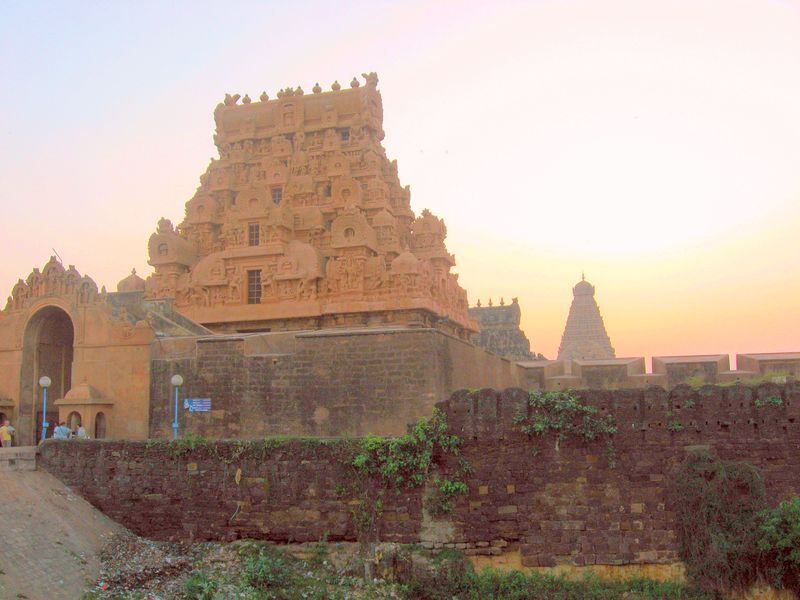
Sunset, Thanjavur Temple, 2008 (©Metta Yoga)

“A good Yoga teacher should follow Yoga as a sadhana or spiritual practice, not simply as an outer vocation.   The aspiration for Self-realization and God-realization should be the foundation of wanting to be a true Yoga teacher.

Consider bringing in Ayurveda, pranayama, and mantra into what you present as Yoga.  Learn the main yogic types of meditation.  Learn at least some Sanskrit so that you can know what the original terminology of Yoga means.   Try to study the deeper Yogic texts and do not just limit yourself to the Yoga Sutras, which is only one of many great Yoga classics. My favorite is the Yoga Vasishta.

Try to study the life and teachings of the great modern yogis like Ramakrishna, Vivekananda, Yogananda, or Ramana Maharshi.

Visit India and its ashrams and holy places to find out more about the spiritual background of Yoga.  Do not be afraid of the devotional or Bhakti side of Yoga but try to understand its relevance.

But above all root your teachings in nature and in your own experience, as Yoga is something that is rooted ultimately in all of life.  Learn the cosmic Yoga if you can, letting the Earth, mountains, wind, stars and waters be your teachers.” [emphasis supplied.]

This post raised some hackles when it was suggested that yoga teachers would benefit by studying in India.  It was even suggested that going to India to study yoga smacked of elitism.  So when I read this post by David Frawley I had to smile.

David Frawley is the Director of the American Institute of Vedic Studies.  Frawley’s article is interesting because his compares yoga in the East and West, something I have also blogged about.  Yes, yoga IS different in India (at least where I study), despite the mainstream commercialization of it here.  I think Frawley’s article is very insightful and he hits the nail on the head when he says things like “some modern asana groups want to avoid the spiritual side of Yoga, or at least the Indian side of that spirituality.  Some spiritual Yoga groups, meanwhile, have no asana component or teaching…” and…

“A true Yoga teacher in the classical sense would be one who could teach all eight limbs of Yoga with integrity, experience, devotion and insight.  They would be able to develop programs at an individual basis and not simply be limited to group or public classes.  That requires much more study and practice than most Yoga teacher’s training programs today.”

You can read the comments in the “Babies Teaching Babies” post from those of us who have gone to India to study.  A comment was made that those who’ve been to India suggested that “those of us who haven’t gone to India aren’t teachers.”  I disagree:  “the experience of being in India changed my whole way of looking at Yoga;  and “yes it is possible to teach without going. but I UNDERSTOOD a a hell of a lot better when I began immersing myself in the culture, I became a much better teacher after I started going.”  I said that my practice and teaching totally changed after learning what I learned in India.  Frankly, I learned things at the Krishnamacharya Yoga Mandiram that I never heard anyone talk about in any previous trainings (except the teacher who inspired me to go to India in the first place.)

I am actually a bit dismayed yet amused at the elitist charge (considering that back in the day I was on food stamps and marched in protest with the Farmworkers’ Union) and the defensiveness that speaks once again (as is so common lately in the yoga blogosphere) to the “us v. them” mentality.  Perception is reality which is different for everyone.  The non-dualism of advaita wisdom does not map to North American uber-dualism.

No one suggested that those who do not study in India are not yoga teachers.  David Frawley does not suggest that either.  But what he does is differentiate between someone who teaches asana and someone who teaches more than asana when he is asked what he believes makes a good yoga teacher.  His advice for students who want to become teachers is:  “To be a real Yoga teacher is a great achievement of the human spirit and requires great dedication and commitment of a life-time.”

Of course not every yoga teacher can go to India to study or even wants to go.  India is not for everyone — I wrote about that  here.  There’s a lot fear involved when some people think of going to India.  During my first trip an American yoga student had a mental meltdown 10 days into the month long intensive and had to be sent home.

But I can tell you that you will learn more about the spirituality of the Gita, or Sutras, or whatever your favorite spiritual yoga book is by feeling it wash over you in a temple as the priests chant rather than reading about it in a book.  I guarantee it.

And just because someone goes to India to study, that does not automatically make them a better teacher — just like someone going to the best law school or medical school does not automatically make them a good lawyer or doctor.  There are many other things involved in making a good teacher, it’s individual, it’s not just one thing.  To teach ANYTHING well, one needs the aptitude to teach.  “Good” teaching springs from knowledge and years of practice and experience, including life experience.  Wisdom comes from life experience, not out of books.  It’s been said that there’s a ton of knowledge out there now, but not a lot of wisdom.  Same in the modern yoga world.  Even after 10 years of teaching, I still consider myself a baby teacher.  OK, maybe a toddler by now.

But those who DO decide to study in India will be rewarded beyond their wildest dreams.  I can only speak about the school that I attend, I have no idea what happens in Pune (Iyengar yoga) or Mysore (Astanga yoga), but there is a reason that people keep returning to the heart of yoga to study.  It IS different, and paraphrasing what Louis Armstrong said about jazz, “If you have to ask what India is, you’ll never know.”

In order to study in India, yes, it IS hard to find subs for your classes.  It IS hard to be away from families for however long the study takes.  And  yes, there is no guarantee that your yoga job will be waiting for you when you return, given that in certain areas of the country (especially mine), yoga teachers are a dime a dozen and as soon as you leave, 12 more are waiting to take your gig, some who will teach for nothing.  But as the saying goes, if it was easy, everyone would do it.

The bottom line is that if you want to do it, you’ll do it, without hesitation.  You’ll save your money for a year or two years or whatever it takes, find your subs or even give up your classes, maybe even a family, and go.  That’s how important it is to some people to travel to the heart of yoga.  When I made my decision to go the first time I knew in my bones that nothing and no one would stop me.  Is that elitism?  Or commitment of a life-time?  My students are glad when I go because they know they can not drink from an empty cup and what I bring back is not only for me, but for them.

The fact of the matter is that yoga teacher trainings in the United States are much more expensive than it is to go to India for a month to study with the senior teachers of Iyengar, Jois, or Desikachar.

“To be a real Yoga teacher is a great achievement of the human spirit and requires great dedication and commitment of a life-time.” 

What are you willing to give up to become a “real yoga teacher” whether it’s here OR in India?  I asked that question back in 2008.

So go to India to study.  Or not.  I don’t care, just like I don’t care what “your” yoga is.  I know what mine is.

Just keep it real.

yoga championships?

Mary Elizabeth wrote in the previous post that she “can’t help but think that the emphasis on asanas has contorted not only many bodies, but also our minds, and has encouraged narcissism on and off the mat.”

A yoga instructor in this article states:

“‘Anybody who doesn’t believe it’s a sport should come take a yoga class,’ said yoga instructor Robyn Riconosciuto, who attended the championships to support some of her students who were competing, ‘There’s balance, grace and athleticism. I think they deserve recognition for the strength they have.’”

You know what type of yoga championship I’d like to see?  One where people are sitting in meditation:

without twitching and picking their feet after two minutes..

not looking for a wall to support themselves after one minute;

not picking the lint off their yoga pants…

not picking at their cuticles…

not jumping when someone coughs, a door is slammed, or a lawnmower starts up….

not looking around to see what other people are doing.

THAT would be a true yoga championship!

Do you have any other true tests?

f*@k YOGA

“It is about being here, present, being the real you, and choosing to offer up that soft vulnerable you instead of some fake mock-up to the world with every breath and every movement. It’s about taking the harder path through troubled country that leads to honesty and true connection between souls on a basis of honesty and integrity that comes from the kernel of your being and not some idea of what Patanjali wants you to do or your guru wants you to do or what the crowd wants you to do, or even worse what you think they want you to do. It’s about questioning every concept in your mind and even when you use such limited restricted tools as concepts doing so with awareness that they present a map and not the territory.”

And people thought I was snarky when I wrote about Tara Stiles.  Not quite.

You can read Scott’s entire catharsis here.

I “met” Scott via the India travel website Indiamike when I was planning my first trip in 2005.  The Krishnamacharya Yoga Mandiram used to do their month long intensives twice a year back then, calling it “Universal Yet Personal.”  Scott attended the one before mine and he gave me the telephone number of the rickshaw driver he used, Suresh, whom I still use to this day.

Namaste and love and lite, y’all.

babies teaching babies

John Friend and Anusara Yoga have never been my cup of chai but to each their own.  If you get high on the love and lite and kula, knock yourself out.  But I do have to say that I agree with what Friend says in this video.

In my area of far west suburban Chicago, yoga teachers are a dime a dozen.  When I was certified as a teacher almost ten years ago there were basically four studios in Chicago that had TT programs.   Now almost every yoga studio that I know of in the suburbs and Chicago have their own TT program.   The most searched for phrase here is “how much does a yoga teacher make” or something similar (the second most searched for term, which used to be #1, is “naked yoga” but that’s another post.)   My teacher training was not Yoga Alliance registered and neither was my teacher, but he eventually chose to grandfather into the YA because that’s what people looking for TT programs wanted, whether he was a “Yoga Alliance Registered” school.  However, he still thinks the YA is meaningless and so do I.  I let my membership lapse.

To make any money a studio must continually offer workshops or have TT programs.  A studio owner can’t make a living (i.e., support yourself) on only offering group classes (this is in my geographic area, your mileage may vary.)

If I had a dollar for every time someone over the years has told me I should do my own teacher training, I could buy a ticket to India.   I go back and forth on that question and I will admit that one of my reasons for considering it is money.  I made $250 in May teaching privately, not exactly what I call a living.  But ultimately using  money as the primary reason to conduct my own TT never feels right to me.

So with all the TT programs out there, I have to ask: what are the intentions?  Is offering a TT program a studio owner’s dharma?  Friend mentions the word “dharma” more than a few times in this interview and I think that needs to be considered by student, teacher, and teacher trainer.

Like John Friend, I also was a student for 7 years before I did my first teacher training.  Now people who’ve practiced for less than 6 months want to be a teacher.  Why?  Because it seems cool and hip and fun?  And what type of practice do you have?  Do you even meditate?  And yes, I believe every yoga teacher should have a sitting practice of some type.  In fact, if I had my own TT program every participant would be required to do a 3 day silent retreat with me before getting the piece of paper.  That would separate the wheat from the chaff real quick.

When I finished my first 200 hours of training, I felt like I knew nothing.  I felt like an ant at the bottom of the yoga hill.  Even after 15+ years of yoga, 5 trips to India to study with Desikachar and his senior teachers, and 1000+ hours of training (and next year with AG Mohan), I have crawled only slightly up that yoga hill.  I am student first, teacher second.  Yet, there are people half my age conducting yoga teacher trainings in my area whom I know for a fact do not have the training I have.   It confuses me.   The teacher with whom I trained has encouraged me to do my own teacher training, telling me “there are people doing it who don’t know half of what you know.  do it.”

Back in the day in the old school way, you went out to teach when your teacher said you were ready to teach.   That is how the teacher who certified me started teaching — he studied and lived with his guru for 8 years and then was told “go teach.”   I am not saying it has to be like that now, it would not be realistic here.   But now anyone who has had a weekend training or even just an online teacher training (believe it or not) can get hired as a “yoga teacher.”

Does this scare anyone else or is it just me?

I can understand someone wanting to do a teacher training to deepen their practice.  Not everyone who does a TT wants to teach.  Or should.   Friend says that not everyone is right to teach.  What is the person’s aptitude for teaching?  Is there a deeper calling to teach yoga, is it  your dharma?  Or is just something that sounds nice to do because you lost your job?  As for me, I was encouraged to teach by the teacher of my beginner’s yoga class that I took for a few years.  I also truly feel that teaching is my dharma — but that would require a lengthy discussion of my astrological natal chart so I won’t go there. 😉

A 200 hour training is merely the beginning and frankly, I have to ask what is being taught in all these trainings.  I ask this question because I was shocked at the quality of questions coming from people in my last training in India (all westerners.)   After the first days, I felt that the training was “dumbed down” because of these questions.  Many of the participants said they were teachers, but I know that my own students would not ask the types of questions that people were asking.   Their questions made me grateful (again) for my original trainings but then, that was almost 10 years ago and times have changed.

So are recent (i.e., within the last 10 years) yoga teacher trainings now merely diploma mills in the rush to get yoga teachers on the market?  Quantity over quality?

“The reason why yoga is presently skewed towards ekanga (or ardhanga without the breathing component) and not ashtanga is because by and large teachers do not teach the other angas.  When I was in school I heard a quotation which runs something like this: “If a pupil has not learnt, the teacher has not taught”.   Yoga is a rich subject.  Considering its popularity there is no reason why practitioners should not endeavor to go beyond asana practice while still having a very firm asana base. “  — Srivatsa Ramaswami, writing about what he has learned from teaching his 200 hour TT programs