wisdom from my teacher: “Spinal Exercise”

Here is the latest newsletter from my teacher, Srivatsa Ramaswami, the yoga master I met in 2003 who inspired me to travel to the heart of yoga.  Here also are links to his newsletters from 2009 and 2010, a wealth of yoga information from the longest standing student of Sri Krishnamacharya:

Ramaswami’s Newsletters Vol. 1

Ramaswami’s Newsletters Vol. 2

Each volume has a search function, so you can search for “mudra”, for example, and find 15 references.  Thanks to Krisztian Krutzler for preparing these downloadable docs.

If you are in the Chicago area and want to study with a true  yoga master, come to the Chicago Yoga Center, September 9-18.  Ramaswamiji will offer a two hour program on mantras on the 9th and a 10 hour program on the last two chapters of the Yoga Sutras on 10th and 11th. There is also a 25 hour certificate program on Core Vinyasakrama asanas and a 10 hour program on asana, pranayama and meditation on the 17th and 18th.

_________________________________________________________________________

SPINAL EXERCISE, THE BOTTOM OF IT

I have not been writing about Asanas for quite sometime.  I have covered a lot of ground in my Vinyasakrama book and also in the earlier book, Yoga for Three Stages of Life.  I thought though I could write about asana again- of course, nothing entirely new but a
different angle.

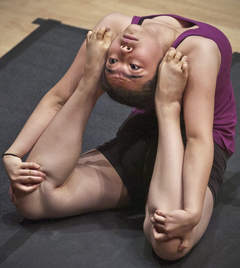
It is said that one of the main aims of asana and pranayama practice (Hata Yoga) is to maintain the health of the backbone.  It is a common refrain that one is as old as the condition of the backbone.  And some of the most charming postures of yoga involve the many positions of the spine.  Parsva Bhangi, Matsyendrasana, Akunchanasana, Kapotasana.  Paschimatanasana and a host of other poses bring out the majesty and
the versatility of one of God’s marvelous engineering creations called the spine.

The spine has been the center of attention of several systems, like the chiropractics. Among Yogis, Kundalini Yoga and Hata Yoga can be considered to be spine centric.  The one bone assembly, the backbone is not straight but one that is curved back(kyphosis) and forward (lordosis) and the yogis try to make it straight at least during the time they sit and meditate so that the Kundalini is aroused and moved through the sushumna in the spinal column as per the Kundalini Yoga or the integrated prana moves through the sushumna as the Hatayogis explain hatayoga.

The spine can be divided into different sections for study and practice.  The bottom is the tailbone or coccyx which is curved and has three to five tiny vertebrae.  It stays beneath the pelvis.  There is some mobility in it but we do not pay much attention to it until one
falls on the butts.  A few years back, already an old man, I tried to carry a teapoy down the stairs in my house.  I was wearing hard slippers and as I overstepped a step I slipped (I had the slippers on, you see) and fell heavily on my butts.  The teapoy (tea table) broke and we had to discard it.  I was in great pain.  My wife took me to a hospital immediately for a precautionary X ray which did not reveal any damage (not broken like the furniture).  But the orthopedist warned me that I may have some recurring pain in the coccyx region when I sit for a long time.  For a period of time whenever I did long travel, like from NJ to Los Angeles, I used to feel a lot of pain sitting.  So I know where the tailbone is.

The backbone although it is one assembly has different sections each having its own idiosyncrasy, so when exercising the backbone one has to pay attention to each section. The tailbone/coccyx, sacrum, lumbar, thoracic and cervical sections have their distinct characteristics.  The muladhara chakra is associated with coccyx, the svadhishtana
chakra is linked to the sacral region, the manipuraka with the lumbar region, then we have anahata with the thoracic spine and the vishuddhi chakra is in the cervical region.  The spinal column descends from the occipital region and we have the aajna chakra in that region and the sahasrara is in the cranial region.  The tailbone is the baby of the
assembly at the bottom and tucked nicely but is surrounded by heavy muscles and tissues and protected well.  It has some mobility.  Since it is the root of the spine it is also known among Yogis as the Mula.  Since both Hata Yoga and Kundalini Yoga are predominantly connected with the spine the mula becomes an important aspect of yoga. When one wants to work with the spine, it, the coccyx, should be firmly anchored.

Let us consider the example of the fishing rod (old times).  It has a flexible pole, a string and the bait. (sorry I could not think of an ahimsa example).  One holds the pole at the far end and when the bait is taken, the pole bends. The fisherman will have to hold the pole firmly so that the pole can bend to the extent required, even though there will be some play or movement in the hand of the holder.  Further he has to hold at the farthest point, holding a bit inside the pole reduces the leverage and the pole will not bend sufficiently.

The coccyx and sacrum (sacro-coccygeal section) are at the bottom of the backbone. The coccyx is at the very end of the spine.  It represents a vestigial tail (hence the common term tailbone) and consists of three to five very small bones fused together. There is limited movement between these bones permitted by fibrous joints and ligaments. The sacrum is a large triangular bone at the base of the spine and at the upper and back part of the pelvic cavity and where it is ‘inserted’ like a bone wedged between the two hip bones. Its upper part  is connected to the last lumbar vertebra and the bottom part to
the coccyx.   In children it consists normally of five unfused vertebrae which begin fusing around 16 years and become completely fused around 26.  It is kyphotic (curved, concavity facing forward). Even so, it is now an established fact that the sacrum moves between the ilia by both ambulatory and respiratory motions.  It would therefore point to the
logic of the use of fuller breathing in vinyasa movements as in Vinyasa Krama.

So the mula or the tail bone will have to be held firmly during the spinal exercises.  And the yogis used the well known technique called mulabandha which is contracting a few groups of muscles surrounding the tailbone:  the perineum, rectum and the gluteal muscles.  All
spinal movements, the forward bend,the rounded back, the turn, the back bend, the side bend, all will be better if the mula is gripped firmly and engaged.

Now let us consider the different types of spinal movements.  The turning or twisting movement has to emanate from the mula and my Guru had a couple of asana vinyasas to provide for this movement.  The Jataraparivrittis efficiently engage the tailbone and the next
immediate section sacrum.  Please refer to my book The Complete book of Vinyasa Yoga (pages 105,106,119,121,122).  Tatakamudra (page 105) by anchoring the sacro-coccygial portion of the spine helps to stretch it. These are some of the very early exercises my Guru used to teach to almost all the students.

For the back bending exercises it is necessary to protect the lumbar spine. Towards that, the flexibility and the strength of the sacro-coccygeal region is to be necessarily cultivated. The pelvic push is efficiently facilitated by a simple but effective asana called dwipadapeetam (pages109-115) or desk pose.  This posture which is casually practiced with the feet apart and thighs spread out leaves out the the spine in the pelvic region. Hence it is necessary to keep the feet together, tighten the gluteal muscles, draw in the rectum and gently push the tailbone/sacrum up and feel a healthy stretch at the
bottom of the spine. Any back bending done without fully involving the sacro coccygial region is a less efficient back bend and tends to put more strain on the lumbar spine. Again my Guru used this posture to teach to almost anyone.  This upward pelvic push is to be done on inhalation generally but, it can be done while exhaling smoothly by the elderly, the obese, the pregnant, the highly strung etc.  Because the feet and back of the head are well anchored it becomes easy to control the back bend very well and one can improve the stretch step by step.  Other poses that are in this group would be catushpada peetam
or Table pose ( page79 ) and Purvatanasana or the anterior stretch pose (pages78,79). The other back-bends in the prone poses such as Bhujangasana, dhanurasana and salabhasana (pages 138-145) also may be done with the thighs and feet together to keep the sacrum and tailbone engaged and stretchered.  To ensure this condition, the teacher may ask the student to keep the feet and thighs together by placing a piece of paper between the feet  and not let the paper drop to the floor while raising the legs up in asana like Salabhasana.  In these prone exercises keeping the legs together enables to exercise all parts of the spine, especially the oft neglected sacro-coccygeal area.

The sacral/pelvic tilt also is an important movement in the context of forward bending.  This is achieved best in balasana or forward bend in Vajrasana (page 179,180) first and then in paschimatanasana (page 75-77) or the posterior stretch pose.  Those who are able to engage the muscles surrounding the sacrum and coccyx are able to achieve a good forward bend facilitated by the tilting or tipping of the pelvis. One procedure that will be helpful is for the teacher or a friend to support the sacrum with both the hands and push forward and down on exhalation and allow the subject to return to dandasana on inhalation while still maintaining the healthy pressure.  It may be good to maintain the pressure for a while in the posture pushing forward and down on each long exhalation and then holding it on inhalation.  Over a period the practitioner would be able to use the group of muscles at the base of the spine and stretch the muscles of the sacral region.

Then we have the important movement of lifting and holding the tailbone/sacrum up, by pulling up the waist and hips.  Here the muscles of the hip joints are brought into play.  This can be done in the beginning of tadansana sequence itself.  When the subject raises the
arms (page 4-5), he or she can get a partner to hold the pelvic girdle below the hip joints and push the pelvis up.  This helps to stretch the pelvic and hip muscles up and along with that the sacrum and tail bone also move up a little bit and it will be easy to stretch the
supporting musculature.  One can do the movements a few times with the helper holding the pelvis up a little while the arms are brought down on exhalation and pulling the pelvis up when one raises the arms on inhalation.  Over a period of time the practitioner, while raising the arms, will engage the hip muscles and gently pull the pelvis along with the sacro coccygeal portion of the spine. Sri Krishnamacharya would frequently exhort the student to pull up and hold the hips up in several seated postures like parvatanasana (page 196) and dandasana (page 39).  He would say in Tamil “iduppai thooki pidiyungo” or “Pull up the waist/hips and hold it up”.

I think it is good to use these simple asana and vinyasa procedures to prepare the bottom of the spine.  These simple procedures help to maintain a good flexibility and the tone of the supporting musculature at the bottom end of the spine. My Guru taught many of these simple and doable procedures almost to all levels of yoga abhyasis.  He would
appropriately alter the breathing to langhanakriya so that some of the overweight, older, tense and pregnant (except prone poses in pregnancy) abhyasis could do these procedures.  These are good preparatory exercises that will be helpful in getting a good control over the sacro-coccygeal spine that will help in doing some of the more difficult and charming spine-centric asanas like ushtrasana/kapotasana, triyangmukha uttanasana (backbends), paschimatanasana (forward bend), matsyendtasana (spinal twist), akunchanasana(rounding the spine), parsva bhangi(side bend) and other spine centric asanas and vinysasas.

The term Cakra is well known to Yogis.  Cakra means a wheel in normal usage.  The Samkhyas refer to the potter’s wheel as cakra while describing the post kaivalya time of the yogi. The seven cakras are usually represented as wheels.  Brahmananda, the commentator of the Hatayogapradeepika, refers to cakras as Nadicakra in the context of
nadis. He calls it a collection/group of nadis or nadi samooha.

Several contemporary yogis relate this concept of nadi samooha to ganglia or plexus.  A wheel also is an assembly of different parts, like the hub, spokes, rim and a tyre.  Since Nadis can also refer to blood vessels, the heart itself is referred to as hrdaya cakra.  The
Chaedogya Upanishad of Sama Veda mentions that there are 101 nadis that emanate from the heart.  It is possible then that cakra could mean an organ in this context.  The anahata cakra refers to a cakra that produces a sound without being struck by another agent.  The heart produces the sound by itself.  So anahata cakra could mean the heart cakra or the heart.  In the Suryanamaskara mantra of Yajurveda, there is a mantra which refers to the human body as “ashta cakra, nava dvaara.”  The nava or nine dvaaraas or openings are the two eyes, the two ears, the two nostrils and the mouth in the face plus the other two openings.  While explaining the meaning of the eight cakras, Sayana, the well known commentator of the vedas, refers to the cakras as different arrangements of cells or different tissues (humors) in the body as tvak (skin), carma (dermis), rakta (blood), mamsa (muscle), medhas (fat), asti (bone), majja (marrow), sukla (seman)/
sonita (uterine secretions).

Thus the term cakra could indicate a group, collection, village of some tissues or an assembly.  It is also suggested by some scholars that the cakra w.r.t the spinal column could refer to different parts of the backbone itself, each section having its own unique
arrangements of bones: the coccyx, sacrum, lumbar, thoracic, cervical and occipital.  And the entire spine with the cranium looks like a kundalini or a cobra with the beautiful wavy body curvatures.

enough’s enough

I’m sure by now many have read about the latest incident at elephant journal: the posting of a video entitled “Yoga for Black People” and what occurred when a black woman spoke her truth about it.  I won’t rehash the incident but you can read about what happened and the aftermath here and here.

Chelsea has written an eloquent open letter to Waylon Lewis.

While I don’t want to send more traffic to a site that I consider toxic, I feel I have to put in my two rupees because the way Chelsea was treated was certainly not the first incident of that kind for EJ.  I also had an incident with EJ and its yoga editor last year over the Tara Stiles controversy.  I also experienced a Waylon “apology.”  You can briefly read about it here.  I wrote:

“I felt blindsided and betrayed.  He did not feel it necessary to ask my permission or even to ask my opinion before he wrote about me.  While he apologized to me months later for writing the story, it did not matter at that point. Intention is everything and you can’t unring a bell.  To me his story brought to light what this modern yoga scene has become: us v. them.  The rightous v. the unrightous.  The purists v. the modernists.  Old v. young.  Thick v. skinny. The Lulus v. The WalMarts.”

Once again, the issue is not as simple as it appears on the surface.  Just like Judith Lasater’s letter to Yoga Journal was not about the Toesox ads with Kathryn Budig, and just like the whole Tara Stiles thing raised deeper issues to be questioned, the issues that Chelsea raised were not just about the posting of a one stupid video.

Once again, as with the Toesox and Tara Stiles’ incidents, someone who speaks out against the status quo is chastised, told to get over it, to lighten up, and OH MY GOD, the worst insult of all, “you don’t have a sense of humor.”

That’s what every guilty party yells when someone calls them out on their nonsense — “What?  Who me?  What did I do?”

Calling something a joke as Waylon did doesn’t make it any less important.  EJ is truly a dysfunctional household when an attempt is made to shame and embarrass the ones who are calling out the perpetrator.

What irked me more than that video was that Chelsea was told to shut up — by Waylon and EJ’s readers — after standing up for what she believed in.  She was told, basically, to get to the back of the bus.  This reaction from so-called hip readers of a supposedly cutting edge online “yoga and spirituality” site?  Please.  You can read in this post the typical responses when someone questions EJ’s status quo.

There must be something “wrong” with our outlook, there is something “wrong” with us. We are patted on the head with the comment “lighten up, honey, it’s no big deal.”  Yes, it IS a big deal in the larger context.  I was labeled a “radical feminist” by the yoga editor of EJ during the Tara Stiles thing — AS IF that’s the worst thing you can call an outspoken woman (besides calling her a bitch, that is.)

Dare I ask, what ever happened to just saying “I’m sorry” and leaving it at that instead of trying to justify bad behavior, instead of making excuses?  It’s called empathy.  Waylon — having been raised Buddhist as he loves to tell everyone — should know that empathy is one of the things that is cultivated in a Buddhist practice.  It’s the basis of compassion.  With all the posts about mindfulness on EJ, one would think that Waylon would have read a few and would spend a few mindful moments contemplating the repercussions of his actions before clicking “publish.”  Karma, Waylon.  Don’t blame people for “kicking the shit” out of you (in comments) when your own actions brought it on.

Waylon’s response to Chelsea was that it was “just a comedy video.”  Using that logic, one might justify the use of the N word by saying “it’s just a word.”  Yeah, it IS just a word but a loaded one that offends people.  Does that mean because one doesn’t find the N word offensive they can use it?  And then tell others who are offended by it to lighten up?  That really helped Michael Richards’ comedy career.

How about posting a video of “Yoga for Muslims” or “Yoga for Mexicans” or any other “Yoga for [fill in the blank]”?  Racial and ethnic humor is a sensitive subject and it takes finesse.  Some can pull it off and it’s funny, others can’t and it’s seen as racist.  Don’t shout down the ones who find some “jokes” offensive.

The “Yoga for Black People” incident is just the latest in a long line of incidents that show how Waylon needs to clean up EJ’s act.

Take your own advice, Waylon: walk your talk.

David Frawley’s advice for yoga teachers: “go to India”

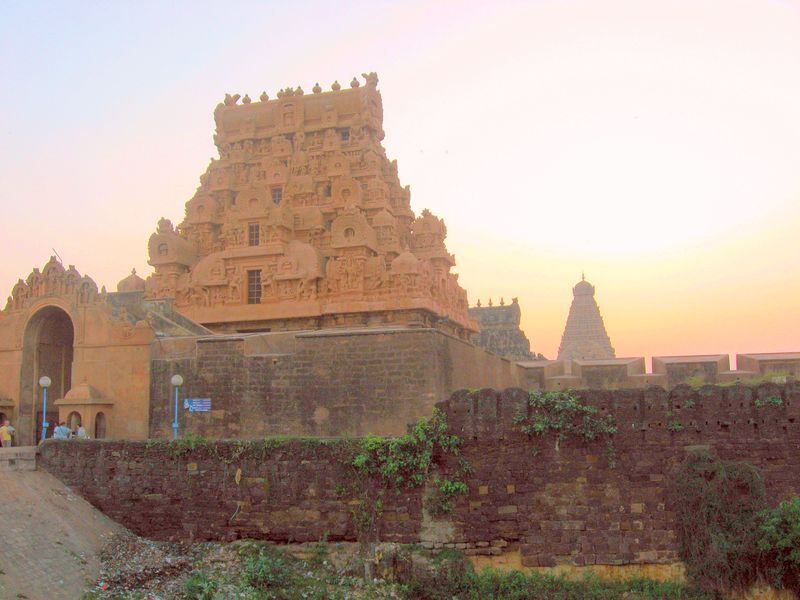
Sunset, Thanjavur Temple, 2008 (©Metta Yoga)

“A good Yoga teacher should follow Yoga as a sadhana or spiritual practice, not simply as an outer vocation.   The aspiration for Self-realization and God-realization should be the foundation of wanting to be a true Yoga teacher.

Consider bringing in Ayurveda, pranayama, and mantra into what you present as Yoga.  Learn the main yogic types of meditation.  Learn at least some Sanskrit so that you can know what the original terminology of Yoga means.   Try to study the deeper Yogic texts and do not just limit yourself to the Yoga Sutras, which is only one of many great Yoga classics. My favorite is the Yoga Vasishta.

Try to study the life and teachings of the great modern yogis like Ramakrishna, Vivekananda, Yogananda, or Ramana Maharshi.

Visit India and its ashrams and holy places to find out more about the spiritual background of Yoga.  Do not be afraid of the devotional or Bhakti side of Yoga but try to understand its relevance.

But above all root your teachings in nature and in your own experience, as Yoga is something that is rooted ultimately in all of life.  Learn the cosmic Yoga if you can, letting the Earth, mountains, wind, stars and waters be your teachers.” [emphasis supplied.]

This post raised some hackles when it was suggested that yoga teachers would benefit by studying in India.  It was even suggested that going to India to study yoga smacked of elitism.  So when I read this post by David Frawley I had to smile.

David Frawley is the Director of the American Institute of Vedic Studies.  Frawley’s article is interesting because his compares yoga in the East and West, something I have also blogged about.  Yes, yoga IS different in India (at least where I study), despite the mainstream commercialization of it here.  I think Frawley’s article is very insightful and he hits the nail on the head when he says things like “some modern asana groups want to avoid the spiritual side of Yoga, or at least the Indian side of that spirituality.  Some spiritual Yoga groups, meanwhile, have no asana component or teaching…” and…

“A true Yoga teacher in the classical sense would be one who could teach all eight limbs of Yoga with integrity, experience, devotion and insight.  They would be able to develop programs at an individual basis and not simply be limited to group or public classes.  That requires much more study and practice than most Yoga teacher’s training programs today.”

You can read the comments in the “Babies Teaching Babies” post from those of us who have gone to India to study.  A comment was made that those who’ve been to India suggested that “those of us who haven’t gone to India aren’t teachers.”  I disagree:  “the experience of being in India changed my whole way of looking at Yoga;  and “yes it is possible to teach without going. but I UNDERSTOOD a a hell of a lot better when I began immersing myself in the culture, I became a much better teacher after I started going.”  I said that my practice and teaching totally changed after learning what I learned in India.  Frankly, I learned things at the Krishnamacharya Yoga Mandiram that I never heard anyone talk about in any previous trainings (except the teacher who inspired me to go to India in the first place.)

I am actually a bit dismayed yet amused at the elitist charge (considering that back in the day I was on food stamps and marched in protest with the Farmworkers’ Union) and the defensiveness that speaks once again (as is so common lately in the yoga blogosphere) to the “us v. them” mentality.  Perception is reality which is different for everyone.  The non-dualism of advaita wisdom does not map to North American uber-dualism.

No one suggested that those who do not study in India are not yoga teachers.  David Frawley does not suggest that either.  But what he does is differentiate between someone who teaches asana and someone who teaches more than asana when he is asked what he believes makes a good yoga teacher.  His advice for students who want to become teachers is:  “To be a real Yoga teacher is a great achievement of the human spirit and requires great dedication and commitment of a life-time.”

Of course not every yoga teacher can go to India to study or even wants to go.  India is not for everyone — I wrote about that  here.  There’s a lot fear involved when some people think of going to India.  During my first trip an American yoga student had a mental meltdown 10 days into the month long intensive and had to be sent home.

But I can tell you that you will learn more about the spirituality of the Gita, or Sutras, or whatever your favorite spiritual yoga book is by feeling it wash over you in a temple as the priests chant rather than reading about it in a book.  I guarantee it.

And just because someone goes to India to study, that does not automatically make them a better teacher — just like someone going to the best law school or medical school does not automatically make them a good lawyer or doctor.  There are many other things involved in making a good teacher, it’s individual, it’s not just one thing.  To teach ANYTHING well, one needs the aptitude to teach.  “Good” teaching springs from knowledge and years of practice and experience, including life experience.  Wisdom comes from life experience, not out of books.  It’s been said that there’s a ton of knowledge out there now, but not a lot of wisdom.  Same in the modern yoga world.  Even after 10 years of teaching, I still consider myself a baby teacher.  OK, maybe a toddler by now.

But those who DO decide to study in India will be rewarded beyond their wildest dreams.  I can only speak about the school that I attend, I have no idea what happens in Pune (Iyengar yoga) or Mysore (Astanga yoga), but there is a reason that people keep returning to the heart of yoga to study.  It IS different, and paraphrasing what Louis Armstrong said about jazz, “If you have to ask what India is, you’ll never know.”

In order to study in India, yes, it IS hard to find subs for your classes.  It IS hard to be away from families for however long the study takes.  And  yes, there is no guarantee that your yoga job will be waiting for you when you return, given that in certain areas of the country (especially mine), yoga teachers are a dime a dozen and as soon as you leave, 12 more are waiting to take your gig, some who will teach for nothing.  But as the saying goes, if it was easy, everyone would do it.

The bottom line is that if you want to do it, you’ll do it, without hesitation.  You’ll save your money for a year or two years or whatever it takes, find your subs or even give up your classes, maybe even a family, and go.  That’s how important it is to some people to travel to the heart of yoga.  When I made my decision to go the first time I knew in my bones that nothing and no one would stop me.  Is that elitism?  Or commitment of a life-time?  My students are glad when I go because they know they can not drink from an empty cup and what I bring back is not only for me, but for them.

The fact of the matter is that yoga teacher trainings in the United States are much more expensive than it is to go to India for a month to study with the senior teachers of Iyengar, Jois, or Desikachar.

“To be a real Yoga teacher is a great achievement of the human spirit and requires great dedication and commitment of a life-time.” 

What are you willing to give up to become a “real yoga teacher” whether it’s here OR in India?  I asked that question back in 2008.

So go to India to study.  Or not.  I don’t care, just like I don’t care what “your” yoga is.  I know what mine is.

Just keep it real.

yoga championships?

Mary Elizabeth wrote in the previous post that she “can’t help but think that the emphasis on asanas has contorted not only many bodies, but also our minds, and has encouraged narcissism on and off the mat.”

A yoga instructor in this article states:

“‘Anybody who doesn’t believe it’s a sport should come take a yoga class,’ said yoga instructor Robyn Riconosciuto, who attended the championships to support some of her students who were competing, ‘There’s balance, grace and athleticism. I think they deserve recognition for the strength they have.’”

You know what type of yoga championship I’d like to see?  One where people are sitting in meditation:

without twitching and picking their feet after two minutes..

not looking for a wall to support themselves after one minute;

not picking the lint off their yoga pants…

not picking at their cuticles…

not jumping when someone coughs, a door is slammed, or a lawnmower starts up….

not looking around to see what other people are doing.

THAT would be a true yoga championship!

Do you have any other true tests?

f*@k YOGA

“It is about being here, present, being the real you, and choosing to offer up that soft vulnerable you instead of some fake mock-up to the world with every breath and every movement. It’s about taking the harder path through troubled country that leads to honesty and true connection between souls on a basis of honesty and integrity that comes from the kernel of your being and not some idea of what Patanjali wants you to do or your guru wants you to do or what the crowd wants you to do, or even worse what you think they want you to do. It’s about questioning every concept in your mind and even when you use such limited restricted tools as concepts doing so with awareness that they present a map and not the territory.”

And people thought I was snarky when I wrote about Tara Stiles.  Not quite.

You can read Scott’s entire catharsis here.

I “met” Scott via the India travel website Indiamike when I was planning my first trip in 2005.  The Krishnamacharya Yoga Mandiram used to do their month long intensives twice a year back then, calling it “Universal Yet Personal.”  Scott attended the one before mine and he gave me the telephone number of the rickshaw driver he used, Suresh, whom I still use to this day.

Namaste and love and lite, y’all.

babies teaching babies

John Friend and Anusara Yoga have never been my cup of chai but to each their own.  If you get high on the love and lite and kula, knock yourself out.  But I do have to say that I agree with what Friend says in this video.

In my area of far west suburban Chicago, yoga teachers are a dime a dozen.  When I was certified as a teacher almost ten years ago there were basically four studios in Chicago that had TT programs.   Now almost every yoga studio that I know of in the suburbs and Chicago have their own TT program.   The most searched for phrase here is “how much does a yoga teacher make” or something similar (the second most searched for term, which used to be #1, is “naked yoga” but that’s another post.)   My teacher training was not Yoga Alliance registered and neither was my teacher, but he eventually chose to grandfather into the YA because that’s what people looking for TT programs wanted, whether he was a “Yoga Alliance Registered” school.  However, he still thinks the YA is meaningless and so do I.  I let my membership lapse.

To make any money a studio must continually offer workshops or have TT programs.  A studio owner can’t make a living (i.e., support yourself) on only offering group classes (this is in my geographic area, your mileage may vary.)

If I had a dollar for every time someone over the years has told me I should do my own teacher training, I could buy a ticket to India.   I go back and forth on that question and I will admit that one of my reasons for considering it is money.  I made $250 in May teaching privately, not exactly what I call a living.  But ultimately using  money as the primary reason to conduct my own TT never feels right to me.

So with all the TT programs out there, I have to ask: what are the intentions?  Is offering a TT program a studio owner’s dharma?  Friend mentions the word “dharma” more than a few times in this interview and I think that needs to be considered by student, teacher, and teacher trainer.

Like John Friend, I also was a student for 7 years before I did my first teacher training.  Now people who’ve practiced for less than 6 months want to be a teacher.  Why?  Because it seems cool and hip and fun?  And what type of practice do you have?  Do you even meditate?  And yes, I believe every yoga teacher should have a sitting practice of some type.  In fact, if I had my own TT program every participant would be required to do a 3 day silent retreat with me before getting the piece of paper.  That would separate the wheat from the chaff real quick.

When I finished my first 200 hours of training, I felt like I knew nothing.  I felt like an ant at the bottom of the yoga hill.  Even after 15+ years of yoga, 5 trips to India to study with Desikachar and his senior teachers, and 1000+ hours of training (and next year with AG Mohan), I have crawled only slightly up that yoga hill.  I am student first, teacher second.  Yet, there are people half my age conducting yoga teacher trainings in my area whom I know for a fact do not have the training I have.   It confuses me.   The teacher with whom I trained has encouraged me to do my own teacher training, telling me “there are people doing it who don’t know half of what you know.  do it.”

Back in the day in the old school way, you went out to teach when your teacher said you were ready to teach.   That is how the teacher who certified me started teaching — he studied and lived with his guru for 8 years and then was told “go teach.”   I am not saying it has to be like that now, it would not be realistic here.   But now anyone who has had a weekend training or even just an online teacher training (believe it or not) can get hired as a “yoga teacher.”

Does this scare anyone else or is it just me?

I can understand someone wanting to do a teacher training to deepen their practice.  Not everyone who does a TT wants to teach.  Or should.   Friend says that not everyone is right to teach.  What is the person’s aptitude for teaching?  Is there a deeper calling to teach yoga, is it  your dharma?  Or is just something that sounds nice to do because you lost your job?  As for me, I was encouraged to teach by the teacher of my beginner’s yoga class that I took for a few years.  I also truly feel that teaching is my dharma — but that would require a lengthy discussion of my astrological natal chart so I won’t go there. 😉

A 200 hour training is merely the beginning and frankly, I have to ask what is being taught in all these trainings.  I ask this question because I was shocked at the quality of questions coming from people in my last training in India (all westerners.)   After the first days, I felt that the training was “dumbed down” because of these questions.  Many of the participants said they were teachers, but I know that my own students would not ask the types of questions that people were asking.   Their questions made me grateful (again) for my original trainings but then, that was almost 10 years ago and times have changed.

So are recent (i.e., within the last 10 years) yoga teacher trainings now merely diploma mills in the rush to get yoga teachers on the market?  Quantity over quality?

“The reason why yoga is presently skewed towards ekanga (or ardhanga without the breathing component) and not ashtanga is because by and large teachers do not teach the other angas.  When I was in school I heard a quotation which runs something like this: “If a pupil has not learnt, the teacher has not taught”.   Yoga is a rich subject.  Considering its popularity there is no reason why practitioners should not endeavor to go beyond asana practice while still having a very firm asana base. “  — Srivatsa Ramaswami, writing about what he has learned from teaching his 200 hour TT programs        

yoga miscellaneous: healing

A letter from Sri.K. Pattabhi Jois to Yoga Journal, Nov. 1995

“It is unfortunate that students who have not yet matured in their own practice have changed the method and have cut out teh [sic] essence of an ancient lineage to accommodate their own limitations.”

“Spiritual Madness and Compassionate Presence” — healing of mental suffering through the philosophy and practice of Yoga

“One of my patients had severe post-traumatic stress disorder. His experience of isolation and helplessness sent shockwaves through his day-to-day life. He had flashbacks and significant difficulty relating to others.

We began his treatment with daily pranayama. We added meditation on both the destructive and creative aspects of the mother goddess Kali. Finally, he began to meditate on his own eternal nature: “I am that I am” (Hum So). Slowly but surely, this healed his illness…”

I worked with a private student today and after 10 years of teaching I am still amazed at how transformative the breath is. She is a relative newbie to yoga and in her classes at various venues from health clubs to studios, teachers have told her to “focus on the breath” but apparently no one has ever TAUGHT her how.

I could see how tight her belly and shoulders were. We did conscious breathwork just like Mark Whitwell or Ramaswami or my teachers at the Krishnamacharya Yoga Mandiram teach.  A light bulb went off over her head. Her entire body visibly relaxed and she left my house looking lighter and brighter. In a word, transformed.

She’s returning for more instruction on the breath and wants to work with me in the vinyasa krama method:

“By integrating the functions of mind, body, and breath…a practitioner will experience the real joy of yoga practice. . .Vinyasa krama yoga strictly follows the most complete definition of classical yoga.” – Srivatsa Ramaswami, The Complete Book of Vinyasa Yoga

Breath + yoga = healing.

Trauma Sensitive Yoga: breathing the walking wounded, part 3

breath + movement = roots

Psychologist Babette Rothschild has said:

“Breath is a reminder of trauma. Sensory messages from muscle and connective tissue that remember a specific position, action, or intention can be sources of triggers. Accelerated heart rate and increased respiration can be implicit reminders of that same reaction that accompanied the trauma.”

As we talked about the breath during the training, I thought about how fortunate I am to have studied directly in the Krishnamacharya lineage — studying with Srivatsa Ramaswami, Desikachar, Mark Whitwell, and lately with Gary Kraftsow.  They all studied with Krishnamacharya and Krishnamacharya’s yoga is all about linking breath with movement.  This aspect is crucial in teaching trauma sensitive yoga.

Donna Farhi has said that “breath is a dynamic system that most of the time runs on automatic, allowing input from internal organs to mange the rate and depth of breathing.”

Trauma is stored in the body and body memories can override thinking.  Breath is the doorway to the nervous system — trauma survivors have layers of physiological defenses in place that serve as psychological infrastructure and protection from implicit memories.  Removing these defenses too quickly can result in significant destablization.

Hearing this I thought about the yoga classes I’ve taken where pranayama is indiscriminately taught, seemingly for no purpose other than to fill space in the class (this is my experience, your mileage may vary.)  I became more aware of this after I returned from studying at the Krishnamacharya Yoga Mandiram the first time.

In that lineage yoga practice is asana-pranayama-meditation.  I remember being in a class after my return and the first thing the teacher did was kapalabhati breathing — no explanation, no instruction, just do it.  It was very jarring (I started but did not finish) and I thought…HUH?   Does this teacher know everyone’s dosha in the first place to be doing this?   If it did not feel at all right to my system, an experienced practitioner, I could only imagine what it felt like to the ones who were brand new to yoga in this class.

If you’ve read the first two parts of this series, you’ll know where I am going with this.  Breathing — just doing it or hearing the breath of another student — can be a PTSD trigger for trauma survivors.  Ujayi breath can be very scary; techniques such as kapalabhati and breath retention are out of the question in a trauma sensitive yoga class.

Trauma sensitive breathing should always be performed in the context of a muscular, physical form (asana) to facilitate grounding and present moment experience.  The movements are always initiated by the inhale or the exhale, because breath alone can trigger PTSD.

What are some breath practices for a trauma sensitive yoga class?  Simple breath awareness (constant attention to the breath); “add a little” breath; emphasizing breathing through the nose because some trauma survivors breath through their mouths; nadi shodana; and ratio breathing, i.e., different counts for the inhale/exhale.

The bottom line is helping people notice when their breath changes, helping them notice the quality of their breath so they can notice their experience in the present moment. Mindfulness. Just this, just here, just now.

As you may have determined, with so many PTSD triggers, being trauma sensitive in a “regular” group yoga class would prove difficult.  Although a trauma survivor may really want to experience yoga, the thought of walking into a public yoga class might be too challenging, too scary.  In his book Overcoming Trauma Through Yoga, our teacher Dave Emerson wrote about the experiences of trauma survivors in public yoga classes.  One woman said that just the experience of a teacher walking up to her slowly and silently as the woman was in child’s pose was enough to make her run out and never return.  She did not feel safe at all.

Creating a yoga class exclusively for PTSD or trauma survivors creates community, a sangha.  We were advised not to do this work in a vacuum, but to connect with a mental health professional, a VA center, a domestic violence shelter, among others.  We were also advised not to work privately with students because of safety issues.  I feel confident enough to work privately with domestic violence and sexual assault survivors, but I might not feel secure with others, it would depend on the situation.  I am using The Trauma Center’s protocols in working one-on-one with TS students: (1) the student must also be working with a psychologist, psychiatrist, or other mental health professional so we can work together as a team; (2) the student must continue taking their medication, if any; (3) the student must not have been hospitalized for any psychological issues within the last six months; (4) there can be no active psychosis.

At the start of our training, the question was raised: how must yoga in America change if 80% (according to a collection of research) of the population have experienced or witnessed trauma?  Trauma is defined by Dr. van der Kolk as being inescapable stress, heightened alertness (constant hyperarousal), or helplessness in response to an event.  Some responses to these states are detachment/disconnection from the body, self, or social relationships; insomnia; fight or flight responses; depression; chronic pain; constant intrusive thoughts; consistent feelings of anger and shame; substance abuse.

We were asked: do we need to return to a “simpler way” of yoga?

This training was one of the most influential trainings I’ve taken in my 10 years of teaching.  I hope I have helped both yoga teachers and trauma survivors in this three part series.

Krishnamacharya said that breath is central to yoga because it is central to life…and yoga is about life.  Trauma is a part of life, but we do not have to allow it to define us.  Yoga is about replacing old negative patterns with new positive ones, one step at a time.

Just this. Just here. Just now.

Trauma Sensitive Yoga: the walking wounded, part 2

A trauma survivor can be an adult survivor of childhood abuse, a domestic violence survivor, a survivor of sexual assault, someone who was in a horrible car wreck or natural disaster, or a returning soldier with Post-Traumatic Stress Disorder (PTSD.)

Basically, anyone who walks into your class. As teachers, we never know what a student’s story is, either physically or psychologically.

A “trauma sensitive” yoga class is taught very differently from the yoga class with which we are familiar — soft music, altars, incense, physical adjustments. A typical yoga class may not be comfortable place for a trauma survivor and in fact may feel very dangerous. Merely saying the word “relax” can be a PTSD trigger if the person was told to relax and then was abused.

For someone who has been abused, a physical assist can be a severe trigger for PTSD. Many teachers say, “but I always ask first.” Think about that statement. For someone who has a history of abuse and was not allowed to say no (so has issues with power and control), assists are problematic.

Dr. Bessel van der Kolk is the recognized authority on PTSD and heads The Trauma Center in Brookline, Massachusetts. He has said that “the goal of treatment of PTSD is to help people live in the present without feeling or behaving according to demands belonging to the past.”

The Trauma Center has begun to establish empirically that yoga is helpful for people with PTSD (van der Kolk, 2006). Along with feedback such as, “I feel like I can use my body again,” the groundbreaking study that the Trauma Center conducted in 2004 showed that yoga changes core brain physiology related to PTSD and trauma.

In a brain subjected to trauma, parts of the brain can be underdeveloped; parts of the brain can be atrophied; a compromised neocortex (the “thinking” brain) can not regulate the lower brain (the limbic brain is the emotional center of the brain); there is a lack of synaptic connections. The amygdala is the alarm clock of the brain, it is the site of stored memory and bodily sensations. It becomes engorged and overactive in PTSD. The corpus callo is the fibrous material beneath the cortex that transmits information between the two hemispheres of the brain — in PTSD this can atrophy. The right side of the prefrontal cortex can atrophy in PTSD. These are just three examples of structural changes in a traumatized brain.

This makes recent research on how the brain can change (neuroplasticity) huge. The research is out there, you can google it: via yoga and meditation, new synaptic connections are made, old pathways are reactivated and there is neurogenesis. The Trauma Center’s research has shown that a 60 minute yoga class once a week in a 10 week session begins to reduce PTSD symptoms.

So how do you make your class “trauma sensitive”? As teachers we naturally think our classes are healing in a certain way, but some aren’t. We were told how Iyengar yoga classes, for example, because of the language used and the way many are taught can be problematic for trauma survivors. Seeing yoga straps lined up on a wall is not a good environment for someone who was tied down and abused.

Since much of trauma was caused by physical manipulations, physical assists for the most part are out of the question. At the root of trauma/PTSD is an extreme lack of choice. With specific yoga shapes (don’t say “pose”), trauma sensitive yoga teachers invite people to begin to make choices again in a direct relationship to their experience. All these choices are about safety, comfort, and ease.

Environment is important: smells, mirrors, exposed windows, closets, temperature, and lighting can all be PTSD triggers to someone.

Do you see where I am going with this? ANYTHING a yoga teacher does can be a trigger for PTSD. How many teachers are equipped to handle stress responses that may come up such as hyperarousal, hypoarousal, disassociation, or flashbacks? If a stress response happens, one key is to start moving the large muscles like gluts or quads because those muscles use up the stress hormone cortisol (Warriors, forward bends.)

For a trauma survivor in a yoga class, it’s about reclaiming their body, not about a teacher manipulating a student into a shape. As teachers we need to cultivate our ability to offer verbal assists. In trauma/PTSD, survivors have “lost” their bodies. Our teacher gave an example of how one of his students said she felt like she had a hole where her stomach should be. As yoga teachers it is not our job to “fix” a student, but to help them begin to trust their bodies again. It’s about helping students use their bodies and breath as resources for self-regulation, calming themselves down if need be. Physical assists create dependency.

In a trauma sensitive yoga class, language must change: no absolutist, commanding language; use concrete and visceral language; no woo-woo “out of body” language, no metaphors. It is the invitatory language of inquiry that directs attention to the body and invites mindful movement and breathing. The teachers advised us not to say “be gentle with yourself” because that comes across as a challenge that can set people up for failure — trauma survivors don’t know how to be gentle with themselves. Even the word “play” (saying “play with the pose” is not a good idea) is a loaded word. Emphasize choice: “as you are ready”; “if you like”; “you decide”; “you choose.”

Use non-intimate language for body parts: sternum v. chest; base of spine v. tailbone; seat v. butt or pelvis. However, ANY word can be a trigger and a teacher must be able to handle triggers.

Use non-aggressive language. How many of us have been in a yoga class with a drill sergeant instead of a yoga teacher — “you SHOULD look like this.” An abuse victim interprets your words differently than a soldier would with PTSD. The body is not a combat zone…for any of us.

Some of the loaded poses (for obvious reasons) are Happy Baby, hip openers, chest openers. Powerful bodily sensations can create powerful emotions so these poses must be taken slowly, in increments. Bookend a new pose with a familiar pose.

Trauma Sensitive Yoga: the walking wounded, part 1

“The body keeps the score.” Dr. Bessel van der Kolk

According to the teachers at my recent Trauma Sensitive Yoga training, 70-80% of the population have experienced some type of trauma, whether being in a war or a catastrophic car accident. This statistic comes from a collection of the clinical literature currently out there. Keeping that statistic in mind, think of your yoga class. In many cases abuse is caused by physical manipulation of the body. Now think about what those yoga adjustments are doing to a trauma survivor with PTSD who was held down during their abuse. Even chanting and Sanskrit can be triggers for someone who suffered cult abuse.

Anything a yoga teacher does can be a trigger. Anything. Telling someone to be still and watch the breath can be a trigger, especially to a woman who was raped and the last thing she heard before she disassociated from the attack was the rapist’s breath in her ear. The word “pose” can be a trigger, especially for an adult survivor of childhood sexual abuse who was made to POSE for pornography.

How will you teach your classes? Whether as teachers or students, we know that yoga heals, that is a purpose of yoga. But for many trauma survivors, walking into a yoga class is impossible. If you were that child who had been tied up, think how seeing a yoga strap would make you feel. Trauma survivors are stuck in a body/breath/mind that is still relating to past conditions. Time is frozen in the trauma survivor’s brain, we’re stuck in a loop. I know what my triggers are.

Approximately 88% of men with Post-Traumatic Stress Disorder met lifetime criteria for one or more disorders such as depression and anxiety. Seventy-nine percent of women with PTSD met the criteria for one or more. Eighty percent of people with PTSD met criteria for another psychiatric disorder (Solomon and Davidson, 1997.)

In a word, my training at the Trauma Institute was amazing. I consider it one of the most influential trainings I’ve done in my almost 10 years of teaching. Forty yoga teachers and clinicians from all over the United States and some from Europe came for four days to learn about the ground-breaking research being done (scientists and researchers are finally catching up to what yogis intuitively knew thousands of years ago) and to learn how to create trauma sensitive classes. A “trauma sensitive” class is not your mother’s yoga class. It MUST be taught differently, even as to word choice and environment.

Many of us in the training were survivors, including me. Many felt that a true community was being created, much more so than a regular yoga teacher training. On the last day I sat in a small group and heard how just listening about trauma and PTSD was a trigger for some. Many of us had jangly nerves, as one woman described it, but all left empowered and ready to take this healing into our communities. One woman said she was proud to be a survivor and I nodded my head in agreement.

We learned much about the different parts of the brain that are literally physically damaged during trauma. Prolonged abuse damages the brain even more — parts of the brain can atrophy and shrink and the connection between our “reptilian brain” and our “thinking brain” short-circuits. There are now many studies on trauma survivors via brain scans that show the physical changes. But the fact is that it does not have to stay damaged. The fairly recent concept of neuroplasticity is huge. It was previously thought that the adult brain can not change, but brain scans show that it can change and repair itself from trauma. One of the most important things we learned was that while talk therapy is effective, it can only go so far because it is head/mind oriented and trauma/abuse is so body-based. The Trauma Institute’s soon to be published research shows that the body-centered activity of yoga combined with talk therapy is much more effective in treating PTSD and trauma survivors. Why? Because the body keeps score, the body has memory. Next year the Trauma Institute will begin a 5 year study of the effectiveness of Jon Kabat-Zinn’s Mindfulness Based Stress Reduction techniques v. yoga on trauma/PTSD. The research will utilize brain scans.

We heard about “Trauma Theory for Yoga Instructors”, “The Neurobiology of Trauma as it Relates to Yoga” (presented by Heather Mason), and also heard from Bill, a Viet Nam war vet who suffered from PTSD. He told us his story about how he was a hospital corpsman in the Marines and his PTSD did not manifest until his own children were born years later. “Life became gray,” he said. The birth of his children triggered his PTSD because when he saw his babies he remembered all the dead Vietnamese children he saw. He said he constantly feared for his children, he was stuck in the loop that something terrible would happen to them, at any time, he was sure of it.

In both 2001 and 2002 he suffered a neurological episode where his left side stopped working — PTSD and traumatic brain injuries affect the same part of the brain. He attributed his neurologic damage that showed up years later to the herbicide Agent Orange telling us that the body reacts to herbicides in a very specific way: “we were eating it and drinking it.” Bill was fortunate enough to connect with Dr. Bessel van der Kolk as his psychiatrist who told him to try yoga for his PTSD and neurologic symptoms. Bill told us that yoga managed his symptoms and have grounded and centered him. Bill is in his 60s and he told us that he has been told that he should be in a wheelchair or in a nursing home but yoga has saved his life.

Bill has been doing Bikram yoga three or four times a week and has been doing it for about five years. He says he has tried other types of yoga but Bikram is it for him. Bikram is not considered “trauma sensitive” yoga but it helps Bill because of the consistency of the routine, the same thing every day, every class. We learned that consistency is one of the top three requirements of a trauma sensitive yoga class: BE SAFE, BE PREDICTABLE, BE CONSISTENT. Bill gave us his opinion about why consistency is important:

in the last 45 years America’s warfare has been ill-defined, ambiguous, with poorly stated goals, and all have been counter-insurgency wars. In wars such as these, soldiers can never create a pattern, nothing is ever repeated, you can’t go down the same road twice because you might get killed. Bill asked us to think how it feels to have our neurological system disrupted if we don’t have patterns — it is disruptive to the emotional system that is connected to our physiological well-being. For Bill, Bikram yoga via its repeated patterns serves as his ground.

However, for someone else, Bikram yoga with its commanding teachers could be a trigger. The yoga remedies for trauma and PTSD are definitely not one size fits all. For example, Richard Miller worked with the Walter Reed Army Medical Center in a famous study of the effects of yoga nidra on soldiers with PTSD. Yoga nidra was found effective on this population. Bill told us that soldiers with PTSD like the feeling of deep relaxation that yoga nidra gives just by virtue of how “on” they had to be while in the field. Yoga nidra is a relief to them, it’s “heaven” just to be able to relax, Bill said. But for someone else, such as the survivor who was constantly told to be still and don’t move, deep stillness for so long would be a severe PTSD trigger.