when loving-kindness is needed


(Photo for the Tribune by Patrick Yeagle)

About 5 hours ago I had to deal with students whose friends witnessed a massacre.

7 dead in NIU shooting; 4 identified; Ex-graduate student slays 6 before killing himself

I teach at a community college that is less than 40 minutes from Northern Illinois University. I was starting my 4:45 yoga class when students walked in late and told me there was a shooting at NIU, that they were waiting for news about their friends. Two girls were crying because they did not know if their friends were dead or alive.

I had to make some announcements before I started to teach, but I knew that metta — loving-kindness — meditation was in order. So I asked them to come to a comfortable seat and just breath, to watch the breath, and not to run from whatever physical or emotional sensations come up. and then I started to teach them about loving-kindness meditation.

I told them to step outside themselves and see themselves and repeat “may I be well, happy, peaceful, may I be safe.” I said that if they preferred they need only say “may I be safe.” after awhile I told them to visualize the NIU campus, to visualize anyone that they knew was in that killing hall, or to visualize the friends, parents, and loved ones of those who died, and to send them loving kindness and peace.

then I told them that what they are about to do will be the hardest of all: to send loving-kindness to the killer. I told them that when I was in the Dalai Lama’s teachings, His Holiness said that the highest compassion of all was to have compassion for your enemies, or someone like a terrorist or a murderer. I told them if they did not want to do that, that’s fine, but keep sending loving-kindness first to themselves, then out to others.

I told them that thoughts are energy, so they should send out love and peace, even to people who they think don’t deserve it, like the killer. I told them about my Buddhist prayer that I end all my classes with (however, not at the school — it’s a public school, tax-payer supported, you know how that goes), the prayer about the Four Immeasureables:

may all beings have happiness and the causes of happiness
may all beings be free from suffering and the causes of suffering
may all beings never be parted from freedom’s true Joy
may all beings dwell in equanimity, free from attachment and aversion

I told them that “all beings” meant just that: everyone, not just “good” people, but even killers.

Tomorrow will bring more news about what happened. next week I will deal with the aftermath of this on my students. I hope for the coming week they will remember what I taught them today, for themselves, to ease their suffering.

I thank all my teachers, and my teachers’ teachers, for all that I have learned about yoga, meditation, and Buddhism.

and I bow to Buddha, for the Dharma and for showing me the way out of suffering.

peace
shanti
salaam aleikum
so shall it be

happy valentine’s day from the Universe

Love where you’ve been.

Love where you’re at.

Love how you think.

Love the power you pack.

Love all that you seek.

Love all that you feel.

Love your rocking emotions,

and the thoughts you make real.

But mostly, I really, really love you in this very moment.

What?

Loving you from every angle –

The Universe

this was today’s email from The Universe.

love yourself first. send metta — loving-kindness — to yourself first and then to others in your life.

here are some roses from India for you all….

body consciousness


Those of you who have been reading this blog regularly know that I don’t treat yoga as a physical exercise or performance art. I know that people come to yoga for all different reasons, and many people say “so what if people just do yoga for the work-out? they’ll find the non-physical part of it eventually.”

my contention is…maybe.

remember what I said before: in the pre-Yoga Journal days, that is, when I dabbled in yoga and meditation in college in the early ’70s, the only people I knew doing yoga and meditation were patchoulli oil wearing hippies who had already been to or were going to India. They lived in communes or had studied with white-robed gurus who did not separate yoga and meditation. Yoga was meditation and meditation was yoga. what a concept!

I also contend that if one is “doing yoga” for only the physical aspects, it ain’t yoga. it’s acrobatics. it’s gymnastics. but it ain’t yoga. I’ve heard Desikachar, the son of Krishnamacharya, say the same thing. you can call a dog a cat a thousand times, but that will never make that dog a cat. it’s still a dog, no matter what you call it. so you can call your morning work-out “yoga” all you want, but that does not make it yoga.

what I find in my classes both with beginners and experienced students is that they are very disembodied. their bodies are in the room, but their minds are not. my teaching is very breath-oriented, and I can always tell when someone moves first, and then breathes. it’s become second nature to me. and when they are holding the asanas, I can always tell how they are “out there”, instead of “in here”, that is, in their own skin. the darting eyes, the twitching fingers, the hard bellies without the softness of breath, the constant adjustments without stopping to feel the asana, the need to rush on to the next asana, these are all dead give-aways of disembodiment.

I teach a slow flow vinyasa, moving with the breath, and also yin. Yin is a style that can make people uncomfortable in their own skin because they have to be still for at least five minutes in order to stretch the connective tissue (and thereby the meridians of the body) in order to facilitate opening and an increased flow of chi. it’s a style that teaches you to stop resisting, first in your yoga, but more importantly, I believe, in your life.

it is also a style that connects you to the concept of surrendering to your body. I think the concept of surrender is a dirty word to many western yogis because the western mindset is conditioned for resistance and hardness, in other words, “working out.” I believe that the way you do your yoga is the way you live your life…soft v. hard, resistance v. surrender, rushed v. slow, pushing away v. acceptance.

In my Mindfulness Yoga and Meditation Training we must do periodic readings and one reading was a chapter called “Sensations” from Aligned, Relaxed, Resilient: The Physical Foundations of Mindfulness by Will Johnson. as I was reading a light bulb went off over my head and I said “YES!, this is why people are uncomfortable meditating”. not because our minds run away with us, which is what people always say, but because we run away from our physical sensations. what comes up in asana practice or when we try to meditate draws us into the present moment and sometimes that’s a terrifying place to be. the present moment helps us experience life in the here and now instead of regretting the past or anticipating the future. the present moment helps us become embodied rather than disembodied. when we stop feeling our physical sensations, when we run away from them, when we are “out there” instead of “in here”, that is when the monkey mind takes over. that’s when I see the twitching fingers and the darting eyes.

it’s hard to be still because we are conditioned to run.

Johnson says that “it is not possible to be aware of the full presence of bodily sensations and lost in the involuntary monologue of the mind at the same time.” Buddha said that “everything that arises in the mind starts flowing with a sensation on the body.”

Below is an excerpt from one of my favorite blogs The Absent Mind. In this post Mike writes about meditation, surrender, and acceptance:

I’ve been feeling that I could actually meditate indefinitely, if not for physical limitations. And even then, I could probably bear any level of physical discomfort. Somewhere along the line, I passed a point where I stopped resisting or expecting anything from meditation. Or life for that matter. The two go hand in hand.

…I still resist life here and there like everyone else. But not nearly as much as I once did. With regard to meditation, I am in awe of the beauty of utter simplicity. A friend of mine once said that transformation is the shift from nothing is very satisfying to nothing is very satisfying. Brilliant, and oh, so True.

When people ask me about meditation, they often tell me they have tried it but can’t sit still for even 15 minutes. What can I tell them? Practice.

Here is another hint that might unlock the door for some. The reason that people can’t sit still in meditation (or any other part of life) is that they want to eliminate what they perceive as the negative. In the case of meditation, it can be mind chatter or whatever unpleasant thoughts or feelings arise. How many times have I heard the words, “If I could only quiet my mind …”?

But the problem with that perspective is this: reducing the negative in anything only changes the scale on which you operate. It never eliminates duality. For example, if you reduce mind chatter to the point where you only have a fleeting thought once every 2 minutes, you may still be just as annoyed by that thought as you were with constant mind chatter. There is no escape from thoughts, feelings, or any other forms of negativity. There is only surrender, acceptance.

As one of life’s most excruciating ironies, a funny thing happens with surrender. Gradually one opens up to the profound beauty in every movement, thought, feeling, or stirring. One becomes able to perceive even the slightest shift in energy, and the Silence of Pure Being arises amidst the storm of thinking, feeling, and otherwise being alive.

(emphasis added)

In my comment to his post I said that when people try to meditate they usually run from any type of temporary physical sensation. Mike said: “I notice this, too, when attending yoga classes. The most challenging (yet also most satisfying) aspect of the asana is the relaxing into body consciousness. Of course, this is why breath is so important, because it is synonymous with energy flow and the consciousness of the body.” (emphasis added.)

Mike said that he pondered the question, “why does consciousness follow this body around?” and when he asked his teacher, his teacher said “‘the body is consciousness.’ …there is no separation of mind and body, they are one and the same.”

mind + body = no duality. until we understand that, we’re not doing yoga.

how’s this for power yoga?

for those of you wanting a yoga class that kicks your ass….

“Let’s get physical, physical,
I wanna get physical, let’s get into physical,
Let me hear your body talk,
Your body talk, let me hear your body….BOOM!”

(thanks, Y Dawg!)

blog it forward

In the comments of my last post, my cyber-yogabud, YogaDawg, listed this blog as one of his ten faves as did Brenda of Grounding Thru the Sit Bones. to that I say, muchos gracias, y’all! it does my heart good to know who reads my rants and musings.

but naming my ten fave blogs is as hard as trying to name my ten fave songs or ten fave movies, it’s almost impossible. just look at Lindia’s Hall of Fame in the sidebar and those are my favorite blogs to visit. but out of that list, I can narrow it down to blogs that I try to hit every day, so here goes:

YogaDawg, of course, for the laughs!

my gal pal in India, sirensongs, for her Feringhee: The India Diaries

The Existentialist Cowboy — I think Len’s posts on politics are brilliant and why is he not on TV instead of fascist knuckleheads like Sean Hannity and Bill O’Reilly?

Vanessa: Unplugged — thoughts out loud, straight, no chaser (love that line!)

Just Breathe — Nadine also studies at KYM so that’s why!

Everything Yoga — because I agree with a lot of what Diane says about yoga

The Divine Democrat — ‘cuz I love the avatar of the nun smoking a doobie and Mary Ellen is a Chicago gal just like me

FranIAm — just ‘cuz and because she writes the sweetest comments on my posts

A Bowl of Stupid — Matt is on an “India sucks” rant right now, but, hey, even I think India sucks sometimes and I love India!

and last but not least, The Absent Mind — I don’t think Mike will be posting anymore unforuntately, but I found his writing to be the most profound and powerful that I have ever come across. I will miss his writing and his comments to my posts tremendously.

now y’all have to name your ten favorite blogs!

on a more contemplative note, this blog has been de-listed from two yoga blogs that I regularly read and I can’t help but wonder why.

shanti, y’all…

response to "getting back to yoga"

(Please read Getting Back to Yoga, Part 1 and Part 2 in their entirety before reading this post.)

This post is excerpts from an email I received from a regular reader who is also a yoga teacher. She gave me permission to use it, with edits. she asked me to disguise her words because she is worried that she might lose her job if someone recognized her.

is that what the state of yoga in this culture has come to? think about that. that might be the bigger issue here. are we as teachers so afraid to call a spade a spade, so afraid to speak our truth about teaching and the state of yoga as some of us experience it that we are afraid to lose our jobs? a job that we do because we love it and not because we can make any type of money to support ourselves.

call it a yoga rant if you want to but it’s food for thought and I believe these things need to be said because the mainstream yoga media doesn’t talk about it. the mainstream yoga media is more concerned with marketing to the perfect yoga demographic. as my yoga cyberpal YogaDawg says, no yoga BS here.

I thought her comments important enough for a post of their own instead of in the comments section where they might be ignored.

“…this whole “Americanized” yoga thing is the same thing that is going on with our whole culture…skinny, tight, no wrinkles on a 65 year old woman, tummy tucks after babies, puffy collagen lips…I won’t even get started.

I had 30 in a class last night, way too many. After class a woman asked if I always do postures that you have to support your weight…she has a severe arm injury…no upper body strength at all. this is a public class, for the general population…this is not private instruction, which she needs.

I am working with a young man with rheumatoid arthritis. he was going to take a community class with a student teacher. When I heard that I told him absolutely not. I am working with him for free to keep him from injuring himself.

Yoga is advertised as a cure-all, body opener, strength builder, look beautiful like the pictures in Yoga Journal, your wrinkles will disappear as soon as you feel your breath….And everybody can do it, just modify a pose in a group class, no matter what the asana is.

A woman came when she was very pregnant and said, “I know you will modify every posture for me.” And what am I supposed to do with the 20 other people (half of which are new) in class while I am attending to her? And she was new to yoga. Not a good time to start when pregnant with your first child. I told her to start a prenatal program.

At one of the first classes I taught I was asked, “Oh wow, are you going to teach us those really hard arm balances and all that cool stuff?” I said, “no, that would not be me”, and the student hasn’t been back. they have no idea that you go to an advanced class or one-on-one to learn those asanas.

Wow, I really took off on this one…sorry, but I do feel better….”

hey, even yoga teachers need to let off steam, none of us are enlightened yet.

and I totally get what she is venting about. because for as much as yoga is portrayed in western culture, for as much as we hear or read about it in the media (it had its 15 minutes of fame on Oprah), for as much as we yoga teachers like to think that yoga is “mainstream”…it’s not. yet yoga IS advertised as a cure-all (“GET THAT YOGA BUTT IN 20 MINUTES PER DAY AND OPEN YOUR THROAT CHAKRA, TOO!”), and as much as I believe in the healing power of yoga, this is a huge disservice. people who could benefit from private yoga go to group classes because they don’t know any better and end up getting frustrated or worse, injured, sometimes seriously.

as I wrote in my last post, I was taught that personal transformation can begin in a group class, but is accomplished by working one on one with a trusted teacher and having faith in that teacher. there have been many times when I have suggested to certain students in a group class that their needs would be much better served by private yoga sessions. yet, for some reason, the idea of private yoga classes in this culture is met with skepticism. it boggles my mind that people will pay someone $75 or more to clean their house or to pick up their dog’s poop (not to mention the money one can spend at Starbucks in one month), but the thought of paying a highly trained yoga teacher $75 or less for a private yoga session is anathema to them. people pay more than $50 for a pizza party for their kids.

it’s all about priorities….

getting back to yoga, part 2: sraddha

Yoga Sutra-s I.20:

sraddhaviryasmrtisamadhiprajnapurvaka itaresam

“Through faith, which will give sufficient energy to achieve success against all odds, direction will be maintained. The realization of the goal of Yoga is a matter of time.”

(Reflections on Yoga Sutra-s of Patanajali, TKV Desikachar)

Some of you might be incredulous at Dr. NC’s statement that my spine will become realigned in three months if I do my yoga therapy practice every day, but I am not. That’s because I have sraddha which is Sanskrit for “faith.”

Sraddha is not religious faith but a “strong belief.” In his translation of the Sutra-s, Desikachar writes: “Faith is the unshakable conviction that we can arrive at a goal. We must not be complacent about success or discouraged by failure. We must work hard and steadily inspite (sic) of all distractions, whether good or bad.”

When I first attended KYM in 2005 I was struck by a teacher’s words when she said that personal transformation in yoga can begin in a group class, but is only accomplished by working one on one, the teacher with the student, in the traditional way, the old school way. THAT is sraddha and that is the difference as I see it between Americanized yoga and the yoga that I study in India.

The “goal” of yoga as propounded by Patanjali in his Sutra-s is freedom from suffering. nothing more, nothing less. How many doing yoga right now in the west have that sraddha, that belief? How many want to relieve their suffering — and we all suffer whether you want to admit it or not — or just merely go through the physical motions of the asana practice not being fully present, aware, and awake in the present moment? How many treat their asana practice as a performance or have been in a group class and felt that the teacher is on stage?

How can there possibly be personal transformation if there is no sraddha?

As I did my asana class every day with Usha, I felt myself softening, for lack of a better word. She knew I taught yoga and she asked me if I minded her “corrections.” I told her that I absolutely did not mind her corrections, that I am a yoga student first, and then a teacher, and that I am at KYM to learn.

So she began to point out the “hardness” in my body as I moved. For example, the hardness of my outstretched foot in janu sirsana, the foot tightly flexed, the ballmount pushing out, toes spread, that “energized” foot as we are so often told in a group class. Or my hands above my head in uttanasana, tight, flexed, palms facing each other, instead of the palms turned outward, fingers soft.

I then began to realize how “hard” American yoga is compared to the yoga I do in india, soft, yielding, receptive, nurturing, and I have to question why.

While Usha was correcting me, I told her yes, this is the way my teacher Ramaswami holds his hands when he shows us uttanasana (Ramaswami was an original trustee of KYM, an old friend of Desikachar), how could I forget this? It was good to be brought back home and removed from my “performance”, my need to show the perfection of my alignment, the hardness of my body, because it’s not about that at all. It’s about healing first and foremost, and having the sraddha to believe in that healing.

That is what I think in many cases American yogis need to realize, that yoga is about healing first, the other benefits are secondary. That our bodies and minds are laboratories for the exploration of the deeper aspects of yoga. That instead of performing on the mat, we need to dive into that yogic stew of the tools that Patanjali gave us in his Sutra-s and marinate and cook ourselves into a brand new, or at least, an improved, tastier dish.

Yoga Journal was waiting for me when I returned from India. If I did not get it for free through my yoga insurance I would never subscribe to it. I paged through it for about ten minutes and threw it in the recycling bin. It has become nothing more than one huge advertisement for yoga clothes and other yoga tchotkes that we supposedly need and one show biz yogi’s or another’s teacher training program. One huge advertisement for yoga stuff mixed in with articles on non-attachment. What a disconnect.

It’s all about the marketing, but after all, that’s so American. We’re always running after the next best thing whether it’s the latest cell phone or the latest yoga gimmick. I returned from india realizing (yet again) that I am tired of the mass-marketing, the dumbing down of this ancient holistic science. Years ago in the pre-Yoga Journal days, people went to classes that were just called “yoga” or “hatha yoga.” When people ask me what style of yoga I teach, I tell them honestly, “my style — come check it out and if it resonates with you, fine, if not, that’s fine, too.” I’m not going to label my yoga or give it a brand name to sex it up just to attract students. I am certainly not going to put my own name on it and trademark it, which I of course could do just like any number of well-known yogis have done. Yoga is yoga.

I will not give the name of the blog where I read this, but underneath a photo of a young, skinny, cellulite-free woman in tree pose, a reader wrote that if she were “that skinny” she could be a yoga teacher.

Sigh.

have a little sraddha, baby.

the new official transportation of this blog

Back in October I wrote a post about what the official transportation of Linda’s Yoga Journey is, i.e., the ubiquitous Indian autorickshaw. here is the post so you can read all about it.

However, since returning from my third trip the rick has been replaced by the lovely bullock cart. yes, friends, I am in love with bullocks and the carts that they pull.


(view from atop a bullock cart)


(bullock decorated for a Pongal celebration)


(proud bullock owner)

I attended a village’s Pongal celebration (Pongal being a holiday like our Thanksgiving, which I will write about later) and I had the great fortune to be given a ride to the village on top of a bullock cart.

You see working bullocks all over Tamil Nadu and for the most part they are placid creatures. Their eyes always seem to say that this is their lot in life so why get upset about anything.

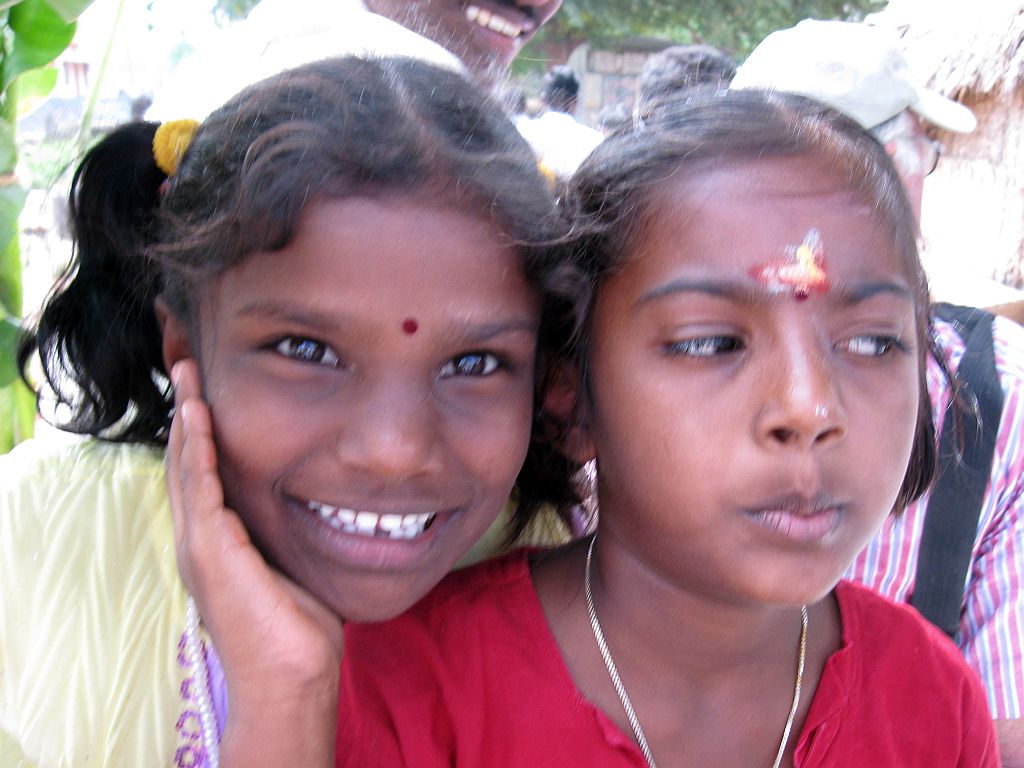
The ride on the cart was very relaxing but I was very tempted to tell the driver “faster, faster!” so I could experience a run-away bullock cart. I wanted to pretend I was on a run-away stagecoach like in an old Western movie. what can I say? ever since I was a girl I always wanted to push the envelope. But it was a slow, easy ride where these kids were my bullock cart partners:

this was one of my wonderful tamil nadu days that I so achingly miss right now as I look out my window and watch the snow come down. we are supposed to get a foot of snow here in chicagoland and ever since I returned on January 23, this weather has been a total shock to my system after being in south india for a month!

When I returned from india so ill, I told myself that I would give india a break in 2009. but the missing is palpable and it is like an ache in my heart.

oh well….to paraphrase Louis Armstrong about jazz, if I have to explain, you wouldn’t understand.

getting back to yoga


(Dr. NC @ KYM, The Power of Yoga, March 2006)

I guess maybe it’s about time that I start writing about yoga again. but then again, maybe not, as I’m beginning to think that my yoga thoughts are too radical to be accepted calmly by some people. I told my students this morning that I’ve always felt like an outsider and now, returning a third time from my yoga life in India, I feel even more radical.

Every time I go to KYM to study, it always brings home to me how much I dislike about the state of yoga in the west. Maybe “dislike” is too strong a word — I will rephrase: how certain things about the state of yoga in the west bug me. Now before anyone jumps down my throat, I am not saying that one is better than the other, i.e., east v. west. I’m saying that to me there are marked differences between the two and I know which one resonates with me in a much more profound way.

KYM is known for yoga therapy or what was formerly called viniyoga. Desikachar no longer refers to his father’s style as viniyoga. We each met with a yoga therapist and received a consultation for whatever ailed us, physically, mentally, or emotionally, then an appropriate yoga therapy practice was prescribed for us. That practice became our private asana class with a therapist, and we took the daily classes in pranayama, meditation, and the Yoga Sutra-s together.

I came to India with a painful back problem that I’ve had for about three months. My ego was telling me I’m a loser because of course as a teacher I’m not supposed to have any physical problems because I do so much yoga…right? One day in October I woke with severe muscular pain on the right side of my lower spine and I had done nothing to my back like pick something up the wrong way or get up from a chair the wrong way, and it certainly did not happen doing yoga. I just woke up one day in severe pain. The pain would go away during the day as I moved around and I was still able to teach, but it served as a reminder of one of Buddha’s Four Foundations of Mindfulness, Mindfulness of the Body, and that no one escapes sickness, old age, and death.

My consultant at KYM was Dr. NC (we call him Dr. NC because he has a last name with about 26 letters) who taught the yoga therapy classes in the intensives I took in 2005 and 2006. I explained my problem and my pain and he had me do some asanas and examined my spine. He asked me to squat and asked if I noticed anything. At first I said no, then he told me to repeat the squats and to pay attention. I noticed that my left side felt like it weighed a ton and my right side was very light. I told him this and he said yes, that I favor my left side to the detriment of my right. He said my spine had curved to the right and that the right side of my pelvis is higher than my left.

I was horrified. How could this happen, I asked, I’M A YOGA TEACHER! (as if we are supposed to be invincible.) Dr. NC said that walking a certain way, sitting a certain way, standing a certain way with a hip hiked up and out, constantly carrying a bag on my left shoulder, all of this contributed to a spine curvature after 50 years. It just happens, he said, it’s just the way it is.

So after he said that it’s wonderful I am so flexible and in such great shape for an old broad — OK, he did not say “old broad” but he was amazed at my uttanasana — he wrote a yoga therapy program for my back that is simply amazing and wondrous. He said if I did the practice every day for 3 months my spine should be back into alignment.

I did the practice for 5 days with Usha, one of the KYM yoga therapists. She was also wonderful, adding a little something every day to the asana mix, so I came home with five different yoga therapy sessions. I did the practice every day in India until I got food poisoning and I have not done it for two weeks now, but I started again from square one yesterday and I will build it up again.

It is an amazing practice because I can literally feel the change in my spine and pelvis when I sit in sukhasana. At the beginning of the practice my right sit bone is off the floor. At the end of the practice both sit bones are firmly grounded and I have no pain for the rest of the day. Before I started doing this practice, I would wake up at night in excrutiating pain when I turned from my right side to my left side and now that no longer happens.

So what does this have to do with yoga east v. west?

TO BE CONTINUED…

this is no surprise


You’re Siddhartha!

by Hermann Hesse

You simply don’t know what to believe, but you’re willing to try
anything once. Western values, Eastern values, hedonism and minimalism, you’ve spent
some time in every camp. But you still don’t have any idea what camp you belong in.
This makes you an individualist of the highest order, but also really lonely. It’s
time to chill out under a tree. And realize that at least you believe in ferries.


Take the Book Quiz
at the Blue Pyramid.