things that make you want to say "namaste, bitches"

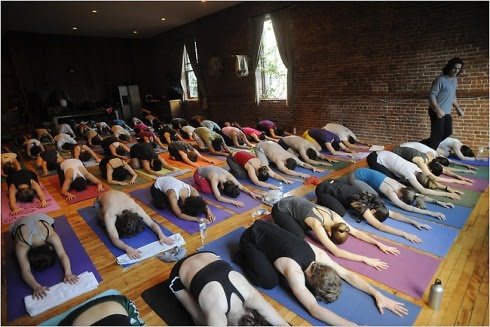
The New York Times article about etiquette in yoga studios is making the rounds of the yoga blogs.

YogaDork is quoted about people barging into class:

“‘You are Zenned out,’ said the blogger YogaDork, who asked to remain incognito, describing the splendor of Savasana, resting pose. ‘And people are fumbling for bags and rolling up the mats.'”

Let’s see…what are my pet peeves?

Men in yoga classes are few and far between where I live so no chance on seeing any cojones flying in the breeze because of loose yoga shorts. And no, I’m not disappointed.

As for barging in, once I had a woman rip off the plastic of her brand new yoga mat in the beginning of class when everyone was sitting in stillness, making a very loud tearing noise, and then act like she did not know that would happen when I shot her a look. And that was AFTER she unzipped her winter coat. Loudly. Did I say she also came in late?

As for cellphones, I’ve gotten used to them by now. That’s not to say that they don’t bother me — HELLO! YOU’RE NOT THAT IMPORTANT, REALLY!! — but they don’t bother me as much anymore.

Once in a class during savasana a woman’s phone rang and she must have jumped a foot off her mat. Now THAT was funny because she literally looked like she levitated, very quickly. I mean, her whole body came up like a plank. BOING! After class she told she did not know how to turn off her phone. Really.

Drumroll, please…..my two biggest pet peeves, one as a teacher and one as a student, are:

1. As a teacher, gum chewing.

Why would someone chew gum in a yoga class?

In the first place, I don’t even understand gum chewing. I’ve never been a gum chewer, what’s the purpose of it? It seems like everywhere you look nowadays someone’s jaw is flapping away.

Next time I have a gum chewer in class I’m telling them I won’t revive them if they choke on it.

2. As a student, anyone walking on my mat.

This is very common in workshops. It makes my skin crawl.

Why are people clueless about this?

I PUT MY FACE ON MY MAT, WHY ARE PUTTING YOUR DIRTY, SMELLY FEET ON MY MAT?!?

And sometimes people even act insulted when you quickly pull up your mat when you see them walking towards you.

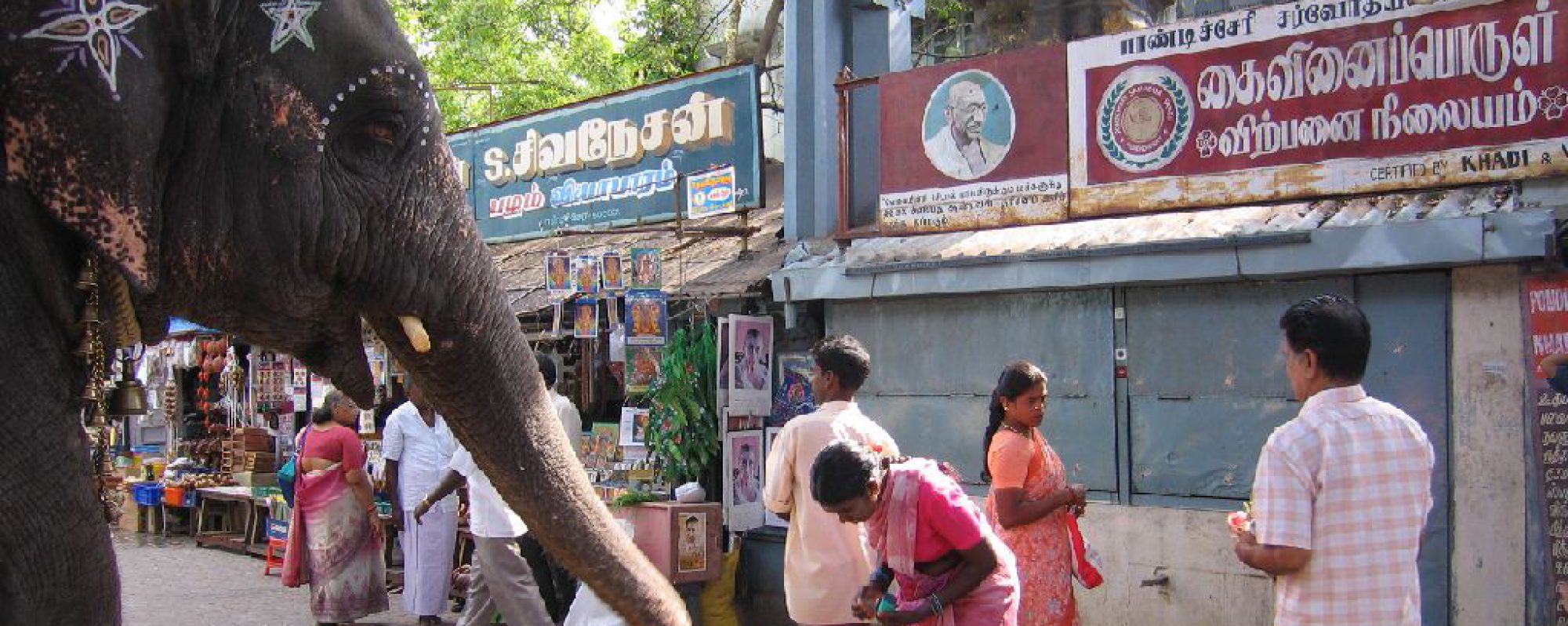
How about it if I put my foot on your nose, sister? I’ve walked barefoot all over India, maybe you want a piece of that in your face?

Aaaaahhhh…..I feel so much better now…..

OK, Divine Ones….your turn.

addthis_pub = ‘yogagal60510’;

shi*t a crazy old yogini says 2

“All the google searches for “chakra underwear” fascinate me…and then they end up here. I never knew so many people were so interested in wearing underwear with chakra images. Must be a new social dynamic, like people who tweet.

Hey, is that a chakra in your pants or are you just happy to see me?”

Show Biz Gurus and Chakra Underwear

addthis_pub = ‘yogagal60510’;

show up and shut up

The yoga/Hindu wars started in the articles by Deepak Chopra and Aseem Shuklah that YogaDork posted here and here. I think the comments are longer than the articles themselves.

Now the fracas has spilled over to here and here over at elephantjournal even getting into the Aryan Invasion of India theory which is a whole ‘nother kettle of fish. Yawn.

I’m here to bring it back.

I’m here to keep it real.

Like Brenda told me on my birthday, “keep kickin’ it and staying real…” So this one’s for you, Brenda.

This is the only yoga I care about: paz yoga. And I’ve been keeping it real for these women for a long time.

I can assure you that these women don’t care about the Gita, the Vedas, the Upanishads, whether a yogi is a Hindu or vice versa.

They could not care less about how Lululemon pants help your camel toe (some show up to my class wearing jeans) and they’ve never heard of any of your favorite show biz yoga rock stars. Ana who? John who? Shiva who?

And they certainly don’t care about any celeb-yogis. But they love it when I tell them to move their hips like Shakira.

Show up on your mat, shut up, and do your practice.

You do your yoga and I’ll do mine.

addthis_pub = ‘yogagal60510’;

holding feet to the fire

I received an email today from Yoga Journal asking my permission to publish my email to them as a letter. This is what I had to say about their ad choices:

“On page 53 of the latest Yoga Journal there’s an ad for Slim Quick Ultra Calorie Burner to lose weight. In the same issue there is a story that the healing power of yoga will cure what ails America without pills or surgery.

Some magazines don’t accept advertising for products that are anathema to their magazine’s philosophy.

Apparently Yoga Journal does not have those same advertising ethics.

I think that Calorie Burner is for everyone who wants to look better in those naked yoga classes.

Just sayin'”

Yoga Journal may not consider moi as having one of the best yoga blogs (but YogaDawg stuck up for me), but they love my letters! Years ago they also published one of mine about how yoga is not one size fits all.

Somebody’s gotta do it…..


addthis_pub = ‘yogagal60510’;

more questions than answers


The New York Times article A Yoga Manifesto has really made the rounds of the yoga blogs with each blogger approaching the story a bit differently.

As I wrote here there is a new movement in yoga — moving away from the rock star yogi mentality to donation-based classes. Yoga to the People in New York City is riding the crest of this new wave.

On the surface I think it’s a great idea and I give YTTP founder Greg Gumucio mucho credit for what he has accomplished. I’ve always thought that yoga should be accessible for everyone and even more so for people in the lower-income bracket. But Roseanne raises an interesting question in her post about YTTP. Roseanne tried a YTTP class and has this to say about it:

“Their “manifesto” sounds good in theory ~ but my understanding of it changed when I actually experienced one of their classes in NYC last month. As I noted, the final effect was “discount” yoga, complete with fluorescent lighting and classic rock radio, rather than the DIY proletariat experience I had expected. After reading this article, I now know where the problem lies: ‘High volume is the key to [YTTP founder Greg Gumucio’s] business model — he says up to 900 people may go to a Yoga to the People studio in a single day….’

Sure, more people doing yoga is a good thing, but herding hundreds of them through a rotation of anonymous teachers in crowded studio classes… how does that improve the world? Especially when the spirituality, teacher-student relationship and, in my experience, quality are sacrificed in the name of economy.”

As I read her post some thoughts popped into my head: how many of the people going to the inexpensive classes can easily afford to pay the standard prices at a yoga studio, such as $15 or $17 a class? Are these inexpensive classes taking away from a small, independent, non-franchised studio that can not afford to price their classes at $8 or another lower rate? And if that small studio closes because of the cheaper competition and yoga teachers lose their jobs because cheap yoga put the studio out of business, how is that a good thing? Should we just chalk that up to good ol’ American marketplace economics? Cheaper will always bring in more people but is it really better?

I would rather see people doing donation-based yoga who truly can not afford standard yoga studio prices than the ones who only want a deal.

Living in my suburban area where it is difficult for a yoga studio to survive raised these questions for me. People live in $500,000+ houses (which in my area is a “starter home”) and drive Hummers, but many go to health clubs or gyms or park districts for yoga because it’s “free” (i.e., part of the membership) or the price is less than $10 a class. I’ve been teaching a long time and I’ve heard the rationalization of “why go to a studio when the gym yoga is free?” That attitude is one of the reasons that has kept me from opening a yoga studio — because there’s lots of cheap yoga around. A yoga studio is a business just like any other business and that would not be a good business decision.

Just throwin’ the questions out there…talk amongst yourselves.

addthis_pub = ‘yogagal60510’;

the surrealistic version of Eat Pray Love

I’ve always received messages in my meditations. Some might call them visions although that is too strong a word for me because I certainly don’t consider myself any type of psychic. I do get flashes of peoples’ lives when I do energy healing — I usually don’t tell them what I see but when I do it is always confirmed. But for the longest time a picture came into my head of an older me, with long gray curly hair, wearing orange robes and sitting with my eyes closed on a ghat somewhere in India. I don’t know if it is a picture of the future or from the past. When I first started to receive these images I did not know what a ghat was and India was not even a thought in my mind.

After five years of going to India this was my first trip to north India, to the Ganges. When I walked onto our hotel terrace overlooking the river in Haridwar it took my breath away. I stood there amazed because I instantly knew I had been there before. I have written before about how for the past two years I knew in my bones I had to be at THIS Kumbh Mela at THIS time in my life. Nothing was going to stop me.

I stood there for a long time taking everything in and it was such a deep, visceral knowing that I could only compare it to when my feet first hit the ground in Chennai five years ago, the feeling that I had come home. Everything that was in my view I had already seen and known. There was no mistake about it, I had already been here, in this spot. It was the week of Mahashivaratri and the orange robes of the sadhus across the river looked so familiar to me on a level that was very different from seeing them in photographs.

Before the Mela we had been in Kolkata where we went to Kalighat. When I walked into that temple I received such a blast of shakti that I had to sit down before I fell down. When we were in the inner chamber itself my friend told me that my eyes were so dilated that I looked like I had dropped a hit of acid. The cockroaches crawling all over the metal grill surrounding the murthi of Kali Ma sparkled so brightly that they looked like crawling jewels. I mentioned them to my friend but she could not see what I saw.

After we made our offering and the priests thumped our foreheads we walked around and came to the area where the goats are sacrificed. The idea of an animal or a human dying for the Divine is abhorrent to me but I take many things in stride in India. If the thought of legless and deformed beggars or slum children pulling on your sleeve for a rupee is too much, then India is not the place for you.

I watched a woman butchering the meat as stray dogs gathered waiting for a morsel of goat to drop. Goat heads with blank staring eyes lined the edge of the sacrificial platform and I looked at the dogs. In my shakti induced high their panting mouths seemed to be smiling. Kalighat is next door to where Mother Theresa tended to the dying whether they were Christian, Hindu, or Muslim, and instead of feelings of revulsion about the decapitated goats, I took in the entire scene and all I felt was pure love. In the Bengali tradition, the goal of the Kali devotee is to become reconciled with death and to learn acceptance of the way that things are. The love that I felt was raw and primal and my heart space filled with the fire of bhakti. I felt as if I were on fire. I felt extraordinarily alive.

All the people who had died next door, all the goats who had given their lives for the Mother, all those dogs who were going to eat. It was my own surrealistic version of Eat Pray Love.

I was filled with joy.

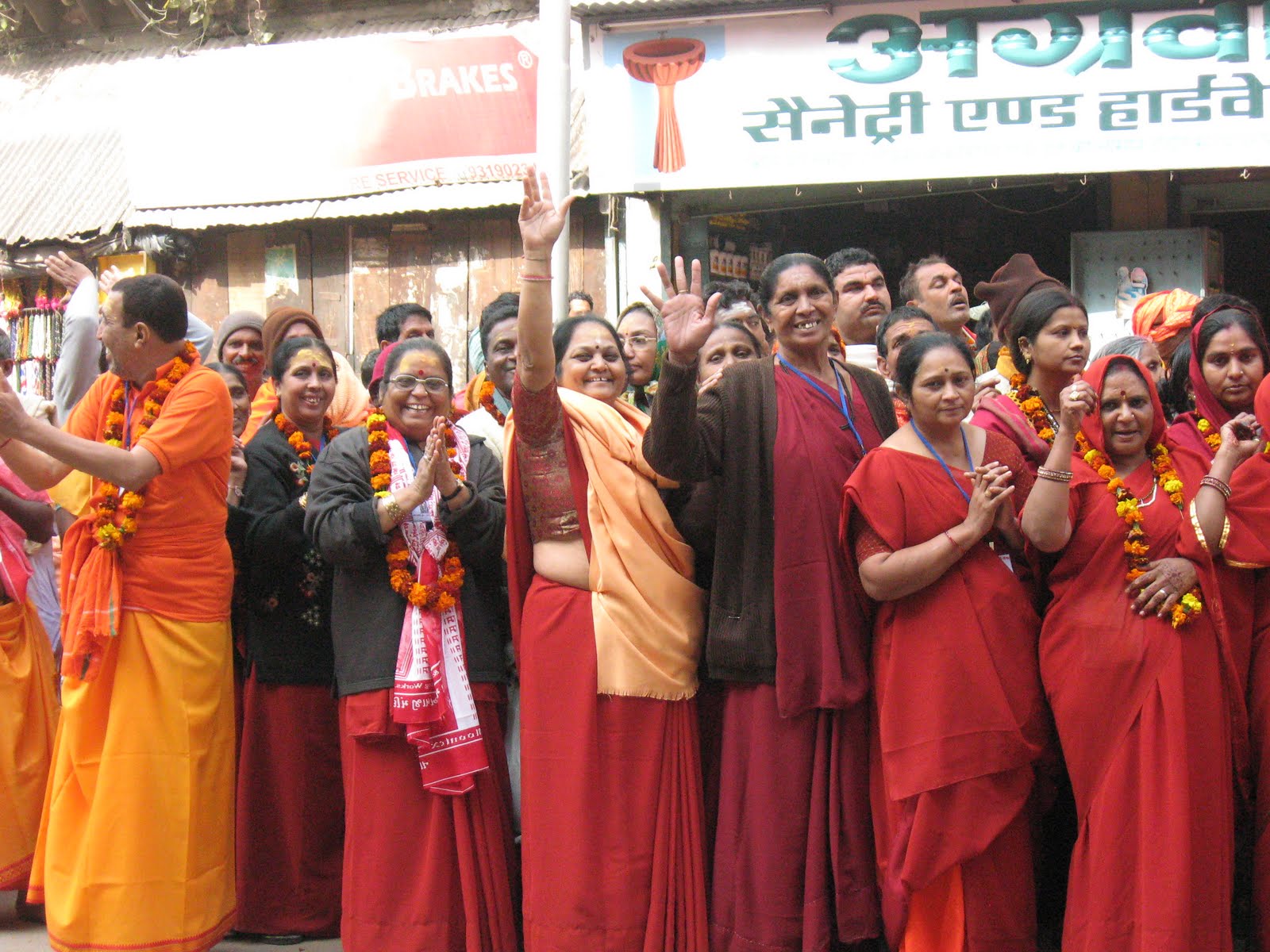
On Mahashivatri we watched the procession of the naga babas to the Ganges and I knew that I had never been to such a joyful event in my life.


devotees of a swami

Our hotel in Haridwar had its own ghat and after the naga babas took their bath on Mahashivaratri I walked down the steps into the Ganges and dunked myself three times. We had already been in Haridwar for five days but I wanted to wait until the day that Shiva married Parvati to really feel the river. I had immediately felt the energy of the river just standing on the terrace on the first day so I knew it would be even more energized after the holy men bathed.

I was right. During my third dunk I stayed underwater a bit longer and I felt electric. I came out and sat on the steps with my feet in the water. Bathing in the river is thought to wash away one’s sins, a death, so to speak (“you will die in India….”) The waters of the Ganges are called amrita, the “nectar of immortality”. Hindus believe that there is nothing as cleansing as the living waters of Ganga Ma. I wanted to sit there all day with the water on my skin. Something was coursing through me and once again all I felt was joy. Our true nature.

As it turned out it was an auspicious day for me because that night I met a swami of the highest order, a man who is the Acharya Mahamandaleshwar of the Juna Akhara.

That morning he had thrown a rose to me from the procession — he stopped his chariot, looked right at me, threw the flower and smiled, and then moved on. At that time I did not know that in the afternoon I would be invited to a special puja that night at his ashram, the oldest one in Haridwar. A mantra teacher friend from Mumbai sent me a text telling me he was staying at an ashram and would I like to come for a special Mahashivaratri puja. He said he would be chanting during the ceremony and maybe I would be interested. I had no idea that he was staying in the ashram of the rose throwing swami, I did not even know the swami’s name. Before I left my friend said, “what if it’s the swami from this morning?” I told her that would be too much of a coincidence — but there are no coincidences, all things happen for a reason.

When the rickshaw arrived at the ashram that night and I saw the picture of the swami who threw the rose, I froze in my seat. I couldn’t believe it. Once again that shakti blast pieced the coconut and all I could do was stare at the billboard with his picture. I sat there for so long that some of the devotees asked me if I was alright. I walked into the ashram grounds and eventually was taken back into the swami’s compound before the start of the puja. Nothing was planned, everything just happened, merely the flow of the experience, the essence of allowing things to unfold. I was told that night that it was my good karma to be there, that I was meant to be there from the moment I caught that rose. I returned every day to the ashram before we left Haridwar.

For whatever reason, maybe it was my jump into the Ganges, but my personal practice and my yoga teaching have changed. I really can’t describe it, but the energetics have changed, even my students say so. I’ve read that when shifts of consciousness occur it changes your DNA.

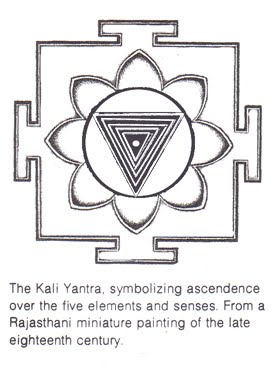
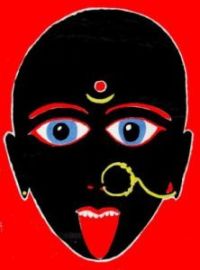
The new message I received during my recent meditations was that the day I stop teaching here will be the beginning of my Indian life. But not yet. I still have some cooking to do, it will take a few more years. I’m coming to end of my marinating and it’s nice to begin to see what the feast is going to look like. Or not. That’s OK, too. Kali is said to not give what is expected. It is said that perhaps it is her refusal to do so that enables her devotees to reflect on dimensions of themselves and of reality that go beyond the material world.

Everything with a grain of salt. All things happen when they are ready to happen. They always have.


addthis_pub = ‘yogagal60510’;

really?

On page 53 of the latest Yoga Journal there’s an ad for Slim Quick Ultra Calorie Burner to lose weight. In the same issue there is a story that the healing power of yoga will cure what ails America without pills or surgery.

Some magazines don’t accept advertising for products that are anathema to their magazine’s philosophy.

Apparently Yoga Journal does not have those same advertising ethics.

It would have been funnier if the ad was on a page that faced a story about yoga being about learning how to accept yourself and how you are perfect in this moment just the way you are. But that’s my sense of humor. Not everyone’s cup of chai.

I think that Calorie Burner is for everyone who wants to look better in those naked yoga classes.

Just sayin’

study + practice = balance


Prajnaparamita
(The Prajñāpāramitā Sutras are a genre of Mahayana Buddhist scriptures dealing with the subject of the Perfection of Wisdom.)

Brenda Feuerstein was kind enough to give me permission to publish this article by Georg Feuerstein. Georg has authored over forty books including The Shambhala Encyclopedia of Yoga, The Yoga Tradition, and Yoga Morality. You may also know Georg and Brenda from their Traditional Yoga Studies website: “Traditional Yoga Studies (TYS) is dedicated to promoting authentic yogic teachings based on scriptural and oral transmission, as well as solid research, and to bringing out their relevance at the present time of severe environmental and social crisis.” You can visit http://www.traditionalyogastudies.com for distance learning courses on:

1. 800-hour course on the history, philosophy, and literature of Yoga;
2. 250-hour course on Patanjali’s system of Classical Yoga;
3. 250-hour course on the Foundations of Yoga; and
4. 120-hour course on the Bhagavad-Gîtâ

Brenda also told me that they have received an anonymous donation and have decided to pay it forward and give away 10 partial scholarships for their 800-hour Philosophy, History and Literature of Yoga Course. Applications are due by the end of January 2010. If you interested in applying for the course scholarship program which is 50% off the regular price ($600.00 off), you can email Brenda the following information: full name and mailing address, email address, and tell them about yourself, why you want to study the course, and why you require a scholarship for the program.

In light of reader comments on my last post, I thought Georg’s article was especially timely.

Talk amongst yourselves!

Studying Yoga by Georg Feuerstein

Everybody talks about practicing Yoga. Few Westerners talk about studying it, and many believe that the study of Yoga is unnecessary and even a waste of time. They like to quote Sanskrit sayings about the uselessness of book learning. These are typically taken out of context, and other, more pertinent statements are either ignored or not even known.

Then, again, there are those who—like the majority of academics—maintain that one must understand Yoga objectively and that by practicing it, one automatically jettisons any claim to objectivity.

Both attitudes are wrong. The belief that studying Yoga is redundant is self-evidently mistaken, because unless we know what we are practicing, we cannot really hope to be successful in our practice. This is like wanting to build a computer without expert knowledge of its component parts and how they interact. Perhaps a more pertinent example would be to want to remove a brain tumor without any medical knowledge and surgical skill.

Thus, the Vishnu-Purâna (6.6.2), a medieval encyclopedic Sanskrit work, rightly and unequivocally states:

“From study one should proceed to practice (yoga), and from practice to study. The supreme Self is revealed through perfection in study and practice.”

The belief that objective knowledge is possible and highly desirable is just that: a belief. Philosophers have considered at great length whether the common ideal of scientific objectivity is in fact possible, and many have come to question this. Many have, in addition, expressed doubt about whether such objective knowledge, even if it were possible, would be desirable. Their thoughtful works are readily available, and so I won’t argue this point here.

My present focus of attention is on the study of Yoga, which tradition tells us is indeed essential to success in the practice of Yoga. Study is treated as an integral aspect of Yoga practice. Thus, Patanjali lists study as one of the five aspects of self-restraint (niyama), the second limb of his eightfold path.

The Sanskrit word for study is svādhyāya, which means literally “one’s own (sva) going into (adhyāya).” It stands for the serious and systematic study of both the Yoga tradition and oneself. Both knowledge of the tradition and self-knowledge go hand in hand.

The traditional scriptures contain the distilled wisdom of sages who have climbed to the pinnacle of self-knowledge, and therefore these texts can contribute to our own self-knowledge. Study, in the yogic sense, is always a journey of self-discovery, self-understanding, and self-transcendence.

Yoga does not call for blind faith, though it stresses the superlative importance of real, deep faith (shraddhā), or trust. Mere belief cannot help us realize that which abides beyond the conditional or egoic personality. Instead, Yoga has always been intensely experimental and experiential, and study is one aspect of this sound approach.

Many Western Yoga practitioners, especially those with a dominant right brain, shy away from study. They much rather polish their performance of this or that posture or, more rarely, learn a new breathing technique. Yet, it would seem they often miss the mark, because they do not know the proper context in which these techniques must be cultivated. The state of Hatha-Yoga practice and teaching in the Western hemisphere is a good case in point: What was once a profoundly spiritual discipline has been demoted to physical health and fitness training. [emphasis supplied.]

Often Western Yoga practitioners do not even have an accurate knowledge of the techniques themselves. They sometimes seek to compensate for their ignorance by trying to reinvent the wheel and by producing their own versions of yogic practices. While innovation is commendable — our whole civilizational adventure is based on it — in the case of Yoga, we would do well to be modest. After all, the Yoga tradition can look back upon the accumulated wisdom of at least 5,000 years of intense experimentation.

Just as a predominantly right-brain (action-driven) approach to Yoga has its pitfalls, a purely left-brained (thought-driven) approach is equally precarious, if not altogether futile. “Armchair Yoga” cannot replace actual experience.[emphasis supplied.] If our practice is merely nominal, so will be our attainments. In Yoga, both theory and practice form a continuum, like space-time. It requires from us a full engagement, as the Buddhists put it: with body, speech, and mind. Yoga, as the Bhagavad-Gītā (2.48) reminds us, is balance (samatva). Hence we ought to engage both cerebral hemispheres when applying ourselves to the yogic path. Let us also recall here that one of the meanings of the word yoga is “integration.”

An ancient scripture, the Shata-Patha-Brāhmana (11.5.7.1), declares that, for serious students, study is a source of joy. It focuses the student’s mind and allows him or her to sleep peacefully. It also yields insight and the capacity to master life. What more could one ask for?

Copyright ©2009 by Georg Feuerstein. All rights reserved.
Reproduction in any form requires prior permission from Traditional Yoga Studies.


addthis_pub = ‘yogagal60510’;

this is my real yoga

“You are a life saver. Without you I would be a stressed out 20 year old bitching about everything. Now I live my life and I’m writing my own story and I have never felt better. I tell everyone about you and how you guide people to find not only happiness but themselves. I thank you for opening my eyes to that.”
[college student, 2009]

With all the yada yada about how old yoga really is (see discussion in comments), the name-branding of yoga and the Show Biz Yogi Lifestyle (TM of course), what is “real yoga”, Bikram’s desire to have yoga (uh, asana) competition in the Olympics, ad infinitum, it all makes me want to scream “STOP!”

Don’t get me wrong, I love a good discussion, but I have to ask: when is enough, enough? Buddha (basically) said not to take peoples’ words as gospel, that you must experience things through your own lens and judge for yourself.

I know what works for me and I’ve written about it on numerous occasions. Brenda made an excellent point when she asked “if you just boil it down to asana without any kind of inner reflection, then isn’t it just floor exercise?” I love her one word opinion about that.

But I will play devil’s advocate and say, so what? So what if someone does some stretches when they get out of bed and calls it yoga? I asked Tom Pilarzyk that question when I heard him speak on whether American yoga is in crisis.

He said that he would compare that to the idea of Christmas. He asked, what if a person said “so what if I only like lots of presents on Christmas?” Tom said, OK, if that’s all you want, but isn’t the idea of Christmas really about something more?

I believe that yoga must contain certain things in order for it to be called yoga. Notice that I did not say any type of spirituality must be a requirement; I don’t even say namaste at the end of my classes. I don’t care if you’ve never read a yoga book and think Bhagavad Gita is the name of the guy who fixed your computer.

As I’ve heard Desikachar say, if yoga does not contain X, then you’re just doing acrobatics. Nick Rosen, the “star” of the movie Enlighten Up said “yoga’s anything you want it to be and that’s very freeing…” Uh, OK…I’m going to swing from a chandelier in my chakra underwear and trademark it as “SwingYoga.” Yup…just call something “yoga” and that makes it “yoga.” Uh-huh. And if you steal this idea I’m going to sue your yoga butt.

Sometimes all this yada yada makes me want to go off and live in a cave. OK, not really, but it does make me question being a yoga teacher, especially when stuff like this happens. I tell myself, why bother, when people aren’t getting it. I know a few teachers who have just given up. Then I remember what I heard Seane Corn say in a workshop: that she’d rather teach to the two who get it than the 10 who don’t.

But then a student tells me what my college yogi told me. Or the hearts of the domestic violence survivors crack open when they know that maybe just for this moment they are loved unconditionally.

That is my real yoga, and frankly, I don’t care what you do. I used to care, but I don’t anymore. You do your “yoga” and I’ll do mine. But please…don’t insult me and my teachers and my teachers’ teachers going all the way back to Patanjali by calling your morning stretches or your posing, yoga.

Don’t insult the original yogis, the sramanas, those renouncers of the Hindu rituals who around the 8th Century BC to the 2nd century CE used their bodies and minds as laboratories for the direct experience of yoga and nondualism.

If something isn’t changing for you off the mat, then don’t call it yoga.

Instead of a Christmas analogy, I’ll use food. If you want to make a chocolate cake but leave out the chocolate, can you still call it a chocolate cake? Or is it just a poor imitation?

Just askin’.

it truly IS the Kali Yuga

The Kali Yuga: the “Dark Age” lasting 432,000 years…when avarice and wrath are common, rulers become unreasonable, cowards have the reputation of bravery and the brave are called cowards…and lies are passed out as truth.

“In the age of Kali, every virtue had been engulfed by the sins of Kali-Yuga; all good books had disappeared; impostors had promulgated a number of creeds which they had invented out of their own wit. The people had all fallen prey to delusion and all pious acts had been swallowed by greed….

In the age of Kali duplicity, perversity, hypocrisy, malice, heresy, pride, infatuation, concupiscence and arrogance etc. pervade the whole universe….

In the age of Kali there is no contentment, nor discernment, nor composure…Envy, harsh words and covetousness are rampant; while evenness of mind is absent….

Self-control, charity, compassion and wisdom disappear while stupidity and fraud multiply to a large extent. Men and women all pamper their body; while slanderers are diffused all over the world….”
(excerpts from the Tulsi Ramayana.)

As roseanne wrote, it sure does seem like the end of yoga as we know it….

I saw this over at YogaDork and shook my head. Just when you thought the commercialization of American Yoga couldn’t get any worse, eh?

Everything eventually comes full circle. I used to be a fitness instructor and saw things come and go. Is that tai-bo guy still around?

This is why I say the “new yogi” will be a “radical yoga traditionalist.”** Two teachers I consider radical traditional yogis are Paul Grilley and Mark Whitwell (uh, and me, too, because like Paul I’m a traditionalist but don’t mind killing yoga’s sacred cows on occasion.)

Yup, Playboy Yoga, no chanting and no Sanskrit for sure (but does she eat granola?). No clothes either, because you can download her naked yoga (which will be a boon for everyone who searches for “naked yoga” and hits on this blog post so knock yourself out.)

Talk amongst yourselves.

____________________________________________

**“radical yoga traditionalist” concept originating here, comment #6. if that inspires you, then please give credit where credit is due. or else I’m calling Bikram’s lawyer regarding copyright.


addthis_pub = ‘yogagal60510’;