Christine writes the fabulous blog, blisschick where she exhorts you to be the change and live your bliss. Those of you who are regular readers of this blog or my other blog know that I’m all for that!
Christine contacted me last year to ask if she could interview me to be her FIRST BLISSCHICK OF 2009. I was honored because her other BlissChicks are women who are much more accomplished and successful than I, at least in my humble opinion.
So here you go, you can read about me here. I loved the videos she included — one of my favorite Annie Lennox songs and the Indian dance.
Her other form called Kālikā is referred to as “the Fierce Black One.” The Hindu Goddess Kali is sometimes depicted with a black face so you can see how Kali and the Vajrayogini are related. They both wear a mala of skulls.
Upon seeing the eyes of Kali tattooed on my arm a Tibetan told me: “Vajrayogini, Kali, same energy, you, same.”
On New Years Day I saw Slumdog Millionaire for the second time . If you haven’t seen Slumdog, go see it! Here’s the trailer:
Some of the scenes might be hard to watch — my friend covered her eyes more than a few times. The movie shows the India that the package tourists never see. Many “spiritual travelers” think that India is all about yoga, incense, and spirituality, but I can assure you that your rose-colored glasses will fall off very quickly if you read an Indian newspaper everyday. Read this blog for all my India adventures since 2005.
As for my “yoga resolutions” for 2009….
1. Meditate, meditate, meditate.
2. Try to live up to my dharma name of Sama which in Pali and Sanskrit means the same, equal, corresponding, balance, or equipose. It refers to that state of consciousness which reflects neither attachment or repulsion.
3. Always give it up to something that is greater outside myself.
4. Become my own best friend and know that no one is responsible for my happiness.
5. Know that I am not responsible for anyone’s happiness.
7. Devise a “Stress Management 101” 8-week program that includes yoga and meditation and shop it around to local corporations.
8. March: reconnect with my yogini friend from Tanzania, Africa. She is coming to America for the first time to visit her son in Washington DC, then flying to Chicago to spend four days with me. We became friends in 2005 when we studied for one month at the Krishnamacharya Yoga Mandiram and we’ve kept in touch ever since. She is 10 years older than me so she is in her 60s and decided to become a yoga teacher after our time together in India. So you see? It’s never too late for your dreams!
10. April: last 10 day retreat for the Spirit Rock training and stay in California an extra 5 days with my yogini “sister” and India compatriot for an early birthday celebration on the ocean. Also start planning for the Kumbh Mela 2010 because this is the friend I’m going with.
11. May: two days at the Midwest Yoga Conference for workshops with Mark Whitwell (whom I always wanted to experience) and Max Strom. I did one workshop with Max a few years ago and knew I had to do more.
15. November: possible teacher training with Paulie Zink, Paul Grilley’s teacher.
16. December: leave for India to study yoga therapy for two months under the guidance of Swami Tureyananda.
17. Stay in India until the Kumbh Mela in March-April 2010, returning May 2010.
18. Don’t give yoga advice unless someone asks me.
At this stage in my yoga life and teaching I am past the stage of caring what “type” of yoga someone does. To me, yoga is yoga, it all comes from the same source. I know what I like and what resonates with me and that came from exploration and not buying into dogma. my karma ran over your dogma, and y’all can take “my” yoga or leave it. I don’t care. I know that some of the things I say in this blog may upset some yoga virgins or newbie yoga teachers, but that’s what learning is all about, and sometimes somebody comes along to kill those yoga sacred cows. hey, somebody has to do it. now where is my attorney’s number? I think I’m going to copyright “my” yoga and put my name on it.
19. Meditate, meditate, meditate.
20. Let it go…just this, just here, just now.
All that being said, life can change in an instant and nothing is permanent. I give everything up to the Universe. I go with the flow, I am not attached.
1. Spend time Meditating. Meditation is unbroken concentration and the most effective type is self-reflection. Spend at least 15 minutes meditating every morning.
2. Get serious about your practice! One must get serious and simply attending class is not enough. Spend at least 15 minutes each morning doing Asana and focus on the main ones: Headstand, Shoulderstand, Plow, Fish and Cobra, etc.
3. Drink lots of green juices and remember the first Yama, Ahimsa. As long as you are involved with violence, your meditation will go no-where.
4. Understand the five subtle bodies or sheathes so that you can commence negating them at once.
5. How you begin something is of great significance. If you begin the New Year with a big mug of coffee, it sets the wrong tone for the entire year to come. Begin 2009 committed to the attainment of Self-Knowledge.
6. Outside of the three main texts, The Bhagavad Gita, The Yoga Sutras of Patanjali and Yoga Pradipika, read and study Swami Sivananda’s Self-Knowledge as it contains all the answers.
7. Dedicate the fruit of all action and be nice to everyone.
I’ve written previously about MysticSaint’s blog, a blog where you can spend hours reading about spirituality. I thought his post today, The Work of Becoming Human, was not only excellent but timely.
What is this work of becoming “human”? I know that the longer I walk this path the more I “change.” well, maybe not “change” in the usual definition as a transitive verb (yes, I was an English major!):
“To cause to be different; to give a completely different form or appearance to; to give and receive reciprocally; to exchange for or replace with another, usually of the same kind or category; to lay aside, abandon, or leave for another.”
“To become different or undergo alteration; to undergo transformation or transition; To go from one phase to another, as the moon or the seasons.”
I especially like the last line: “to go from one phase to another, as the moon or the seasons.”
When I began my teacher training about 7 years ago and especially when I wanted to go to India for the first time three years ago, the man in my life was not supportive of me whatsoever. In fact, he was negative about my plans to become a teacher and then especially later about my plans to study in India. Finally one day after years of negativity I calmly asked him, “what is it about my spirituality that scares you so much?” He said, “you’ve changed.” I told him that no, I had not changed, I’ve always been like this, only now I am deeper, and it’s just that he had never noticed it in all these years of being together. He had stopped growing and I had not. Or put another way, maybe his growth was at a snail’s pace and mine was exponential.
I got back into yoga in the mid-1990s after dabbling in it over 30 years ago. Only this time, now, I was in the right phase of my life to be able to immerse myself in it. It is said that one discovers or re-discovers one’s essential Self on this path and I know that I re-discovered that which I had put on a shelf many years ago. So just as fine wine becomes more deeply embodied in richness or the sound of a violin becomes sweeter with age, so I have become more conscious through this practice. As I move into this final season of my life, I know that my phases will continue to change as do the faces of the moon, because if they did not, I will have learned nothing from yoga. If I did not transform, I will have stopped becoming more human.
Carl Rogers, the founder of humanistic psychology, wrote On Becoming a Person. Rogers emphasized the concept of “self-actualization” and he believed that self-actualization implies that there is an internal force that calls to develop one’s capacities and talents to the fullest, that it is the individual’s central motivation to learn and to grow. Growth occurs when the individual develops new aspects of their skills, capacities, and views about life. Life is an endless process of creatively moving forward even if only in small ways. Life, therefore, is a verb and not a noun.
What is your idea of becoming more human? I always ask my students to bring yoga off the mat and into their lives. As a yoga practitioner how do you incorporate into your consciousness all the levels of being on which a human can be called “conscious”? and if you are conscious, do you believe yourself to be truly awake?
Self-Knowledge – The degree to which we know ourselves – our weakness, limitations, characteristics, motivations.
Self-Control – The ability to guide and transcend the promptings of the self.
Objective Knowledge – A knowledge that is in accord both with the practical needs of life and an objective Reality that can be known through an awakened and purified heart.
Inner Wisdom – The ability to access guidance and meaning from within oneself.
Being – The capacity to remain in a state of presence, to consciously witness experience.
Selfless love – A love for God and His creations without selfish motives.
Sustaining the Divine Perspective – The ability to always see events and people from the highest perspective of Love and Unity and not to slip into egoistic judgment and opinion.
Divine Intimacy – Awareness of one’s connection of the Divine Source.
Karmani ave adhikars te you have the power to act only
ma phalesu kadachana you do not have the power to influence the result
ma karmaphal hetur bhoo therefore you must act without the anticipation of the result
ma sangostu akramani without succumbing to inaction
The end of any year always leaves me in a pensive mood, plus I always like to throw stuff out and clear things away, like all the papers in my office for one thing. I also like to do some internal cleansing. I don’t make New Year’s resolutions, I send whatever intentions I have out into the Universe — if things happen, they happen. I learned a long time ago to detach from the outcome.
That’s why these words from the Bhagavad Gita resonated with me today. all things change, the nature of reality is impermanence. the older I get the more I realize this is true and the less I try to cling and hold onto things that are by their very nature impermanent. I’ve watched people who can’t control their own minds try to control their lives and it’s a never ending ride on that samsaric wheel. they run faster and faster and get nowhere just like hamsters in their cages.
However, that being said, I’ve made plans to live in India starting the end of 2009 and into 2010. it’s an intention that I’ve thrown into the Universe. I plan to study yoga therapy for two months under the personal guidance of a swami-ji at his ashram in South India and then travel north to the Kumbh Mela in Haridwar in 2010. I received word from the ashram today to come earlier and stay with them on New Years Eve 2009 before the study starts. I could not think of a better place to be on New Years Eve than in India — that’s where I was on December 31, 2007.
So 365 days from today I will be in Ma India again, but as with all things, if it happens, it happens, I am not clinging. a year is a long time in the physical realm but only a blip on the radar screen in the astral realm. and I must always remember that anything can happen.
If I die tomorrow I would still be happy and I regret nothing. I have lived with rasa and passion and followed my dreams. I have walked to the end of an Indian beach where Hanuman lept across the ocean to save Sita and I have also been all alone in India sicker than an Indian street dog. I still regret nothing.
I give everything up to the Universe, but not without inaction. I merely detach from the outcome and live in the Sacred Now.
What do people need to know about their connective tissue? What is the relationship between connective tissue and yin yoga?
Usually the only time people think about their connective tissue — which includes our tendons, ligaments, and fascia that surrounds and intermingles with our muscles — is when we injure it, like a sprained ankle. However, what people do not realize is that the connective tissue of our bodies is all about our flexibility; our muscles are all about strength. The health of our joints is related to the health of our connective tissue. What will give us a sense of ease and comfort in our old age is not how much weight we can lift, but our flexibility and the health of our joints, like our hips, pelvis, and spine. People do not realize that if our connective tissue is not therapeutically stressed on a daily basis, that is, stretched in slow, long-held floor poses such as what is done in yin yoga, our connective tissue will literally shrink wrap our joints. This should be of great concern to women because the spine is surrounded by about seven layers of connective tissue and when, not if, the connective tissue begins to stiffen due to lack of movement, it can literally crush already thinning vertebra and thereby contribute to that “old lady’s hump”. It is not so much osteoporosis that causes the rounding of the back, it is the connective tissue of the spine shrink wrapping the vertebra. That is why forward folds with a rounded back and back bends are so important for the health of the spine. Doing paschimottanasana with a more rounded back helps to stretch the spine more, rather than doing it with a flat back.
In yin yoga the connective tissue of the hips, pelvis, and spine is worked slowly in a “yin” way. Other forms of yoga are more muscular and therefore more “yang”, that is, moving and rhythmic. The only way connective tissue is stretched is by relaxing the muscles and holding the floor yin poses for three to five minutes minimum. Again, flexibility has nothing to do with our muscles, it has everything to do with our connective tissue.
I believe that the ability to stay still for five minutes at a time has a lot more to do with our minds than our bodies. This is why yin yoga is also mind training, we train ourselves to be still in a world that is rushing out of control, and not that we can control it anyway. If someone values the quality of how they are living each moment, giving themselves time to turn off the movie that constantly plays in their mind and do some yin yoga, then they will begin to find more space in their life.
I’ve been interviewed for an article for the health and fitness magazine supplement to my local newspaper that will come out in January. I thought I would post some of the questions and my answers.
How does yin yoga balance the mind, body, and spirit?
Yoga was never meant to be a purely physical practice — the ancient yogis (the sramanas) knew this when they went into the forests thousands of years ago to use their own bodies and minds and nervous systems as laboratories for experiments in personal transformation. We are not just our physical bodies so whatever type of yoga is practiced will balance the mind-body-spirit.
All yoga styles work the energy body, however, I feel that yin yoga is in a sense a deeper practice because the emphasis is solely on the connective tissues, not the muscles. Both the ancient Indian yogis and the Chinese yogis (the Taoists) believed that the connective tissue houses energy pathways, called nadis by the Indians and meridians by the Chinese. These energy pathways contain our life force, prana as the Indian yogis called it, chi as the Chinese yogis called it. Our energy body (the total of all these energy pathways) tends to become dense or stagnate when we do not move our bodies outside of our habitual ranges of motion. This is why we do yoga. But by coming into a pose in a slow yin way and staying for many minutes at a time helps us get deeper within our natural ranges of motion in the joints of the hips, pelvis, and lower back.
Chi stagnation is what acupuncturists deal with so that is why yin yoga is also called “needleless acupuncture” because you can move and balance your chi via yin yoga postures by stretching and pressuring the connective tissues that house the meridians. Modern life is very yang, lots of movement, rushing around, no stillness — this causes stress and burn out. Yin yoga is a way of slowing down and going inward. Life is always about balance, the yin and the yang. Too much yang and you burn out; too much yin and you become a couch potato. Think of all the physical ailments that people have from too much stress and burn-out.
Because of my own personal yoga and meditation practice, I truly believe that combining a yin practice with a yang practice (such as a strong vinyasa or astanga practice) offers a complete yoga practice not only on the physical level but more importantly on the psychic level. I believe that working on these deeper levels is what what leads or our own personal transformation and that the changes we make to our soft tissue have a profound influence on the emotional, mental, and energetic levels. My own yoga practice deepened in a very potent way when I began to move away from an alignment-based, precision-obsessed practice.
There is also a whole psychosomatic level to balancing the energy body. Strong and flowing prana (or chi) is important because it affects the way we feel and the way we think. Blending the physical with the emotional levels expands our possibilities within a complete yoga practice.
“The real sky is (knowing) that samsara and nirvana are merely an illusory display.” —Mipham Rinpoche, Quintessential Instructions of Mind
I have written more than a few times about the emails from the Universe….yes, the Universe sends me an email everyday and sometimes they are so right-on that it makes the hair on my arms stand up. the words below are what I received today and they really struck a chord.
I’ve been through a lot of emotional turmoil this year — not as much as other people I’m sure, but more than some people experience. I made a life-changing decision and someone who I thought wanted to be with me, did not. I learned this year that my mother (from whom I was estranged for over 20 years) died three years ago. that knowledge alone brought back painful childhood memories. and of course all the ridiculous drama at the yoga studios. I’ve also decided to finally disengage myself from someone I’ve known for more than half my life. it will not be pleasant, but 2009 for me must be clean and fresh. a new beginning. like each new moment.
I no longer believe that I have a depressive personality but for the last month I have come to know what depression feels like again, so much so that I wondered whether I had PTSD symptoms. repressed memories screw with your mind when they rear their ugly heads.
So the note from the Universe hit me in the face like the pungent humid air in Chennai does when I step outside the airport at 3 AM. I read it this morning and sat back and said “yes.” but that “yes” was more an affirmation for myself, that yes, I create my own suffering, and yes, there is a way out of suffering, and that way out is not the way I was thinking of when I was at my lowest.
“I can imagine that from your perspective, it must seem like some truly awful things happen in time and space. So if you wouldn’t mind, I’d like to weigh in.
Sama, you live in a world of illusions. A world that springs from a much deeper and far greater reality. And while at times the illusions are indeed ugly, with your physical senses you only see the tip of the iceberg. If you could see the whole, you’d discover that the unpleasantness was only the tiniest piece of a most spectacular puzzle that was created with order, intelligence, and absolute love. You’d see that contrary to appearances, in the grandest scheme of things, nothing is ever lost, no one becomes less, and setbacks are always temporary. And you’d understand that no matter what has happened, everyone lives again, everyone laughs again, and everyone loves again, even more richly than before.”
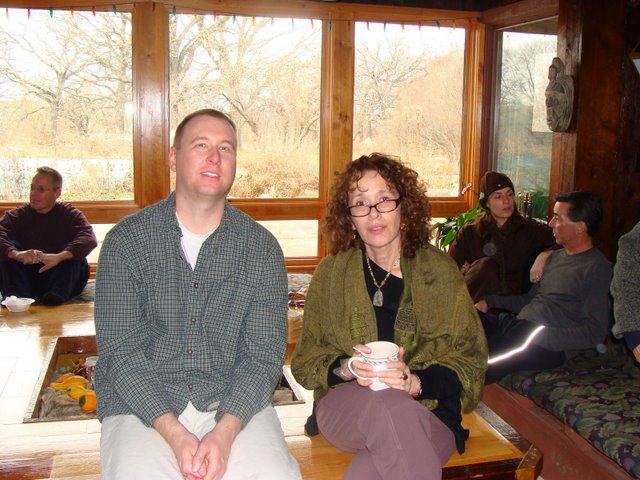
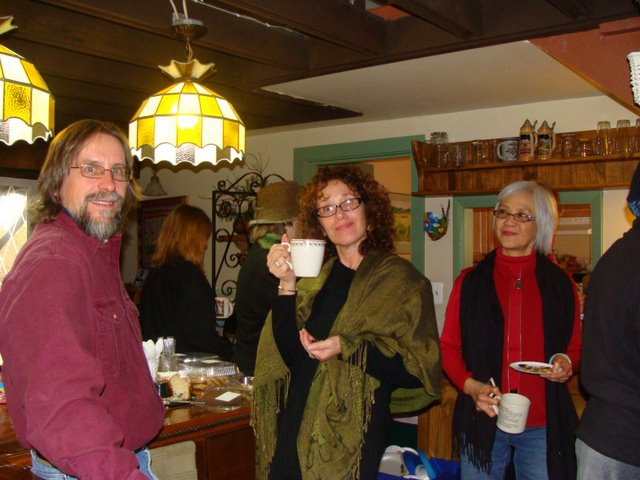
OK, I know I look like I had a few drinks or smoked a doobie, but I didn’t, I swear on Buddha’s teeth. I am with Sujatha, my teacher who named me Sama, and Jayson, another yoga teacher.
that really is NOT an Irish coffee!
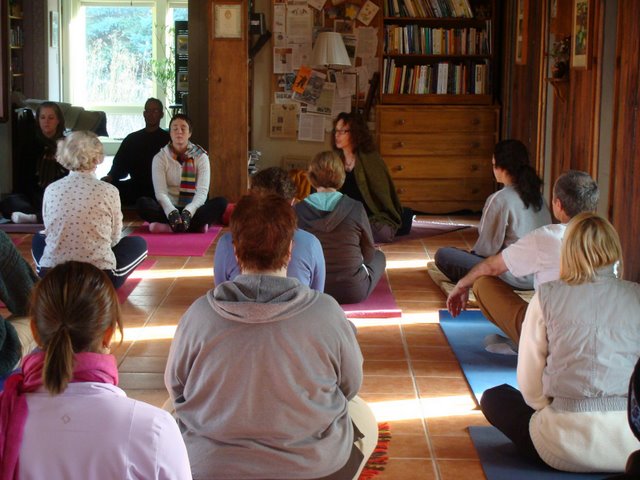
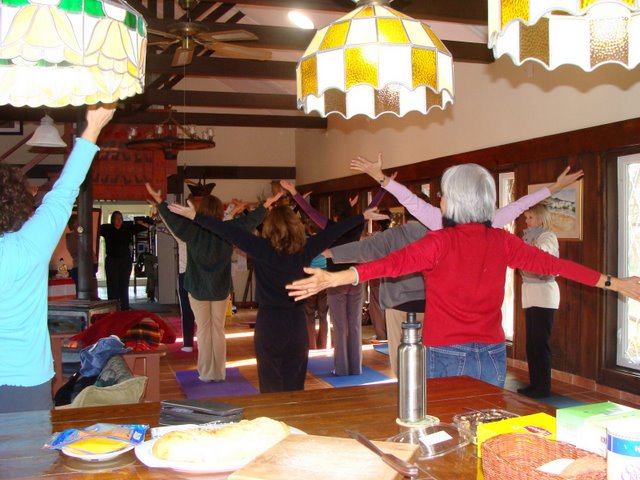
photographic evidence that I really AM a yoga teacher! leading a gentle yoga class before the Thanksgiving meditation retreat
the woman in red really does NOT have pink arms growing out of her neck.
when my sweater fell off my shoulder this dude was checking out my tattoos when he should have been meditating. here he was caught telling me how nice they were. no, seriously, he was a nice guy, he just loved my shoulder…uh…tattoos. also photographic evidence that the lady in red does not have pink arms growing out of her neck. and I’m STILL not drinking Irish coffee from that cup! really.
just a day hanging out with those wild and crazy Buddhists!
Amanda left a very juicy comment to this post. I thought she left such delicious yoga food for thought that it was worthy of its own post.
so what say you, readers? has westernized yoga for the last dozen years or so merely been the “new aerobics”?
Yoga has been in the west for a long time. I have a book I bought at an antique store called The Dayspring of Youth: Yoga Practice Adapted for Western Bodies written by “M” and published in 1933 — not one word about asana is in the book. Indra Devi taught Hollywood stars such as Gloria Swanson and Olivia de Havilland after World War II and in the 1950s. I dabbled in yoga and meditation back in the my college hippie days in the early 1970s and my claim to fame is OMing with Buddhist and Beat Poet Allen Ginsberg. but for yoga to have become so popular and trendy, I believe what Paul Grilley has said about it: that the spirituality had to be totally stripped out of it in order for most westerners to come to it.
So here is what Amanda thinks…the only edits have been for spelling, punctuation, and flow (no yoga pun intended.)
“I am sure there are some lessons for the Western (not the Eastern) yoga community that could be learned from studying the aerobics/groups fitness craze of the 1980s.
At its peak, the aerobics craze dictated (somewhere around 1986-1989) that you ‘needed’ to have all the right brands, the matching leotards, headbands, etc. And preferably be able to teach or do mindnumbingly complex choreography. Aerobics was everywhere – and it was of a variable and questionable quality. Some instructors had ‘it’ and others were simply amateurish, and at worse, downright dangerous. Ironically, the average lifespan of an aerobics instructor was 2 1/2 years.
In the early 1990s, the bubble burst. Be it the matching headbands, the complex choreography, or the whole ‘Barbie Doll/airhead’ image that had built up around the fitness industry, or the economic recession we had back then, people began staying away from classes in droves. It began with men, and continued until it was only the hardcore addicts who were left. Centres that were once highly profitable closed overnight. I know — I owned and operated a centre at this time. I was able to close it and sell the plant equipment and barely avoid losing my house.
By the mid-1990s, this situation began to change. The industry, in Australia at least, had totally professionalised (you need a Diploma level qualification to teach at gyms in Australia — you don’t need this to teach yoga, I notice) and an amazing New Zealand franchise called Body Pump hit the scene. People began to come back. Especially men.
What did Body Pump do? It totally did away with the complexity and the ‘trendy’ clothes. You did Pump in daggy shorts. Instructors taught participants that technique was everything and image was nothing. You focused on the foundations, getting the basics right – with incredible results. As instructors, we were taught how to communicate as experts, were were taught that safety was paramount. Our music and moves were choreographed for us by experts.
Nowadays, if you don’t have Pump on your timetable, you’re losing money. The same New Zealand company has followed with other programs, including one based on yoga. Worldwide, 10 million people every week do either Pump and Body Balance (Flow) alone!
So yoga is 3500 years old and there is a complete way of life, rather than just physical exercise. But when I look at the yoga world in the cities and in the US, all I see is uber-flexible Barbie Dolls in brand name clothes, and a frenzied mega-popularity that will surely burst in this economic climate. I see the aerobics craze all over again. [emphasis supplied.]
Underneath, however, are some dedicated souls who have depth, who are professional and authentic. If I was going to say what can we learn from the aerobics craze, it is this:
the yoga world in the West is yet to really mature – at the moment, it’s an incorrigible teenager. The bubble will burst.
Yet it will mature in order to survive. It will do this and thrive because it will find the right cultural “mix” and niche.
Yoga teachers, studios and schools will disappear whilst this is happening. Those that remain will do so because they have the basics – the heart and soul – of teaching yoga to the community and sharing those basics with others. This is a long, hard journey but one that has to be had.”
Thanks for writing this post, Amanda! check out Amanda’s blog — she is now a “friend of the family”!






 Linda's Yoga Journey
You must be logged in to post a comment.