Dear Representatives of the Many Yoga Clothes/Accessories Companies Who Tell Me They Love This Blog and Then Request that I Promote Your Site:
I do not promote things I know nothing about, but if you want to send me samples of your clothes, yoga props, yoga products, and other various and assorted yoga tchotkes, I am more than happy to try your clothes or products, review them here, and then give them to my students at the domestic violence shelter where I teach yoga. They could really use some yoga clothes so they don’t have to practice in their jeans or work clothes. And we could use lots more yoga props. Like everything.
So please send me lots of free stuff, like that free promotion you want.
Last year I wrote a three part series on trauma sensitive yoga after my training at The Trauma Center in Brookline, Massachusetts. I posted the series on the LinkedIn page of the International Association of Yoga Therapists and shortly thereafter Kelly Birch, the editor of Yoga Therapy Today (IAYT’s magazine for members), asked me to write an article. I was honored (and humbled) to be asked!
My article, Compassionate Presence: Teaching Trauma-Sensitive Yoga, has finally been published in the current issue (Summer 2012.) And let me tell you, it is damn hard writing for someone else! I now know the value of a good editor because Kelly was fantastic. I am even more honored to be in a magazine that also has an article about the Krishnamacharya Yoga Mandiram.
At this point in time only IAYT members can access the site to read the article, but you can download the .pdf from the above link. Please share it with someone whom you think might benefit. Kausthub Desikachar told us in one of my trainings that we must share what we have learned, otherwise we are nothing more than thieves, taking and not giving.
For me, real yoga is about personal transformation and healing. My long time readers know that I teach at a domestic violence shelter and some of the women have started to come to me for classes. Coincidentally, the day I received word that Yoga Therapy Today was being mailed out, I received a call from a woman suffering from PTSD because of an incident four years ago. She had googled “trauma sensitive yoga” in the Chicago area but was concerned that maybe I would not drive almost an hour to see her. The drive did not concern me because after I talked with her I knew yoga would help.
As I wrote a practice for her, a voice told me, “give her a mantra”, something which I’ve never done before with a private student. Somehow I knew she would connect with a mantra. We met, she did the practice, and I gave her pranayama and the mantra, OM JYOTI AHAM — “I am the Divine Light.”
The change was noticeable after the practice. She looked lighter and happier and her eyes were brighter compared to when I walked in. She smiled and said that it was the calmest she had felt in four years even though she takes medication. I told her that all I did was give her a road map pointing the way out, now she has to drive. I told her that she had to something from practice every day, even if it is merely sitting and watching her breath. She wants to continue working with me once a week.
Humbled, honored to do this work — who needs to be a yoga rock star? This is priceless.
Sometimes readers email me to shoot the breeze about yoga stuff. Last week a reader and Facebook friend wondered about this (he gave me permission to quote him.) He said:
“I had a conversation with my mentor…whom has been my connection to the Krishnamacharya lineage. We were discussing the effects of traditional systems vs. Innovative systems, most specifically the relationship between Ego and a teacher’s “need” to innovate.
Obviously one of the key features of Krishnamacharya’s teaching was the importance of adaptation of the practice to suit the individual…..and American teachers seem to be very good at adaptation….but that adaptation seems to be more about their own ego and “self value” in creating the newest and most “effective/clever” system of Yoga.
I’m not really asking a direct question, but more your thoughts, maybe you’ve written something of similar subject? I figure your being connected with KYM, this is something you guys discussed?”
Interesting discussion!
I actually have never written about this and in all my times at KYM, this topic has never come up. If I understand the question correctly, it is: where does the ego and service, so to speak, separate?
I can’t comment on what other teachers “invent”….Anusara, Forrest yoga, etc. Does it come out of their ego on wanting to control or change things? I don’t know. Someone once said that I created METTA YOGA. Did I? I don’t know. I say that Metta Yoga is the Yoga of Awareness, i.e. being awake to reality, all the good and especially the bad, our shadows. All I know is what informs my practice: trainings at KYM, with Srivatsa Ramaswami, Buddhism. “My” yoga is all about the breath, meeting people where they are (both aspects being totally KYM), being aware of what is happening now (the Buddhadharma.) Yoga, for me, must contain pranayama and meditation for it to be called Yoga, but that’s me, that’s the lineage in which I study. Am I going to totally spin the teachings to suit my own purpose? No, because to me Real Yoga (and I don’t care if that phrase upsets people) is about Transformation and Healing.
We all know what happened with John Friend and Anusara…karma? And people applaud Ana Forrest’s “new” way of teaching — isn’t it supposed to be a bit more therapeutic now? I’ve been teaching that way for years, i.e., about watching what comes up, digging down to face your demons. In my opinion, she did not come up with anything brand new.
No one called Krishnamacharya a “yoga therapist.” When I was in India this year, A.G. Mohan told us that Indians did not come to see Krishnamacharya for “yoga for fitness”, i.e., purely asana practice. They lined up literally down the street to see him for yoga for depression, bad backs, and other conditions. He did not teach “yoga therapy”, IT WAS JUST YOGA. So did he change what he learned from his gurus? Of course he met the individuals where they were, we know that he taught Iyengar, Jois, and his son Desikachar differently because that’s how those styles evolved. But did he make up something that was dramatically different from what his gurus taught him? I don’t think so.
All I know is that I must meet people where they are and as Desikachar has said, whatever happens, happens.
What I do know is that in the end, it’s all the same, really. What did Friend create? Anusara is Iyengar inspired and he put a new spin on things, his whole tantra-esque thinking is nothing new, he just made it sexy palatable for Westerners.
After I responded, the reader went on to say that “the direction American Yoga is moving in is pretty darn interesting. In fact, over contemplating your email, I started wondering what drives most Western yoga students to become “teachers” in the first place, let alone trying to reinvent their “own” system. Part of it, I’m assuming, is the ego wanting this seemingly luxurious life of being a yoga teacher……because let’s face it, the way most Americans work their lives away pretty much sucks! The American Dream has essentially become Corporate Slavery.
I think Americans turn to Yoga because it almost seems like a way out. In a way, it’s a very distorted approach to Moksha!
The other reason I think students are going the “teacher” route is that it kind of offers students a way of deepening their own Yoga practice/sadhana — [quoting his teacher] “teaching is a fierce sadhana”. Ain’t that the f%$#ing truth! I think American yoga students do want and are hungry for more than just “asana classes” so why not go through a teacher training course! They are always also described as an “opportunity to deepen one’s own practice”! I think the American yoga community is maturing enough as a whole to realize there has to be something more to yoga than just asana…..hence so much innovation and crazy weird shit happening in yoga classes.
As bad a rep as the Guru principle has received in the US, I think it’s a missing element. The idea that a teacher has done the long hard journey and come back to help others along. Not to say they are totally missing….but I think there is a lack of very experienced teachers amongst the yoga population here. And the ones that are around are too busy traveling around teaching workshops to thousands of students around the country rather than working closely with a student for a long long time!”
As for everyone doing teacher trainings, I personally think there are TOO MANY teacher trainings. It feeds into what I wrote about babies teaching babies….https://lindasyoga.com/2011/08/03/babies-teaching-babies/ — which ironically has a video of John Friend! Hey, who knew, right? 😉
As for yoga teacher trainings helping someone to “deepen” their own practice….really? In what way? Always? For everyone? I tell my students that if their path is the length and width of their yoga mat, that ain’t much of a path. How are you treating people, what are you saying to people? “Deepening your practice” is a loaded phrase.
I believe that teacher trainers do a disservice in taking everyone into their training, like those who have been doing yoga for a month. Uh, no. If I did my own training my requirement would be one year of solid yoga practice, at least once a week. I am damn old school. I was a student for 7 years before I became a teacher, not 7 weeks.
“What you should not do, I think, is worry about the opinion of anyone beyond your friends. You shouldn’t worry about prestige. Prestige is the opinion of the rest of the world.
[…]
Prestige is like a powerful magnet that warps even your beliefs about what you enjoy. It causes you to work not on what you like, but what you’d like to like.
[…]
Prestige is just fossilized inspiration. If you do anything well enough, you’ll make it prestigious. Plenty of things we now consider prestigious were anything but at first. Jazz comes to mind—though almost any established art form would do. So just do what you like, and let prestige take care of itself.
Prestige is especially dangerous to the ambitious. If you want to make ambitious people waste their time on errands, the way to do it is to bait the hook with prestige. That’s the recipe for getting people to give talks, write forewords, serve on committees, be department heads, and so on. It might be a good rule simply to avoid any prestigious task. If it didn’t suck, they wouldn’t have had to make it prestigious.”
“In every community there is work to be done. In every nation there are wounds to heal. In every heart there is the power to do it.” — Marianne Williamson
Three women from the domestic violence shelter came to my home shala this week. They’ve known me from the shelter since 2004. But I am only there once a month. They want more, and since the shelter can’t give them more yoga, they came to see me. I’ve opened my home to them. I won’t charge them what I usually charge for private yoga, so I tell them to pay me what they can afford. I don’t care.
They know what real yoga does, what it’s used for.
Healing.
Transformation.
That’s what they were seeking.
She called me because she wanted relief from her anxiety attacks. She wants to be able to sleep. She had been doing well but took a few steps back. She went to the doctor because she thought she was having a heart attack. The doctor ran tests and told her she was fine. She gave her pills and told her to see a psychiatrist. But she did not want pills or the psychiatrist, she wanted yoga, so she called me.
We talked a long time, she told me her stories, what she has been dealing with. I understood completely. Two steps forward, a few steps back.
I told her how so many people live their lives in fear or anger, sometimes both. We’re mad at the past, afraid of the future, never right here, right now, just this. Only this. She understood, she’s heard me before, she just needed to be reminded of Buddha’s teachings on the two arrows of suffering. I told her to drop the hot coal.
I give what is needed to heal. I dose intuitively as any good medicine woman does. I flow as I am directed. No asana needed right now, only a heart opening. I placed a bolster under her to expand the chest, some blankets under the arms and head and asked her only to breath, to make the exhales longer than the inhales. When you teach someone a healing pranayama, miracles can happen. I gave her a visualization.
And then they came.
I am also an energy worker, a clairaudient, very sensitive to energy changes. My yoga room has an ananda vibe, everyone says so. She said that sometimes new places make her anxious but she felt safe here. It’s good to feel safe with someone you know but don’t know.
The windows were open and I heard the wind rise, the wind chimes started to ring furiously. I felt the change, I heard the swoop, and knew we were surrounded. She was surrounded. My voice sounded disembodied and I felt pressure on my arms as if someone was touching me. When I am do energy work my hands heat up and vibrate, but I wasn’t touching her.
I don’t know how long she was on the bolster, I don’t know how long I spoke about healing the heart.
All I knew was that it was just the two of us again.
After she sat up I asked how she felt and before she said anything I told her, “you were surrounded by angels.” I surprised myself when I said that, but I knew it as strongly as I know my own name. I said that the concept of angel guides had never resonated with me until I had some powerful energy work myself and then I believed. I told her to call them what she wanted…angels, light workers, spirit guides, it doesn’t matter because those are only labels.
She looked changed, lighter, brighter. Happy. She said at one point that even though her eyes were closed she saw a ball of white light surrounding her and the peace she felt was extraordinary. She said she knew now how to reach that place again.
And then she started to cry.
“Healing is not, after all, the same as curing. Healing does not mean going back to the way things were before, but rather of allowing what is now to move us closer to God.” — Ram Dass
Written by S SRIDHARAN, TRUSTEE, KRISHNAMACHARYA YOGA MANDIRAM, CHENNAI — from KYM Newsletter, April 2012
The ancient Indian model of human beings. “Personality”, given in the Upanishads, consists of the ‘five’ sheaths. They are ‘Annamaya’, ‘Pranamaya’, ‘Manomaya’, ‘Vijnanamaya’, and ‘Anandamaya’. ‘Annamaya’ represents that segment of the human system which is nourished by ‘anna’, i.e. food. ‘Pranamaya’ is that segment which is nourished by ‘prana’, i.e. ‘bio-energy’. ‘Manomaya’ is the segment nourished by ‘education’. ‘Vijnanamaya’ is nourished by ‘ego’ and ‘Anandamaya’ is the segment nourished by ‘emotions’.
[NOTE: THE WORD “KOSHAS” IS NOT USED TO REFERENCE TO THE SHEATHS BECAUSE KRISHNAMACHARYA DID NOT BELIEVE THAT THE BODY COULD BE REPRESENTED AS “BAGS”, WHICH IS WHAT KOSHAS MEANS]
Each of these five segments has a head, two wings, a body and a tail. ‘Vijnanamaya’ which represent our ‘individual personality’ has ‘shraddha (faith)’ as head, ‘rtham (righteousness)’ as right wing, ‘satyam (truth)’ as left wing, ‘yoga (meditation)’ as body, and ‘mahat (source of all knowledge)’ as the tail. “Vijnanamaya” represents ‘Buddhi’ which is the ‘determinative knowledge’ or ‘intelligence’ of what has been learnt through the ‘Manomaya’.
This ‘Vijnanamaya’ is different from one person to another and that is why the textual knowledge learnt is interpreted and practiced differently by different people. However, for the ‘Vijnanamaya’ to lead towards the right path, the most important factor is ‘Shraddha’, the faith in what one has learnt. It should be backed up with righteousness and truth in practice. For these to be firmly imbibed one should take to ‘Yoga’.
Development
While the words ‘Development’ and ‘Evolution’ are considered as one, there are differences. Upanishads talk of ‘Evolution’ rather than simple ‘Development’. Evolution involves ‘discovery of the divine’ in us and everyone. While ‘Development’ calls for sharpening skills and adding certain traits, etc., ‘Evolution’ calls for removal of impediments in the ‘realisation of Self’. The major impediment in ‘Evolution’ is the ‘Klesas’ which consist of ‘Avidya’ (Wrong knowledge), ‘Asmita’ (Ego). ‘Raaga’ (Lust). ‘Dvesha’ (Hatred). and ‘Abhinivasa” (Fear). ‘Evolution’ is continuous process till the goal is reached. It does not stop with simple ‘recognitions’ by Society or Institutions.
Modern day ills
In the modern day context, Personality Development is the sum total of the achievements of the individual in academic, art, sports, business or other areas. Often a successful person is considered to be a totally developed person. However, the moral and ethical aspects of life are not given importance. Today’s ills are on account of the fact that textual knowledge is segregated from the practice of ‘truth’. The university education lacks ‘Shraddha’ and that causes the mind to act in ‘sinful’ ways. It has become a common scene to see how highly educated individuals take to violence and deceitful ways. To put it in terms of the ancient Indian model, the development is just up to the “Manomaya” level.
Holistic approach
A holistic approach in personality development, in this context, therefore, would mean a proper development in all the five maya-s. Any practice should aim at developing the maya-s simultaneously well and work in harmony. “Personality Development” is “Evolution” towards reaching the ‘Divine’ in the individual which is at the ‘Anandamaya’ level.
Message from Bhagavad Gita
The first and foremost message of Bhagavad Gita in the context of Personality Development is that even the most learned, highly successful and fearless can suddenly enter into a state of ‘despondency’ leading to ‘inaction’. Arjuna represents the state of normal human beings, even though achieving greater heights have a chance to ‘fall’ if they don’t take to the path of ‘divinity’ and achieve the goal.
The ‘Divine’ qualities one should aim to possess are given in the Sixteenth Chapter and are as follows:
Abhayam: Fearlessness
Sattva samsuddhi: Purity of Mind
Jnanayogavyavasthitam: Practice of Yoga for Self-realisation
Danam: Charity
Damam: Control of Senses
Yajnam: Performance of Sacrifice
Svadhyayam: Study of texts for ‘Self-realisation’
Tapas: Austerity
Aarjavam: Straightforwardness
Ahimsa: Nonviolence
Satyam: Truthfulness
Akrodham: Absence of anger
Thyagam: Renunciation
Shanti: Tranquility
Apaishunam: Aversion to faultfinding
Daya: Compassion
Bhuteshvaloluptvam: Freedom from covetousness
Mardavam: Modesty
Hri: Shame in doing unrighteous deeds
Achapalam: Absence of craving
Tejas: Vigour
Kshama: Forgiveness
Dhriti: Fortitude
Soucham: Cleanliness
Adroham: Freedom from envy
Natimanita: Absence of self esteem
The ‘demonic’ qualities one should aim to get rid of are:
Dhamba: Pride
Darpa: Arrogance
Abhimanam: Conceit
Krodha: Anger
Parushyam: Sternness
Ajnanam: Ignorance
Yoga the best tool for Personality Deveopment
Yoga is aptly fitted, for holistic personality development, because its tools are varied and integrated. ‘Asana’ practice for ‘Annamaya’, ‘Pranayama’ for ‘Pranamaya’, ‘Svadhyaya’ or Study of scriptures for ‘Manomaya’, and ‘Vigyanamaya’ and ‘Isvarapranidhana’ for ‘Anandamaya’.
While the practice for everyone could differ from one to another, there are some ancient methods which have been handed over from time immemorial. One such practice, which aims at ‘holistic personality development’, is the ‘Sandhyavandanam’, the prayer to Sun.
The word ‘Sandhyavandanam’ is split as ‘sandhya+vandanam’. ‘Sandhya” is the name of ‘Sun God’ and ‘Vandanam’ means to ‘prostrate’. There are at least 22 steps, which has ‘asana’, ‘pranayama’, ‘nyasa’. ‘mudra’, and ‘japa’.
There are a number of vedic mantras used in the ‘Sandhyavandanam’, but the main mantra which is used for ‘japa’ is ‘Gayatri Mantra’.
“Let me meditate on the effulgence of the Supreme Being in the Sun, which kindles our intellect.”
The concept behind this Mantra meaning is that all our actions lead us to happiness or sorrow and behind the actions is the intellect. If the intellect is clear and is bereft of the impurities of selfishness, greed and lust, our actions will always lead us to happiness.
Sun is considered as the ‘visible God’ (pratyaksha devata) the provider of life to the Universe. Sun is responsible for all the development in the Universe.
The highest knowledge is that which takes one towards the Supreme Being and that is ‘Brahma Vidya’. The best form of meditation which qualifies one for enquiry into the Supreme Being is Sandhyavandanam.
The holistic development should aim at making human being divine. Such a development will make one realize divinity in the ‘self’ and in every aspect of the Universe at large. There is total love and that brings the eternal peace.
The second of Kausthub’s lectures at the “Discover Yoga Anatomy” intensive at the Krishnamacharya Yoga Mandiram, March 2012….
############
Many people make claims about meditation, but still don’t understand it. They assume that TECHNIQUES are meditation.
What is happening in modern day science and medicine is that they say meditation works, but we don’t want to understand WHY it works. Books on this subject are merely guidebooks, they give no explanation as to HOW meditation works. If we take a tool like meditation and become attached to it, there is no understanding.
WHY is more important than WHAT.
There are three domains of meditation in yoga, but modern yogis are concerned with bendy bodies, fancy clothes, and taking their pictures in front of waterfalls. They should be applying for jobs in Hollywood, not in yoga. Yoga is meant to be done as a meditative practice.
The first domain is that meditation is about helping us live our lives better. We have daily activities, actions concerning the world, we’re part of a social eco-system. Many times we do not deal appropriately with this eco-system because of our klesas — we make mistakes. To help us see clearly, to improve our actions, meditation is done.
The second domain of meditation is to improve or regain our health because we get sick, whether it is body, mind, emotions, or spirit.
The third domain has to do with self-realization. The difference between animals and us is that we are not only interested in eating and sex, but as humans we have the potential for self-realization. We have the ability to question the meaning of life and our role in it, what we can give back.
It is my hope that there will be enough sanity in future yogis to move beyond the body and go inward.
So how does meditation work in these three domains, because it does not work the same in each.
For the first domain, yoga philosophy says that there is a process in which an action begets another action. We hear or read something (knowledge) and that awareness creates a desire. That desire creates an action, so we act from a place of desire. The action is not the end of the cycle because there is a consequence. The consequence leaves an impression on us, good or bad. This is where mistakes happen.
Meditation works here by addressing the source: is your awareness right or wrong? Our knowledge is not based on a fact but what we are drawn to. We have the illusion of clarity, we see what we want to see, not what is really in front of us.
In meditation for this domain, the practice is designed in such a way in order to give us clarity of perception. It takes us to a neutral space, not from a bias. Meditation can influence how we see things, i.e. with greater perception of clarity. In that way, our responses in life become more appropriate — this is the opposite of what we usually do, how we usually react in and to life.
In the second domain, it is given that the mind controls the body. For example, we have a nightmare and truly believe that whatever is happening in the nightmare is actually happening to us, we have a physical reaction to the nightmare — that is how strong the mind is over the body. In the same way our mind can influence us in a positive way. Modern science is finally seeing this. When the mind moves into nirodha samskara (YS Ch. 3), the mind becomes stable. Meditation helps us change the patterns of the mind which can thereby change the patterns of the body. In yoga philosophy, diseases and health are seen as nothing other than a set of patterns. Patanjali introduces the concept of yoga therapy in the second and third chapters of the Sutra-s. The mind is very powerful — there is a reason why it is said “mind over matter” — because the mind can literally change matter. This seems paranormal, but it is not.
The trouble is that we always want things to change quickly, but change takes time. The mind is linked with the senses which are linked to matter. What is held in the mind moves towards what holds the senses. We have seen what could be called miracles at the Mandiram, when all we do is show a person how to breath, how to meditate, when they came here and could not even lift an arm.
However, the same thing won’t work the same way with everyone. The stupidity of modern times is that everyone is the same — we want the same prescriptions. The same focus will be different with everyone. A metaphor for this is that the same food will be cooked differently whether it is cooked in an electric oven or a traditional tandoor — same food, different result. How your mind is will affect what the change is. Giving the same medicine to everyone and expecting the same results is ridiculous.
Patanjali said that each of us has different kinds of mind — which mind that holds the object of meditation will affect the change. The standardization of meditative practices is rubbish.
The third domain is the spiritual domain. The exploration of our potential is the spirituality contained in the Yoga Sutra-s.
We all have within us seeds that are dormant, seeds that will grow. Meditation in the spiritual domain is like a dry field with seeds — prana is equivalent to water for that field. The prana will irrigate that mind field so that our seeds will sprout.
But we trap ourselves. We are ignorant of our seeds. We don’t nourish them because we don’t have the patience.
We don’t want to be who we are, we want to be someone else. We think being different is somehow better. This is where acceptance of ourselves is so important — a mango can never be a papaya. We have to start accepting who were are and stop rejecting who we are.
The river of prana must water the deep levels of the mind, but remember that we also have negative seeds. Besides the beneficial seeds, a field also has poison seeds, weed seeds — we have to accept both. We do not have authority to judge ourselves or others.
If prana is remaining in you, it finds you worthy of something — look at the positive, not the negative, because no one is perfect.
This is the first of four posts on lectures given by Kausthub Desikachar and A.G. Mohan during my two trainings in India during February and March. I will say, yet again, that I have been blessed beyond belief to have been introduced into the Krishnamacharya lineage as early as I was in my teaching career. Even after 10 years of teaching, these last two trainings confirmed (again) how vast yoga is, that no matter how many people I have studied with, there is always so much more to learn. I will never call myself an expert. It is an honor and a responsibility to be a representative of this lineage. I hope I can always convey as authentically as possible what I have learned via my trainings in this tradition.
For those who don’t know, Kausthub is the son of T.K.V. Desikachar, who is the son of Krishnamacharya, the grandfather of modern yoga.
************
Transformation begins with a serious practice of yoga. Throughout the lecture Kausthub emphasized a serious practice of yoga — yoga beyond asana, yoga that is more than skin deep. He said that according to some ancient texts there are four stages of transformation, other texts talk about 7 stages. In his lecture he dealt with the Upanisads and the Hatha Yoga Pradipika that talk about our personal transformation having four stages.
It is Kausthub’s belief that not even 5% of people practicing yoga today are in the first stage of transformation, i.e , the state where prana begins to move fluidly in the body (prana being the life force, not merely the breath as is frequently taught in modern yoga.) He said that most yoga practitioners don’t know what prana really is because they only know asana. This knowledge of prana does not come from a casual yoga practice; it does not come from a practice that is only about the physical. Transformation begins when your yoga transcends the body.
The first stage of transformation is when prana flows smoothly throughout the body. Our perception become very sensitive. Patanjali speaks to this in YS 3.36. Our senses change, everything heightens, our sensations are beyond memory and all these happenings really can’t be explained in tangible terms.
At this stage it is very common for people to stop their yoga practice because their entity is so different now, it is discomforting, it is out of the norm. Our perceptions are altered on a deeper level and this changes our relationships with people, with partners, and sometimes people want to change jobs. However, Kausthub said that this is not the time to make dramatic decisions.
At the second stage of transformation, there is an identity crisis. We start feeling like crap. Our internal drums are beating and there is a loud noise inside us that disturbs our structural foundation, the way we have been accustomed to for so many years. Our mental patterns are challlenged, our outlook changes, but again, try to make no changes….yet.
This is another stage where people leave their practice, we want to continue but we can’t because things are even more discomforting. This is the time to especially sustain the practice. Kausthub said that it is at the end of this second stage that collapse often happens and depression can set in. The ancient yogis said LET IT COLLAPSE. Just as an old building starts to collapse, no matter how much you try to prop it up, it’s not the same. Let it collapse and then build a new foundation for a new building. This is progress.
The third stage is when new patterns start to manifest, the new structures are built. Let whatever is new come up slowly, don’t grasp. It is only by not grasping do these patterns sustain themselves.
The fourth stage is freedom, not bound by any patterns, but this is a stage that few people reach. It is difficult in modern times because we are still attached to so many things.
There was a different teacher-student role in every stage of transformation. That is the way it was in the olden days as my teacher Ramaswami calls the ancient times which is very different from now. In the olden days, yoga was taught one-on-one, teachers did not teach to 300 at a yoga conference. There was absolute trust between teacher and student and the teacher was the platform of support for the student when the student’s structure was changing.
Kausthub believes that model is seriously lacking in modern yoga. Back in the day this teacher-student model was taken for granted but nowadays it is not consistent because there are too many styles of yoga and many of the giants of yoga who could lead people in these transformations are now dead. As for yoga teachers nowadays, Kausthub said that if anyone tells you something is absolute, like “this pose will always help X”, “this pose will cure X”, “X pranayama will change this”, know that it’s bullshit because nothing is absolute. Every mind, every body, every day is different.
The tools of yoga (asana, pranayama, meditation) don’t have power on their own; their power comes from the way they are practiced. He gave an example of child’s pose: it’s called child’s pose because it’s so easy a child can do. Do it over and over without any emphasis on the breath or mental awareness and it’s just movement. But taking 15 seconds to do it with emphasis on the breath and mental awareness has power because you are releasing your prana in a totally different way.
Don’t evaluate your yoga by your level of flexibility or your ability to get into a pretzel pose — only evaluate your yoga by the transformative effect it has on you. When someone asked Kausthub “how do I find a teacher like you are talking about?”, he said “instead of looking for a teacher, ask if YOU are ready to be a student. Seek to be a student first, then you will you find your teacher.”
Referencing current problems in modern yoga, Kausthub said the main problem, in his opinion, is that anyone can be a yoga teacher nowadays. Everyone wants to be a teacher but there is no accountability. Of course training is important, but being a good teacher is not about how much you know but is about your transformation. A serious question to ask is: if someone is going through these stages of transformation, and their teacher just graduated from a 200 hour training, how in the world can a newbie teacher cope with the questions that student will ask if the teacher herself has not experienced those stages yet? In the olden days, a teacher always needed their own teacher before they could call themselves an ACHARYA, and that practice no longer exists in modern yoga. Because anyone can call themselves anything nowadays! Look for a teacher who has a current relationship with a teacher, but focus on the teachings, not the teacher. Kausthub said his father and grandfather were not perfect men, they were not perfect teachers, but they had a passion for the teachings. That is what makes a great teacher. Freedom is not about being perfect, it’s about making friends with your imperfections.
Making a veiled reference to Friendgate, Kausthub said this is not the first time yoga has faced difficulties. If the spiritual teachings are valid, yoga will sustain; if yoga is merely a fashion, it will not sustain. The teachings are much larger than any crisis modern yoga is currently experiencing.
It has always struck me how Western yoga peeps are afraid of the word “guru.” I’ve gotten into it with a well-known yoga blogger about the use of the word guru, her argument being that somehow there is something inherently bad or negative about the word. We give words their power. There are different definitions for guru: venerable, weighty, teacher, dispeller of darkness. In Buddhism a guru is seen as a teacher or a spiritual friend. So many connotations on such a simple word yet so many problems associated with it. That’s what happens when we look outside ourselves for our identity. We become lost and confused.
I was happy to be in India when the John Friend scandal broke. Yawn. That’s when the discussions of guru began. I have no problem with so many seemingly intelligent people calling him a guru. But I think the entire debacle raises questions on WHY so many people got hood-winked. What does that say about them? What were THEY lacking in their lives that they entrusted their identities, indeed their yoga souls, to someone like Friend? People can argue that we all have the need to belong to a group, we all need to feel wanted, praised, loved, but at what price? Just because the Kula Kids gave up their identities to a charismatic charletan, does not make the concept of guru bad.
I have been called a guru, albeit in India, and I don’t have an entourage like Friend. When I am in India and people find out I am a yoga teacher they automatically ask “who is your guru?” People have touched my feet in India, especially at the Kumbh Mela. I know that would shock people here and the first time it happened I was taken aback, but I realized, that’s what people do. I did not automatically think that I am any more special or more important than they are.
Kausthub Desikachar spoke to us twice during my training this month and he spoke about the teacher-student relationship. He said yoga students should look for a teacher who has a current relationship with a teacher, but to focus on the teachings, not the teacher. He told us that people would always tell him how wonderful it is to have Desikachar as a father, how wonderful it must have been to have Krishnamacharya for a grandfather, that they must have been the perfect teachers. He told us, no, they were not perfect men, they were not perfect teachers, but they were passionate about the teachings, that the teachings of yoga are much more important than Krishnamacharya or Desikachar. Kausthub said that if one reads the Sutra-s carefully, Patanjali did not say if we practice authentic yoga that we will not have any problems, we will only have lessklesas. Freedom is not about being perfect, it’s about making friends with your imperfections.
I read on a yoga teacher’s website the other day that she is an “expert in all things yoga.” Wow. Does that make her a guru? Instead of wanting to learn more about her, that makes me run like hell. I have never heard the teachers at the Krishnamacharya Yoga Mandiram say they were experts in anything. In fact, in spite of some of them studying with Desikachar for 10 or more years, during my training they said they are still learning from him, from each other, and from us, the students who come to sit at their feet. Humility bespeaks a true yogi.
So put down that smartphone, look someone in the eye, and listen mindfully next time they speak to you. That person might be your next guru. Not the rock star yoga teacher you idolize at the yoga conference, not the yoga teacher you pay thousands of dollars to for a teacher training, but your next door neighbor. Or a homeless person. Or a domestic violence survivor.
I am blessed with serendipitious meetings when I am India and one of them was during my last weekend in India. In a land where even the beggars have cell phones, this man does not have one. He does not do email and he did not know what Wikipedia was until I told him. He is a wealthy man, a movie distributor whose father was a famous film director in 1950s Bollywood and whose mother was a well-known musician who played at Woodstock. Yet, one of the most unassuming men I have ever met. We talked about the cell phone phenomena, about how people feel lost without them, AS IF constantly checking emails and Facebook and Twitter gives them their identity. He said, “I see people all the time in restaurants, they are out together but not talking, they’re always checking their phones. Nincompoops.” He said they were missing life, missing connecting with someone who could be their teacher. A guru.
My friend said he does not allow people to make or receive calls when they are in his flat, only in emergencies, only if it is an absolute necessity. He makes them go outside because he finds it rude and distracting. This, in a country where there are more cell phones than toilets. I’ve decided that next time I am talking with someone who is more interested in swiping their smartphone or checking Google Maps, I’m going to stop talking and wait for them to practice mindful listening.
We spent 17 hours together during my last weekend in India. No computers, no phones — only walking, talking, drinking tea. And always mindfully listening to each other’s guru.
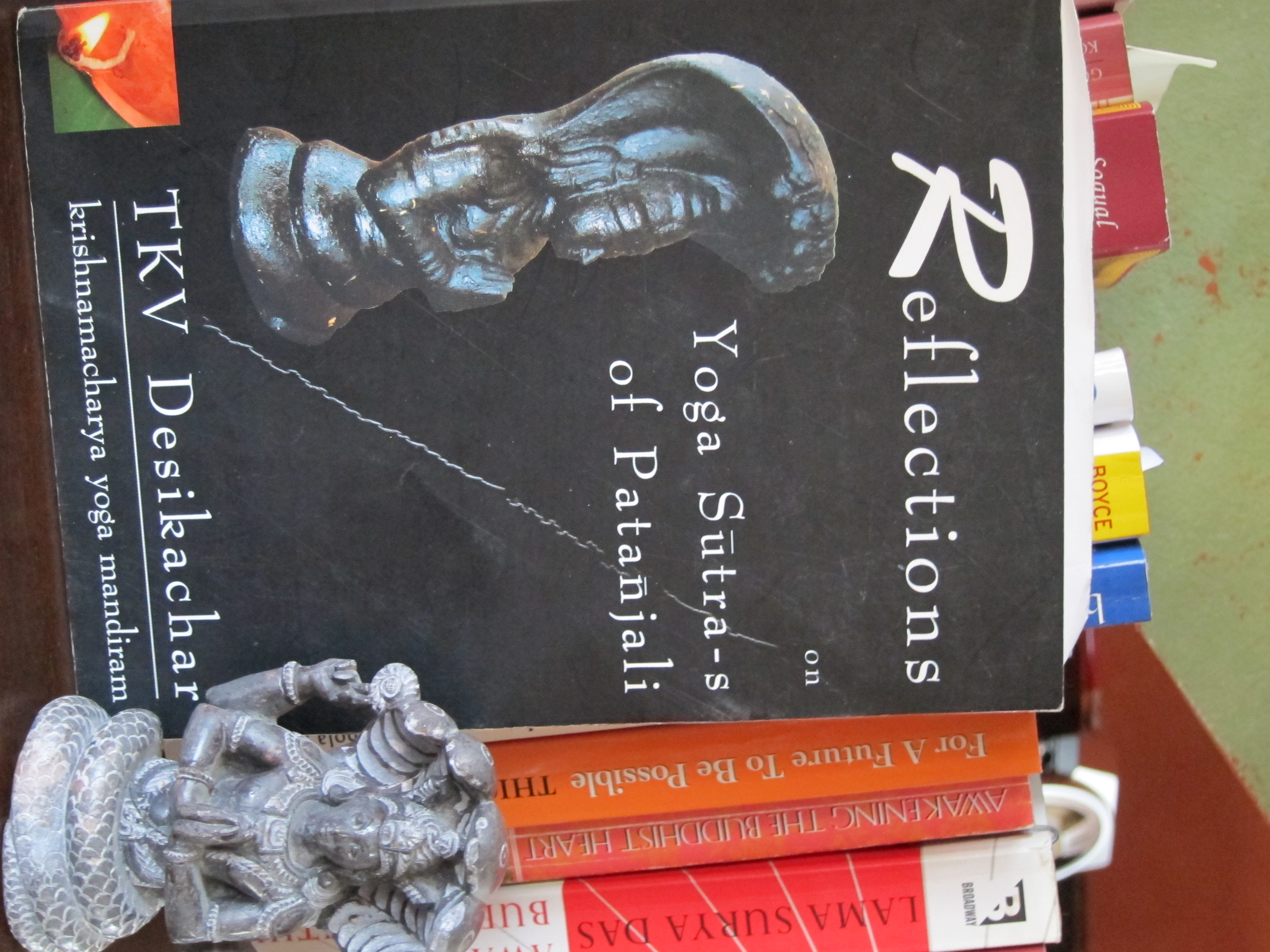
with statue of Patnajali, finally bought after 7 years of going to KYM
Back from India with a good case of reverse culture shock. It’s not fun, I feel like hiding in a closet for about a month, besides which I have a horrible cold from breathing the recycled air of 500+ hacking, sneezing people for 18 hours flying over 2.5 continents and an ocean. But I’m already planning my 7th trip so stay tuned for details — I have already booked March 11-15, 2013 at the Krishnamacharya Yoga Mandiram to bring people for private classes — 5 minimum, 8 maximum. Let me know if you’re interested because after that week I am planning to teach a yoga retreat in Varkala, Kerala. Throwing it out to the Universe and we’ll see what gets thrown back.
My yoga trainings were amazing. I completed Modules 1 and 2 of Ganesh Mohan’s yoga therapy training and because he’s such an amazing teacher that combines the best of East and West modalities, I’ve decided to complete all his modules. I will take Module 3 here then return to India next year for Module 4.
The course at KYM, “Discover Yoga Anatomy”, was equally amazing. After going to KYM since 2005, the senior teachers know me and I can no longer hide in class — I get called on now! The course drained my brain because it definitely was an “advanced” training. For example, we had a course on “Yoga Anatomy in the Classical Texts”, a course where we discussed various aspects of Chapter 3 of the Sutra-s (among other texts). We tore apart YS 3.26-27-28: what was Patanjali really speaking to? Do you take what he said literally or is the north star a metaphoric reference? Where is the north star in our body, what does it represent? Loved it — yoga more than skin deep. I feel grateful and blessed to have been introduced to the Krishnamacharya lineage via Srivatsa Ramaswami when I first started teaching — it is both an honor and responsibility to be a representative of this tradition. SRI GURUBHYO NAMAH.
Yoga more than skin deep, beyond asana… what a concept. I realized in India that the more I study in this lineage, the more I am a yoga freak at home. A stranger in a yoga strange land. As hippies were called “freaks” back in the day, I feel even more so like a yoga freak now. It contributes immensely to my reverse culture shock. I was happy to be in India when the John Friend story broke and was amused by all the blahblahblah about it. I spoke with a KYM teacher about what is called yoga in America and she just shook her head.
In Kerala I was offered a house and garden to convert into “Sama’s Yoga Garden” — “you could do whatever you wanted, let me get that house cleaned up for you, Shakti”, as a new friend called me and reminded me of my essence, daily. Sigh. I could have stayed for at least three more months. A teaching in attachment and letting go. I saw for the first time in 6 trips that I could very well split my time equally during the year between India and here. Yes, it is possible because it feels so right in spite of Ma India’s warts — my trip started out a bit rough, but I eventually realized it was me, not India. Another teaching on having no expectations and letting it all go. I think once I learned that, that set up the scenario for the rest of my trip, things I experienced and who was brought into my life. Serendipity is a wonderful thing.
I actually cut my trip short, changing my flight to return 9 days earlier. I was supposed to end my trip in Varanasi but one day I had a major epiphany that I don’t need to go there because everything that is there in that holy city is already inside me. Stop searching. Just. Stop. “You know your dharma,” the Voice told me. Shut up and do your practice.
That was one lesson Bharat Ma taught me on this trip….know your dharma. “Do your best and let the rest go” was something Ganesh told us. It became my new mantra. And as it turned out, I received an email from someone who has offered to help me find a place to bring yoga to the underserved. My dharma. We’ll see what transpires. Things happen when you let it all go. As I said, we shall see what the Universe decides to throw back at me.
Ganesh’s delightful father, A.G. Mohan, came to talk to us twice and Kausthub Desikchar gave us two lectures. I took lots of notes and will blog about their talks.
But for right now, this yoga freak is getting back into my closet.
************
PRODUCT REVIEW
Hugger Mugger sent me the Earth Elements Mat to road-test in India. I wanted a thin travel mat that could hold up to my sweaty hands and I am happy to report that it fit the bill.
I thought it would be problematic because when I first started to use it my hands were sliding. But the longer I used it, the surface “roughed up” a bit after which I had no problems whatsoever (and I was in weather that was over 90 degrees every day and very humid….with daily power cuts so no AC, no fans.) I have the 3mm mat and although it is thin, it still cushions my bones. It is thin enough to fold up and put inside a backpack for traveling, which I did more than a few times. It is so light you can hold it with one finger.
If you want a great travel mat without paying a huge amount, check out this mat. It gets a ringing endorsement from Metta Yoga, as did their Sattva Jute Mat I used last year.





 Linda's Yoga Journey
You must be logged in to post a comment.