decisions, decisions….

Hmmmm….should I blog about teaching in Tanzania to global yogis….

…or totally disappear once I hit India…no blogging, no Facebook updates, no tweets (which I’m beginning to think tweeting is a huge waste of time anyway.)

The Yoga Adventure in Africa is sold out — but no one from here (USA) is going. Too outside the box and (I’m assuming) too expensive to get to Africa. That is too bad because that means no money whatsoever for the eye clinic in Moshi, Tanzania (except my donation.) I had hoped that enough people from here would have signed up to give Seva $1,080.00. I sent my business newsletter announcing the trip to over 100 people all over the country. YogaChicago magazine (where I placed my ad) has a circulation of over 25,000 readers. A few bloggers (you know who you are! thank you again!) wrote about the trip. In spite of all that, no American takers.

However, within two days of an email announcement, a dozen people from the Tanzanian yoga community signed up. We only have room for 15, so that’s 12, my friend who organized it, her friend who owns the property where I will teach, and me. Full…and me bringing yin yoga to Africa. Paul Grilley told me, “you go, girl!” I’m global, baby.

A friend told me I might fall in love with Africa the way I did with India. I’m not ruling it out…because I’ve asked Maithri if I could teach yoga to HIV/AIDS patients in Swaziland.

Hmmmmm….I like going off the grid….

I step onto the plane in 60 days.


addthis_pub = ‘yogagal60510’;

slipping over the edge

What is it about “restorative yoga” that gets me so agitated?

I wrote here about my experience with restorative yoga at my Mindfulness Yoga and Meditation Training at Spirit Rock. I definitely was not the only person who had a strong reaction (aversion) to the practice and I believe it was because of what we were doing — sitting for many hours every day — that made a restorative yoga practice inappropriate for our situation.

I know that there are many people who love this style of yoga and I also understand how it is very beneficial for some and in certain situations, recovering from an illness for example. Some people think yin yoga is a “restorative” practice but I believe that is a huge misunderstanding. I can easily stay in supta virasana for 15 minutes in a yin class with no agitation whatsoever — my mind is as still as a placid pond. Yin yoga is not restorative yoga, different concepts are involved.

But once you add three blankets, two bolsters, a strap, two blocks, and shoulderstand on a chair, I start grinding my teeth. There is something about fiddling around with all those props that puts me over the edge.

I went to a class this morning that is taught in the style of Rod Stryker. The teacher announced “because of the time change and the full moon” (huh? I don’t even pay attention to the moon phases) “this will be a restorative class.” I almost walked out, but out of respect for the teacher, I did not. I’m not dissing the teacher — she’s an excellent teacher and I’ve known her a long time…it was the yoga. And my reaction to it.

I was on edge throughout the entire class. Nothing restorative about it. Fold the blanket, buckle the strap, adjust the bolster, hang over a chair. Faggedaboutit. Shoulderstand in a chair made me very nauseous and I normally stay in shoulderstand for a minimum of 5 minutes. The only part I liked was savasana because I was done messing around with all those damn props.

I’m a vipassana person who is very accustomed to watching whatever comes up, all physical and emotional sensations. I don’t run from them. So I keenly observed what came up during class: “agitation is like this. examine it. where is it? it’s temporary, let it go, things will always change.” I have to admit that the class was good mind training.

My yoga behind closed doors is like this:

I play some cool music and start moving, flowing, feeling. Maybe I drop into yin asanas, maybe not. For me, there is stillness in motion and I treat the asanas as mere shapes and forms that are constantly changing and evolving.

So I think maybe that because I’m a meditator, because I treat my movement as a meditation, that I’m already there. That I don’t need to force myself to slow down for 90 minutes in a restorative class as some people do because…I’m already there.

My other thought is maybe just like there are certain pranayama techniques that affect each dosha differently (I was told at KYM that I should not do much kapalabhati), maybe restorative yoga affects some people adversely. Why not? Even good medicine can kill you if not taken in the correct way.

Or maybe it’s just because I’m a rebel yoga grrl who doesn’t like being told to fold that, tie the strap here, put that bolster there, now rest — even if it is not appropriate for your physical, mental, and energetic bodies to rest at that particular time. It offends my free spirit and it stifles me.

I’m going now. I have to meditatively move.

addthis_pub = ‘yogagal60510’;

Krishnamacharya, Desikachar, Indra Devi

Here is an amazing video of Krishnamacharya, his son Desikachar, and Indra Devi from 1988. Sri Krishnamacharya was 100 years old in this video.

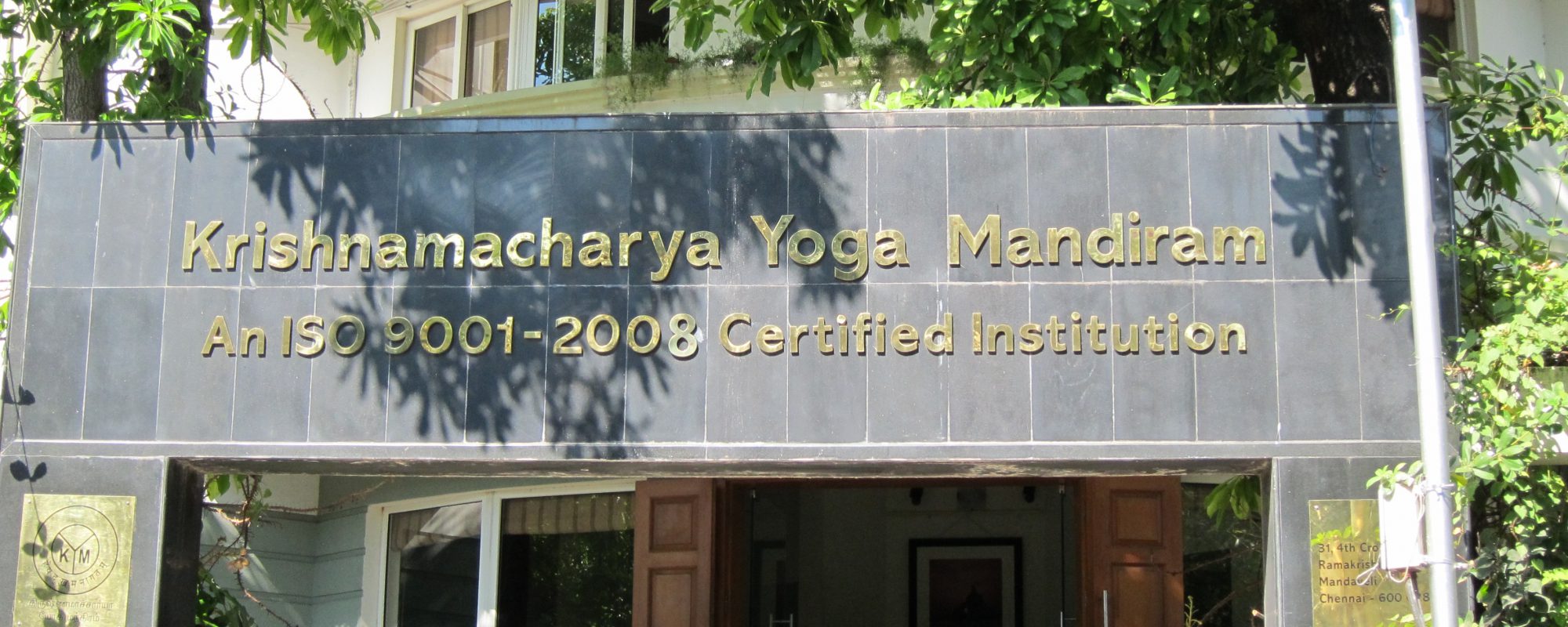
When I am at the Mandiram I love listening to Desikachar’s stories about his father’s students. Desikachar told us a story about how perturbed he was when he saw his father hugging a western woman, on the street no less. If you know anything about South Indian culture, especially Brahmin culture, that is absolutely not done! Then his father told him it was Indra Devi, his student.

Desikachar told us how when he was growing up he was not interested in learning yoga. He was not like Jois or Iyengar who started their studies when they were young. Desikachar was an engineer, he wanted to make money. Then one day he saw his father stop his pulse for two minutes, he had such control over his body. He told us when that happened he fell to his knees and asked his father to teach him everything he knew about yoga. The rest is history.

I am honored and blessed to have such a close connection to the source, to the heart of yoga.

Sixty-four more days and I am back in Ma India’s arms. My friends keep asking me if I am going to come back. Studying yoga at the source, climbing Mt. Arunachala, Kali temples in Kolkata, the Temple of the 64 Yoginis in Bhubaneswar, culminating my India trip at the largest spiritual gathering in the world, the Kumbh Mela….

A few years ago an akashic record reader told me (before the Mela was even a thought in my mind) that what I experience on one of my India trips will be so profound that I will have to go to a “place with palm trees” to recoup.

I am. Zanzibar has palm trees.

addthis_pub = ‘yogagal60510’;

yoga wisdom from my teacher

Meditating on Meditation by Srivatsa Ramaswami

“I was watching a live television program in India some 30 years back
when TV had just been introduced in India. It was a program in which
an elderly yogi was pitted against a leading cardiologist. It was
virtually a war. The yogi was trying to impress with some unusual
poses which were dubbed as potentially dangerous by the doctor. Almost
everything the yogi claimed was contested by the non-yogi and soon the
dialogue degenerated. The yogi stressed that headstand will increase
longevity by retaining the amrita in the sahasrara in the head and the
medical expert countered it by saying that there was no scientific
basis for such claims and dubbed it as a pose which was unnatural and
dangerous and will lead to a stroke. The Yogi replied by saying that
Yoga had stood the test of time for centuries; it had been in vogue
much before modern medicine became popular. Thank God it was a black
and white program; else you would have seen blood splashed all over
the screen.

Things have become more civil in these three decades. Now neti pot,
asanas, yogic breathing exercises and yogic meditation have all become
part of the medical vocabulary. There is a grudging appreciation of
yoga within the medical profession. Many times doctors suggest a few
yogic procedures, especially Meditation, in several conditions like
hypertension, anxiety, depression and other psychosomatic ailments.

Ah! Meditation. The Yoga world is divided into two camps. On one side
we have enthusiastic hata yogis who specialize in asanas and the other
group which believes fervently in meditation as a panacea for all the
ills.

But how should one meditate? Many start meditation and give it up
after a few days or weeks as they fail to see any appreciable benefit
or perceivable progress. The drop out rate is quite high among
meditators. The mind continues to be agitated and does not get into
the meditating routine. Or quite often one tends to take petit naps
while meditating. Why does this happen? It is due to lack of adequate
preparation. Basically one has to prepare oneself properly for
meditation. The Yogis mention two sadhanas or two yogic procedures as
preparations. They are asanas and pranayama. Asanas, as we have seen
earlier, reduce rajas which manifests as restlessness of the mind, an
inability to remain focused for an appreciable amount of time. But
another guna, tamas also is not helpful during meditation, manifesting
as laziness, lethargy and sloth and this also should be brought under
control if one wants to meditate. Patanjali, Tirumular and several old
Yogis advocate the practice of Pranayama to reduce the effects of
Tamas. Patanjali says Pranayama helps to reduce avarana or Tamas. He
along with conventional ashtanga yogis also mentions that Pranayama
makes the mind capable of Dharana or the first stage of meditation.
Pranayama is an important prerequisite of meditation.

There is evidence that pranayama has a salutary effect on the whole
system. In an earlier article I had explained the beneficial effects
of deep pranayama on the heart and the circulatory system. Further,
when it is done correctly, it helps to draw in anywhere between 3 to 4
liters of atmospheric air compared to just about ½ liter of air
during normal breathing. This helps to stretch the air sacs of the
lungs affording an excellent exchange of oxygen and gaseous waste
products. These waste products are proactively thrown out of the
system by deep pranayama, which yogis refer to as reduction of tamas.
Thus soon after pranayama, the yogi feels refreshed and calm and
becomes fit for the first stage of meditation which is called Dharana.

What should one meditate on? Several works talk about meditating on
cakras, mantras, auspicious icons, various tatwas and on the spirit/
soul etc. But, the method of meditating, only a few works detail.
Perhaps the most precise is that of Patanjali in Yoga Sutras.
Patanjali details not only a step by step methodology of meditation
but also the various objects of prakriti and ultimately the spirit
within to meditate on. Hence his work may be considered as the most
detailed, complete and rigorous on meditation

For a start Patanjali would like the abhyasi to get the technique
right. So he does not initially specify the object but merely says
that the Yogi after the preliminary practices of asana, pranayama and
pratyahara, should sit down in a comfortable yogasana and start the
meditation. Tying the mind to a spot is dharana. Which spot? Vyasa in
his commentary suggests going by tradition, a few spots, firstly
inside the body, like the chakras as the Kundalini Yogi would do,, or
the heart lotus as the bhakti yogi would do, or the mid-brows as a
sidhha yogi would do or even an icon outside as a kriya yogi would do.
The icon should be an auspicious object like the image of one’s
favorite deity. Many find it easier to choose a mantra and focus
attention on that. Thousands everyday meditate on the Gayatri mantra
visualizing the sun in the middle of the eyebrows or the heart as part
of their daily Sandhyavandana** routine. It is also an ancient
practice followed even today to meditate on the breath with or without
using the Pranayama Mantra.

(*Namarupa published my article “Sandhyavandanam-Ritualistic
Gayatri Meditation” with all the routines, mantras, meanings, about 40
pictures, and also an audio with the chanting of the mantras in the
Sep/Oct 2008 issue.)

What of the technique?

The Yogabhyasi starts the antaranga sadhana or the internal practice
by bringing the mind to the same object again and again even as the
mind tends to move away from the chosen object of meditation. The
active, repeated attempts to bring the mind back to the simple, single
object again and again is the first stage of meditation (samyama)
called dharana. Even though one has done everything possible to make
the body/mind system more satwic, because of the accumulated samskaras
or habits, the mind continues to drift away from the object chosen for
meditation. The mind starts with the focus on the object but within a
short time it swiftly drifts to another related thought then a third
one and within a short time this train of thoughts leads to a stage
which has no connection whatsoever with the object one started with.
Then suddenly the meditator remembers that one is drifting and soon
brings the mind back to the object and resumes remaining with the
“object”. This process repeats over and over again. This repeated
attempts to coax and bring the mind to the same object is dharana. At
the end of the session lasting for about 15 minutes, the meditator may
(may means must) take a short time to review the quality of
meditation. How often was the mind drifting away from the object and
how long on an average the mind wandered? And further what were the
kinds of interfering thoughts? The meditator takes note of these. If
they are recurrent and strong then one may take efforts to sort out
the problem that interferes with the meditation repeatedly or at least
decide to accept and endure the situation but may decide to take
efforts to keep those thoughts away at least during the time one
meditates.

If during the dharana period, the mind gets distracted too often and
this does not change over days of practice, perhaps it may indicate
that the rajas is still dominant and one may want to reduce the
systemic rajas by doing more asanas in the practice. On the other hand
if the rajas is due to influences from outside, one may take special
efforts to adhere to the yamaniyamas more scrupulously. Perhaps every
night before going to sleep one may review the day’s activities and
see if one had willfully violated the tenets of yamaniyamas like “did
I hurt someone by deed, word or derive satisfaction at the expense of
others’ pain”. Or did I say untruths and so on. On the other hand if
one tends to go to sleep during the meditation minutes, one may
consider increasing the pranayama practice and also consider reducing
tamasic interactions, foods etc.

Then one may continue the practice daily and also review the progress
on a daily basis and also make the necessary adjustments in practice
and interactions with the outside world. Theoretically and practically
when this practice is continued diligently and regularly, slowly the
practitioner of dharana will find that the frequency and duration of
these extraneous interferences start reducing and one day, the abhyasi
may find that for the entire duration one stayed with the object. When
this takes place, when the mind is completely with the object moment
after moment in a continuous flow of attention, then one may say that
the abhyasi has graduated into the next stage of meditation known as
dhyana. Many meditators are happy to have reached this stage. Then one
has to continue with the practice so that the dhyana habits or
samskaras get strengthened. The following day may not be as
interruption free, but Patanjali says conscious practice will make it
more successful. “dhyana heyat tad vrittayah”. If one continues with
this practice for sufficiently long time meditating on the same object
diligently, one would hopefully reach the next stage of meditation
called Samadhi. In this state only the object remains occupying the
mind and the abhyasi even forgets herself/himself. Naturally if one
continues the meditation practice one would master the technique of
meditation. Almost every time the yagabhasi gets into meditation
practice, one would get into Samadhi. Once one gets this capability
one is a yogi—a technically competent yogi– and one may be able to
use the skill on any other yoga worthy object and make further
progress in Yoga. (tatra bhumishu viniyogah)

The consummate yogi could make a further refinement. An object has a
name and one has a memory of the object, apart from the object itself
(sabda, artha gnyana). If a Yogi is able to further refine the
meditation by focusing attention on one aspect like the name of the
object such a meditation is considered superior. For instance when the
sound ‘gow” is heard (gow is cow ), if the meditiator intently
maintains the word ‘gow’ alone in his mind without bringing the
impression(form) of a cow in his mind then that is considered a
refined meditation. Or when he sees the cow, he does not bring the
name ‘gow’ in the meditation process, it is a refined meditation.

The next aspect-after mastering meditation— one may consider is, what
should be the object one should meditate upon. For Bhakti Yogis it is
the Lord one should meditate upon. According to my teacher, a great
Bhakti Yogi, there is only one dhyana or meditation and that is
bhagavat dhyana or meditating upon the Lord. There is a difference
between a religious person and a devotee. A devotee loves the Lord and
meditates on the Lord, all through life. The Vedas refer to the
Pararmatman or the Supreme Lord and bhakti yogis meditate on the Lord.
The Vedas also refer to several gods and some may meditate on these as
well. By meditating on the Lord one may transcend the cycle of
transmigration. At the end of the bhakti yogi’s life one reaches the
same world of the Lord (saloka), the heaven. Some attain the same form
as the Lord. Some stay in the proximity of the Lord and some merge
with the Lord. The Puranas which are the later creation of poet seers
personify the Lord and the vedic gods. Thus we have several puranas as
Agni purana, Vayu purana and then those of the Lord Himself like the
Bhagavata Purana , Siva Purana , Vishnu Purana. Running to thousands
of slokas and pages the puranic age helped to worship the Lord more
easily as these stories helped to visualize the Lord as a person,
which was rather difficult to do from the Vedas. Later on Agamas made
the Lord more accessible by allowing idols to be made of the Lord and
divine beings and consecrating them in temples. Thus these various
methods helped the general populace remain rooted to religion and
religious worship. So meditating upon the charming idol/icon of the
Lord made it possible for many to worship and meditate . Of course
many traditional Brahmins belonging to the vedic practices stuck to
the vedic fire rituals, frowned upon and refrained from any ‘form
worship’, but millions of others found form worship a great boon.

Meditating on the form of the chosen deity either in a temple or at
one’s own home has made it possible to sidestep the intermediate
priestly class to a great extent. One can become responsible for one’s
own religious practice, including meditation. The ultimate reality is
meditated on in different forms, in any form as Siva Vishnu etc or as
Father, Mother, Preceptor or even a Friend. Some idol meditators
define meditating on the whole form as dharana, then meditating on
each aspect of the form as the toe or head or the arms or the
bewitching eyes as dhyana and thus giving a different interpretation
to meditation. Some, after meditating on the icon, close the eyes and
meditate on the form in their mind’s eye (manasika).

Darshanas like Samkhya and Yoga which do not subscribe to the theory
of a Creator commended ‘the understanding of one’s own Self’ as a
means of liberation. The Self which is non-changing is pure
consciousness and by deep unwavering meditation after getting the
technique right, one can realize the nature of oneself and be
liberated. Following this approach, the Samkhyas commend meditating on
each and every of the 24 aspects of prakriti in the body-mind complex
of oneself and transcend them to directly know the true nature of
oneself, and that will be Freedom or Kaivalya. Similarly the Yogis
would say that the true nature of the self is known when the mind
transcends(nirodha) the five types of its activities called vrittis to
reach kaivalya, by a process of subtler and subtler meditation.

The Upanishads on the other hand while agreeing with the other
Nivritti sastras like Yoga and Samkhya in so far as the nature of the
self is concerned, indicate that the individual and the Supreme Being
are one and the same and meditating on this identity leads to
liberation. They would like the spiritual aspirant to first follow a
disciplined life to get an unwavering satwic state of the mind. Then
one would study the upanishadic texts (sravana), by analysis (manana)
understand them and realize the nature of the self through several
step by step meditation approaches (nidhidhyasana). The Vedas, for the
sake of the spiritual aspirant, have several Upanishad vidyas to study
and understand It from several viewpoints. For instance, the panchkosa
vidya indicates that the real self is beyond (or within) the five
koshas (sheaths). It could also be considered as the pure
consciousness which is beyond the three states of awareness (avasta)
of waking, dream and deep sleep, as the Pranava(Om) vidya would
indicate. The understanding and conviction that Self and the Supreme
Self are one and the same is what one needs to get, before doing
Upanishadic meditation following the advaitic interpretation.

Summarizing one may say that traditional meditation warrants proper
preparation so that the mind becomes irrevocably satwic and thus fit
for and capable of meditation. Secondly it requires practice on a
simple object until the meditation technique is mastered and such
meditatin samskaras developed. Then the Yogi should set the goal of
meditation based on the conviction of a solid philosophy—bhakti,
samkhya, yoga, vedanta, kundalini (or if comfortable, nirvana) or
whatever.”

Thank you Ramaswamiji!

I can’t credit this as my own question, but it’s a good one: “why is it that all these people practice yoga (also known as “stretching”) but never seem to meditate?”

This morning I asked my class (a class that has 15-20 minutes of meditation at the end — and no one leaves) if they are using meditation to gain something or to get rid of something.

My personal yoga practice is almost all meditation nowadays. Yes, I still move, but asanas are merely shapes and forms to lead me into formless quietude.

addthis_pub = ‘yogagal60510’;

it truly IS the Kali Yuga

The Kali Yuga: the “Dark Age” lasting 432,000 years…when avarice and wrath are common, rulers become unreasonable, cowards have the reputation of bravery and the brave are called cowards…and lies are passed out as truth.

“In the age of Kali, every virtue had been engulfed by the sins of Kali-Yuga; all good books had disappeared; impostors had promulgated a number of creeds which they had invented out of their own wit. The people had all fallen prey to delusion and all pious acts had been swallowed by greed….

In the age of Kali duplicity, perversity, hypocrisy, malice, heresy, pride, infatuation, concupiscence and arrogance etc. pervade the whole universe….

In the age of Kali there is no contentment, nor discernment, nor composure…Envy, harsh words and covetousness are rampant; while evenness of mind is absent….

Self-control, charity, compassion and wisdom disappear while stupidity and fraud multiply to a large extent. Men and women all pamper their body; while slanderers are diffused all over the world….”
(excerpts from the Tulsi Ramayana.)

As roseanne wrote, it sure does seem like the end of yoga as we know it….

I saw this over at YogaDork and shook my head. Just when you thought the commercialization of American Yoga couldn’t get any worse, eh?

Everything eventually comes full circle. I used to be a fitness instructor and saw things come and go. Is that tai-bo guy still around?

This is why I say the “new yogi” will be a “radical yoga traditionalist.”** Two teachers I consider radical traditional yogis are Paul Grilley and Mark Whitwell (uh, and me, too, because like Paul I’m a traditionalist but don’t mind killing yoga’s sacred cows on occasion.)

Yup, Playboy Yoga, no chanting and no Sanskrit for sure (but does she eat granola?). No clothes either, because you can download her naked yoga (which will be a boon for everyone who searches for “naked yoga” and hits on this blog post so knock yourself out.)

Talk amongst yourselves.

____________________________________________

**“radical yoga traditionalist” concept originating here, comment #6. if that inspires you, then please give credit where credit is due. or else I’m calling Bikram’s lawyer regarding copyright.


addthis_pub = ‘yogagal60510’;
just when you think you’ve had enough….


…someone says something nice.

The longer I teach, the more I read about the corporatization of American yoga, the more I was thinking that I should quit teaching group classes and just concentrate on my own practice (which is very free-form but that’s another post), find my own yoga tribe and disappear somewhere…

then someone tells me how I changed their life.

I was going to drive into Chicago this morning to take a class at the studio where I trained. I live 45 miles straight west of Chicago and on a good day it might take me 75 minutes in the morning — a bad day would be 2 hours. It was 7:30 am and I was leaving for a 10 AM class. So I get into my car, leave the garage, turn on the radio, and heard about how bad traffic was all over Chicagoland this morning. The traffic announcer said that three lanes were down on the expressway I take and it was a parking lot. I pulled back into my garage.

Since I was dressed for yoga I decided to go to another studio to a friend’s class, she teaches “Tantra Yoga” in the style of Rod Stryker. I got there and set up and a woman came over and said “Hi, Linda. How are you?” I don’t get to this studio on a regular basis so I don’t know the students and I was surprised someone knew my name. I said hi, fine thanks, how are you?, and she said, “I remember your class. It changed me.”

Now my brain is working overtime…OK….she looks a little familiar….where….how….huh?

I said, “I’m sorry I don’t remember you…where did you take my class?” She mentioned the studio where I used to teach, two years ago. She told me that I taught my yin-yang yoga class (actually a workshop) and that I did a chakra meditation afterward.

She said that she had barely done yoga before walking into my workshop. She said that the chakra meditation had “blown” her apart. I can’t even remember what I did because I never, ever remember what I do from class to class — I channel yoga. Seriously. She motioned from her crown to her root and said “everything opened up. I was like, ‘wow’.” Her eyes glowed from the memory and she gave me a big smile.

I thought, but did not tell her, that I did nothing, she did it all. I merely gave her a road map.

I stood there, stunned. Many of you think I am Ms. Yoga Snark, but I’m here to tell you, I have self-esteem issues as a yoga teacher. Even though I study at one of the most prestigious yoga schools in the world, I still think I am not good enough. I think that I am nowhere near worthy enough to teach globally next year, that I do not deserve the opportunities that are coming my way.

When she finished her story I told her how grateful I was to hear her compliments. She said, “it was because of you and your class that I decided to do teacher training” (which she is currently doing.) I stood there amazed. One class and a woman whom I never saw again. Until today.

Never underestimate the power of yoga. And I will never underestimate myself again.

There was a reason I did not make it into Chicago this morning. I needed to be reminded that I am worthy.

addthis_pub = ‘yogagal60510’;

and the beat goes on….

I promised to write about the talk I went to about whether American yoga is in crisis, but I won’t. That ship has sailed. In the meantime the discussion continued over at elephant journal “Real Yoga Practiced Here” and at Brenda’s house with her post “Whatever happened to dignity?” where she said, “And yet even the yoga community seems full of practitioners keen on branding themselves and selling yoga shoes to “help spread the word”–as if the word wasn’t spreading just fine on its own without a lot of pictures of hot, young bodies doing arm balances.” Even Rainbeau Mars kept popping up to let us know that the “Rainbeau Mars Lifestyle” is really all about just spreading the word about yoga (and buying Adidas clothes) and if y’all don’t see that then y’all are just haters. Nikki asks whether we are practicing real yoga and Diane muses about yoga group think.

Our judgments (whether about yoga or anything else) are based on our experiences and assumptions. So for people who believe yoga is just another fitness class, then American yoga is not in crisis. If one sees yoga as a deeper spiritual (whatever that word means to you) or personal exploration, then one might think American yoga is in crisis if one sees the emphasis placed only on the physical.

AAAAARRRRRHHHHHHH

You do your yoga and I’ll do mine. My yoga contains asana+pranayama+meditation plus occasional chanting and mudras. That’s what I teach and if someone walks into my class and doesn’t like what I do, there are a gazillion yoga teachers out there, find someone else. Simple. And metta to you.

But putting your leg behind your neck or even both legs does not impress me. Children can do that. Show me how you live your life. Show me what you can give up on a 10 day retreat without complaint. I also don’t care how many translations of the Vedas or Upanishads or any other yogic text you’ve read or whether you can chant the Sutra-s backwards.

I have over 1000 hours of training and teaching experience; I’ve been told I have a “beautiful practice”; I have a closet full of yoga books some of which I’ve read more than once. But if I was still operating on automatic pilot, if I was still reacting to things inappropriately, flying off the handle (and I am NOT saying I do not get angry), or treating people badly, what good did all those yoga hours do for me? So is yoga an exercise or is it about transformation? Is it about the journey or the end result?

I returned to yoga in the mid-’90s for a purely physical reason just like many people come to yoga. I returned to yoga to help rehab my severely arthritic shoulder from arthroscopic surgery. But as soon as I started moving my body in that beginning yoga class, barely able to move my right shoulder even after 8 weeks of PT, that whole mind-body-prana connection kicked right in. That bhavana was like an IV. I was introduced to yoga via meditation over 30 years ago when I OMed with Allen Ginsberg, so that barely sprouted seed laid dormant for a very long time until it was watered at just the right time. Conditioned Genesis in Buddhist talk.

So don’t talk to me about Forrest Yoga or Jivamukti Yoga or Bikram Yoga or Anusara Yoga. I don’t care about names with capital letters. Yoga is yoga and why practicing “just yoga” isn’t good enough anymore is beyond me. I’ve heard Krishnamacharya’s son Desikachar say that yoga contains X, Y, and Z and if it doesn’t contain that, then you’re just doing acrobatics. As I’ve said more than a few times about this thing we call yoga in OM-merika, you can call a dog a cat all you want to, that still doesn’t make it a cat.

As Nikki asks in her blog post “Is my yoga practice making any inroad in how I function in life?” Or as one reader said in my post “I am my shadow self”, “if Yoga isn’t pushing you outside your comfort zone, it ain’t really Yoga.”

Why do you yoga? Not “do yoga” because yoga is about undoing, not doing. Yoga does us. I’ve always thought that the reason more people don’t yoga is because stepping into yoga takes courage and many (most?) are afraid to see what might come up.

The abused women I teach at the domestic violence shelter don’t care about Lululemon pants, an Adidas lifestyle, about chanting Sanskrit, about your favorite translation of the Hatha Yoga Pradipika, or whether I can stand on my head in the middle of the room. They care about changing their lives. They care about how focusing on the breath can calm the mind. They care about relieving their suffering, moment by moment. If someone with the idea that yoga is just another way of working out looked into the room and saw our yoga, they might be confused because we’re not in pretzel poses or trying to perfect chaturanga dandasana. We’re not sweating. We’re sitting. Breathing. Maybe facing a few those demons….mindfully.

“Can we do hatha yoga (or any other form of bodily training) with the same wisdom that guides vipassana practice?….

A specific example from my own practice and teaching: I do viniyoga, which emphasizes constant awareness of the conditioned movement of the body and breathing in all postures. This helps bring about a more vivid quality to the breath sensations, making breath awareness meditation more accessible. This is an asset for yogis engaged in ànàpàna-sati [mindfulness of breathing], especially for those with faulty breathing habits, which can incline the mind to distraction. If the postures were practiced with the same deliberate mindfulness used, for example, in walking meditation, such conscious breathing and movement would not only facilitate meditation practice-it would be meditation itself….

That’s just it. It’s not about chakras or kundalini rising, as valuable as this approach may be. It’s just that when I do yoga, I do vipassana.”
BODY PEOPLE, MIND PEOPLE, by Larry Rosenberg

You do your yoga, I’ll do mine.

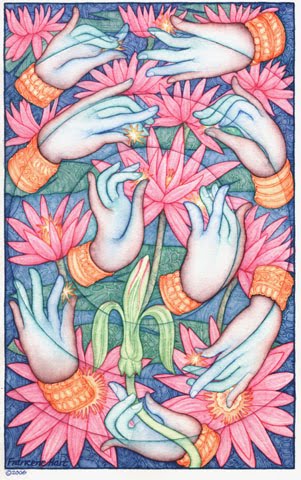
visionary art


Visionary Artist Francene Hart

enjoy….

addthis_pub = ‘yogagal60510’;

Friday’s yoga thought

“Daily Yoga practice may include Asanas, Pranayama and Meditation in proper proportion, so that the yoga diet is balanced.” Srivatsa Ramaswami

In this recent discussion of what yoga should have in order to be called yoga, who can argue against having a balanced diet?

Resources for mindfulness meditation practice: “Mindfulness meditation: The Shambhala Sun offers a diverse selection of teachings on mindfulness meditation, from the Theravada and Insight traditions of Buddhism.”

And here’s an oldie but a goodie: Killing Yoga’s Sacred Cows

Finally….

HAPPY DIWALI TO EVERYONE!


addthis_pub = ‘yogagal60510’;

is there an "American spiritualism" like "American yoga"?


Yes I know I promised to write a review of the talk I attended about whether American yoga is in crisis, but I think that topic is a very small part of a much bigger picture. So I will throw the question out there: what are we lacking that make people do this:

James Arthur Ray’s Spiritual Warrior Event Kills 2

I’ve never seen the movie The Secret so I have no opinion about Ray and what he puts out, but know many people who have and who have thought it the greatest thing since sliced bread (I’m dating myself with that phrase.) I’ve also heard many New Agey people talk about the Law of Attraction (and who hopelessly confuse it with karma) and just have to wonder: why do you feel you are so utterly lacking in anything? It is almost a luxury in this country — one of the richest countries in the world with so much material and yes, non-material, things available to us — to feel that we lack anything! I have met people in India who have nothing compared to westerners yet are content. But I digress.

The psychology of people who will blindly follow a “guru” (whether American, Hindu, Buddhist, etc.) has always fascinated me so when I read Brenda’s post about American false idols I had to ask, what are we looking for when we follow a “brand name” in yoga and spirituality?

Speaking of false idols, read these posts:

The Unquestioned Gurus of the Religion of the Self (that contains the great subheading “Psychopaths as Teachers of Right Living.”)

The Cultivation of Inflation and The Culture of Narcissism in Personal Development

One of the comments to the first link was this:

“…that you can’t just take the most sacred ceremonies from another culture that you do not belong and have not paid any dues too (sic), mix it with whatever you feel like and sell it off as a business venture. for decades actual native americans have tried to warn the white culture about fraud ripping off and bastardizing their culture and ceremonies. no one listened opting instead for the glittery promises of the new age gurus and plastic shamans.”

I found that one comment (especially about paying your dues and mixing things up and selling it as a business venture) on point with the recent discussions about western yoga. Just sayin’.

Roseanne’s excellent posts on the branding of yoga caused spirited discussions as do my posts on Americanized yoga v. what I practice in India. So why isn’t practicing plain old yoga good enough for us? Has yoga in its partnering with companies like Adidas and fila merely become part of this culture of narcissism? Has yoga in this country become a new religion of the self?

To those who stand around a yoga “master” who performs “advanced” asanas at a yoga conference and applaud and film it to put it on YouTube, are we not celebrating the cult of narcissism in a vacuous yoga celebrity culture that we at the same time scoff at?

Amanda wrote one of her always brilliant comments to this post:

“- I suspect the ‘faddish’ and ‘hypercommercialised’ nature of American yoga is what many people object to beneath this critique of contemporary yoga, but don’t verbalise it as such.

– the question of authenticity also jumps out as an issue: does Anusara, Jivamutki, Forrest or whatever style of yoga represent an immature innovation based on shallow Western values such as commercialism and body image or true cultural change within yoga? (Only TIME will tell on this one!)

– babies teaching babies yoga. I agree but our western culture tells us we can do anything if we have the money. Thus, we see 23 year olds running yoga schools. (see my earlier point about paying your dues.)

– an unhealthy obsession with Patanjali’s Yoga Sutra as ‘the last word’ on yoga at the expense of other texts. Hasn’t anyone read Georg Feuerstein or Mircea Eliade?

– an obsession with difficult and physiologically/psychologically harmful or futile asana which ‘apparently’ grant one the body of a hyperflexible, twenty-something. Again, this is the current Western trope of youth/perfection/image that pervades every facet of our lives.”

“If we wish only to teach poses or postures, it would be better to call what we do by a name other than Yoga.” Donna Farhi in Yoga Beyond Fitness, page 125

I’ll ask again as I did in this post, is Americanized yoga a mile wide and an inch deep? And if it is, I will ask again as I did at the beginning of this post, what are we searching for that so many of us unquestioningly put our bodies and minds and psyches into the hands of false idols, whether it’s in the yoga world or elsewhere?

What say you, yoga teachers? Are you a fitness teacher or a yoga teacher? As a commenter said in Brenda’s post, “We are (essentially) fitness instructors. We need to be happier with that role I think.”

I don’t know about anyone else but I have not spent $10,000+ to be a fitness instructor. I was a certified fitness instructor for a short time and I can tell you that as a yoga teacher what I do now is light years away from what I did before, which is why I think the “become a yoga teacher in a weekend” programs are a great disservice. BECAUSE I deal with peoples’ emotions and psyches when I take on private clients, that’s the main reason I’m applying for a certificate course in Jungian psychology, to learn even more on top of what yoga and Buddhism has already taught me about human psychology. Speaking of dealing with the mind, if I conducted my own yoga teaching training program each student would be required to sit for a 10 day silent vipassana retreat in the strict Goenka tradition. Talk about a brain enema. Teachers, know thyselves.

Krishnamurti said, “it is no measure of health to be well adjusted to a profoundly sick society.”: “…as Krishnamurti suggests, it’s possible to think that we’re spiritually and mentally healthy because we share our mistaken values and understandings with those around us. Collectively, our ill minds create a society that is itself ill, and we consider ourselves healthy because we see our values reflected in our fellow worldlings.”

I think I’ve brought up some more questions, so talk amongst yourselves.

addthis_pub = ‘yogagal60510’;