“WHITE LADIES FINDING THEMSELVES SISTERHOODS”

white women
original upload by White Ibiza — irony, much?

“I would like to imagine other options, other ways of being, other ways of understanding identities, other ways of being together, even as we come apart.

Especially, in my world, where women gather.

In sisterhoods — to explore spirituality, creativity, personal development.

Our sisterhoods need to evolve.

They’re so often a slurry of cultural appropriation, spiritual bypassing, neoliberalism, multilevel marketing, and random woo punctuated by various signals of authority, virtue and performative vulnerability from their leaders.

And to quote Queen Latifah, they’re whiter than a Wilco concert.

I know; I’ve been in them, and have profited off of them. In lots of ways, I still do.

We can do better.

 #######

(Pretty done seeing us white women using the word “tribe” for a lot of reasons. Like, people who buy our shit are not a “tribe.” A NEWSLETTER LIST IS NOT A TRIBE. See also: NamaSLAY, Spiritual Gangster, Unicorn Thug, Gypset and other terms that are co-opted by white people from POC to sell lifestyle products.)

#######

The inherent racism, classism + other -isms of LOA and The Secret, and other “mindset” and “manifesting abundance” programs are rarely thoroughly confronted.

#######

Can we give things up so that we begin to enter into a better relationship with each other? What might that look like? Our dreamcatchers, our dreadlocks, our trappings of the new age flattened without dimension or context by Whiteness and by capitalism, which really can’t be separated from each other? Can we wonder why we love to put on face paint and feathers to show our affinity for Standing Rock but don’t say shit about Black Lives Matter?”

____________________

WOW.

A friend had posted this piece by Rachael Rice on her Facebook page and I was blown away.  You can read the entire piece here.  I immediately sent Rice a friend request because damn, I had to know this woman who wrote what I’ve been thinking for a very long time.  I wrote about the lack of diversity in the New Age Yoga World long before it was on the radar screen of some popular yoga bloggers.  Ahem.

This is sure to piss off a kombucha drinking white New Age yoga woman somewhere.  Holding up a mirror to white privilege usually does that (“I’m not racist, I have a black friend!”)

I invite you to read Rice’s entire piece and her links and video before you get your Lulus in a bunch and get all offended and ranty.

I’m not going to unload a shit pile of judgment on outdoor yoga fests where many who attend are dreadlocked white people.  You know which fests those are.  As an introvert and loner, those mega fests ain’t my thang.  I’m a lone wolf.  If you feel the need to bond for three days with like-minded people, go for it.  Just don’t call it a fucking TRIBE.

Before learning definitively I am Indigenous Mexican (I was lied to about my ethnicity but that’s another story), seeing white people wear headdresses as a fashion statement or burning sage (“spiritual Lysol for white women” as a Native friend calls it), made me very itchy.  I couldn’t tell you why but it pissed me off.  I just knew it was wrong.  “Blood memory” a Native friend told me.

Don’t get me started about white people calling themselves “shamans.”  Absolutely a white person can study with an indigenous person and learn the ancient ways.  But not everything belongs to you – some things have to be earned the hard way, through sweat and blood and tears.  And you don’t become a shaman in a weekend workshop at a yoga studio or New Age store.

Rice also writes about giving up her making of dreamcatchers:

“This is my announcement that I will no longer be making dreamcatchers.  It is no longer congruent with my ethics as an artist to profit from this type of work. Really, it never has been. I’ve never felt 100% comfortable appropriating and selling a white girl version of the indigenous craft even though I took measures to give back, to educate, to honor the people I learned from.”

I also invite you to read that entire piece because dreamcatchers are a BIG THING in the New Age World.

As I said, this post is sure to piss off someone.  But these are things that need to be said and explored.  If this post makes you angry or defensive maybe that tells you something.  Learn from it.

As Pema Chodron said, we need our buttons pushed if we want to get woke and stay woke (paraphrased.)  That’s what a good teacher does.

But it’s easier to sleep walk.  I love being the troublemaker.  😉


are you faking it ’til you make it?

483464_10200192391346610_1186192508_n
ONLY IN INDIA ©2017 Metta Yoga & Bodywork Company

Below is a question that was asked in a Facebook yoga group I belong to.  As a teacher who is persona non grata in my local “yoga community”, it was an important question.  My answer to the teacher’s question is below it.

“I’m wondering how people experience and process professional jealousy. It seems to be a part of our normal human experience, but it feels particularly horrible – sticky, viscous and taboo. Sometimes it’s ridiculous – resenting that a new teacher, who I’ve mentored and supported – has ten people in their first class, even though most of them are friends there to offer support. Other times it’s more peer-related: why has that person received that opportunity (even if it’s one I didn’t want) or that recognition or that amount of money? For me, it seems to be rooted partly in anxiety about my capacity to make a living (which is compromised because of my disabilities), and partly in a voracious need to be seen – which I can laugh about, but there it is.”

MY ANSWER:
“I think it’s all about finding your niche and to stop trying to be all things for every yoga student. I’m not a “love and light” type of teacher so for those people looking for that, I’m not their teacher. There are plenty of others out there who will be. I always remember what I heard Seanne Corn say in a workshop, that she’d rather teach to the two who get it (i.e., what she teaches) than the 10 who don’t.  I’ve reconciled myself with that.  That might not mean a lot of money in my yoga bank account, but it’s all about choices. I’d rather be me than try to be something I’m not.  I’m not going to fake it to make it.”

What say you, yoga peeps?  Are you faking it by pushing down your emotions as if they are something dirty?

From my Buddhist perspective, less than beneficial emotions are not to be transcended, they are merely to be recognized and let go.  Yes, I know, SIMPLE BUT NOT EASY.

In this Facebook yoga group some said negative emotions should be transcended so we can evolve into an enlightened state.  Good luck with that Humans!

It fascinates me to see how many yoga people believe we are supposed to be immune to jealousy, hate, anger, bitterness, etc. merely because we practice yoga.  A 200 hour training, 1000 hours, or even 10,000 hours of training does not mean we become enlightened.  I mean seriously?!  Ramana Maharshi spent days in such deep samadhi that he was unaware of ant bites.  THAT’S trancendance, people!

After about six weeks, “he was carried out and cleaned up. For the next two months he stayed in the Subramanya Shrine, so unaware of his body and surroundings that food had to be placed in his mouth or he would have starved.”  And we expect to become enlightened or transcend painful emotions just because we do a little yoga?  WHAT?!  One woman commented in the Facebook group that she felt “immature” and so “unevolved” for having an emotion like jealousy.  I’ve heard the Dalai Lama say that sometimes he still gets annoyed at reporters’ dumb questions.  Hey, if HHDL can get miffed about dumb questions, so can I.

I have found these things to be extremely helpful to me over the years.

The first thing is the wonderful book Shadows on the Path by Abdi Assadi.  It is not a recent book but I think it’s the best I’ve read about our shadows on the spiritual path.  It will definitely be required reading if I ever get around to creating a teacher training.  My copy is heavily underlined and dog-eared.

The second thing is Jack Kornfield’s technique of RAIN:  “RAIN stands for Recognition, Acceptance, Investigation, and Non-Indentification. This acronym echoes the Zen poets who tell us “the rain falls equally on all things.” Like the nourishment of outer rain, the inner principles of RAIN can transform our difficulties.”

I also recommend Phillip Moffitt’s book, Emotional Chaos to Clarity: How to Live More Skillfully, Make Better Decisions, and Find Purpose in Life.   The Amazon blurb: “Despite our best-laid plans, life is difficult, and we sometimes experience anger, anxiety, frustration, and doubt. This emotional chaos can negatively affect the way we live our lives. Yet, Phillip Moffitt shows us that by cultivating a responsive mind rather than a reactive one, we can achieve a state of emotional clarity that allows us to act with a calm mind and a loving heart.”

Stop beating yourself up for being human.  You’re only a yoga teacher. 😉

who says yoga classes should be 90 minutes?

New York yoga teacher J. Brown raised an interesting question today in his blog post regarding the “Incredible Shrinking Yoga Class.”

He writes, “In the last twenty years, yoga in the west has gone from a guru-driven model to a market-driven model. Decisions still often come from atop a pyramid. But now, the directives are based more on aggregated data than on the presumed authority of an ancient wisdom. One small manifestation of this turn can be found in the way that yoga classes have gotten progressively shorter. As yoga teachers are newly questioning old models for what and how they teach, industry mores also deserve examination.”

When I got back into yoga in the mid-1990s the class I attended at my local park district was 60 minutes.  I practiced at the park district for about 7 years (never moving into an “advanced” class whatever that meant back then) before I did my first teacher training and started attending yoga classes in Chicago studios where the classes were 90 minutes.

Those 7 years of 60 minute classes were never “just asana” classes.  Not that we talked much about philosophy or even did formal pranayama, but the teacher was a mindful yoga type before being”mindful” was a thing in Modern Yoga.

J. Brown writes, “Perhaps there needs to be a better way to distinguish between classes that are more directly concerned with the broader aspects of yoga, and those more geared towards an exercise regimen which potentially hints at something found elsewhere.” [emphasis supplied]

I have a simple answer for that: don’t call the asana only/exercise regimen classes “yoga.”  Truth in Advertising, what a concept.

I wrote about that in 2010 (sigh) when I said it was a question of semantics.

Or if it’s an asana-only class, why call it yoga at all? Physical therapists use movements derived from yoga all the time but they don’t call it “yoga.” It’s physical therapy and everybody knows that is what it is. Nothing else.

Getting back to the length of time of a typical modern yoga class, at the Krishnamacharya Yoga Mandiram where I trained the morning asana classes are 60 minutes.  The asana classes also include pranayama and meditation (which is how I teach) and the classes do not feel rushed, in fact, they are perfectly sequenced.  Long savasana is not needed (like a 10 minute one at the end of typical American classes) because we do one or two minute savasanas after certain sequences.

So who decreed that a yoga class needs to be 90 minutes?   But I guess that depends on what calls “yoga” (getting back to semantics.)

At the KYM pranayama classes contain some asana and the meditation class — a whole hour of meditative focus, how shocking! – contains some asana and of course, pranayama.  In other words, the yoga is not compartmentalized like it is here, the yoga is a seamless process.

A shorter, powerful practice is absolutely possible, it depends on the skill and training of the teacher.  But who can teach that way coming out of a modern 200 hour teacher training?

If what is referred to as “yoga” nowadays is shrunk to 60 minutes of posing and a 5 minute nap at the end, how then is that Yoga?  A 60 minute class of 20 minutes each of functional asana, pranayama, and meditation, skillfully taught, can be more potent than 90 minutes of something where “the teacher kicked my ass” that I used to hear all the time in studios.  How many 90 minute classes are nothing more than rushing through as many sun salutations as possible with no attention paid to the breath and doing a typical vinyasa flow once on each side and moving on?

IMG_0112
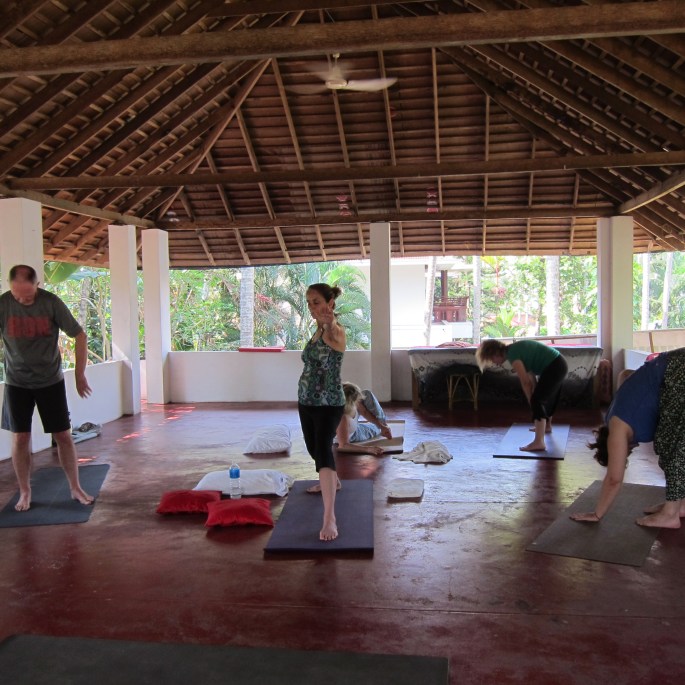
my “freedom style” yoga class in India

Thank the Goddess I no longer teach in yoga studios.  J. Brown writes, “The days of regular attendance in group classes allowing for a comprehensive yoga education have perhaps passed. People are not generally looking for a yoga education when they are coming to a yoga class anymore.”

Maybe so, I haven’t taught in studios for years.  I teach out of my house and I’ve been told my classes ARE like going to Yoga School.  Maybe that’s why some of my students (few that they are nowadays) have been with me since Day One of my teaching in 2002.  They keep telling me every class has been different in all those years.  I still can’t figure that out.

As a wise and pithy friend commented in my semantics post linked above:

“It’s [Yoga] a path of liberation we are talking about here – and not from “bra fat!” Patanjali’s first Yoga Sutra (Hartranft translaton) says it all:

Now, the teachings of yoga.
Yoga is to still the patterning of consciousness.
Then pure awareness can abide in its very nature.
Otherwise awareness takes itself to be
the patterns of consciousness.”

That can still be done in a 60 minute class.  You just have to know how.

children’s yoga

Overheard a long time ago:

“People can learn to bend over and touch their toes (or rather, re-learn since they could do that as a child), and yet that isn’t necessarily yoga.”

I read a story about a yoga student who thinks he is an “advanced” student because he can put his leg behind his neck and other pretzel poses. You know, an Instagram Yogi with thousands of followers.

Thinking he has accomplished everything, he goes to India to find a “yoga master” to teach him more. He finds a yoga master in a cave (of course) and begs to become his student.

The master tells him to show him his most advanced pose so the “advanced yogi” guy does some crazy leg behind the neck arm balance.

“Hmmmmm….,” says the master. “Children can do that, too.”

The guy is shocked and dismayed and disillusioned.

The master says, “Now you can start learning Yoga.”

“Stripping the Sacred” – Brenda Feuerstein

patanjali2
Patanjali

“Teach people, not poses.” — Gary Kraftsow (paraphrased)

“Yoga contains asana, pranayama, meditation.
Anything else is acrobatics.”
(TKV Desikachar, from a long ago intensive in India)

Many of you know Brenda Feuerstein.  She was married to eminent Yoga scholar, Georg Feuerstein (1947-2012) and they collaborated on a wealth of books and trainings in traditional Yoga.   Brenda carries on their work in Traditional Yoga Studies where she does distance learning courses and has a Philosophy/History Training Manual for teaching that segment of 200- to 500-hour Yoga teacher training programs.  It can be purchased here.

Recently on her Facebook page she posted this note that generated many comments.  I believe her words should reach a larger audience beyond Facebook so Brenda gave me permission to post it here.

Of course I agree wholeheartedly.  One of my students who has studied with me for 7+ years is moving out of state and she said:  “This is a great post, I love it and it is so true. I am sure this is exactly what I will be facing once I move and attempt to find a studio/teacher that provide real yoga as it was intended.”

Talk amongst yourselves.

Stripping the Sacred
*Warning – you might not want to hear this*

I started learning Yoga when I was very small from a book my Mom had purchased. Richard Hittleman was the author and I suspect there was no other book on Yoga at the pharmacy where my Mom would have been shopping at the time. She was probably intrigued having read something in Reader’s Digest or possibly heard the word on one of the two TV channels that were available to us.

A little later a TV show started featuring German born Yoga teacher Kareen H. Zebroff. My Mom and I would “do” Yoga with her once a week. We had no sticky Yoga mat, no meditation cushion, no clothing that set us apart from anyone else, and no studio to support our practice after the show. We sat on the cold farmhouse floor and didn’t wonder if we should look into stickier mats and travel mats. My Mom and I just practiced and I felt a “specialness” that I wouldn’t fully understand until years later.

In my teens, I ended up in a small town where I saw a hand written poster of a Yoga class being held at the school gym. Nothing was said about getting my cakras cleared, my core muscles being strengthened, and no mention of the Yoga Alliance. It was straightforward just like her class. There was no music, no props, nothing to sit on but the floor, and most people didn’t even have an exercise mat. People wore sweat pants and t-shirts and a sweatshirt if it was a cold evening. She introduced herself as having studied at the Sivananada ashram and most people had no idea what that meant but most recognized the feeling of “specialness” in her heart. It was quiet and no one was showing how they could do a headstand before class. The class was straight forward. When she spoke it wasn’t in hard-to-understand anatomical terms, but she did use Sanskrit throughout the class. I suspect that is the way she was taught. She spoke gently and sweetly about her teacher and I’d often see her in tears which I knew meant something very “special”. Her class was challenging but not necessarily in a physical way. She taught us Yoga philosophy saying we needed to learn it well otherwise we were just doing calisthenics and we should go elsewhere if that’s what we wanted. She was strong and courageous and filled with love for her teacher and the path of Yoga.

Jump forward to 2015. I was invited to live in a city after living in a rural area for several years and I decided that experience would be helpful in better understanding the current state of Yoga (generally speaking). I was taken to studios daily until I suffered a severe injury. The injury was the result of two Yoga teachers believing they could fix my life-long physical condition from a C3,4,5 fracture that had healed well enough for me to lead a strong and very active life. Even though I told both teachers prior to the class that it was best to not adjust me under any circumstance because I’d worked one-on-one with therapists for years and knew my body very well, my adho mukha śvānāsana, utthita trikonasana, and śavāsana didn’t look “right” to them so I got surprise adjustments and was unable to function normally for months and even today I’m still suffering from the well-meaning teachers who thought they could cure me with their 200-500 hour YA training. Now I understand that modern postural Yoga has helped many people with physical injuries, but the fact remains these teachers felt they could “heal” me with Yoga when in fact I ended up being severally injured. I don’t know of a Yoga anatomy module in any teacher training that would address “fixing” or “healing” neck fractures.

What I learned through all of it was that the “specialness” – the sacred – appears to have been stripped away from Yoga. How is it that we went from a class or two a week offering to a gym/studio setting with 20-30 or more classes a week? How can anything feel sacred when there is so much of it and students become numbers on ledger for the accountant? True, for a tantric it could be, but really? I suspect that many people who say they’re tantrics have no idea what they mean and when asked come up with something they’ve memorized from the internet or some book written by someone who heard tantra sells.

My own opinion is that as long as we have large studios pumping out teachers and building their client base we will never fully regain the sacredness in Yoga. It will continue to be a marketplace where one teacher is trying to outdo the next one and where the words disrespect, lack of teacher and lineage recognition, and plagiarism means getting ahead in business.

We’ve used and abused a tradition with a sacred foundation and the outcome has been devastating on so many levels. People email me asking about book recommendations stating they’re confused with everything that’s out there. People email me and say they have to take a break from their Yoga practice because they’re injured, and I respond with, “what an incredible opportunity you have to go into the foundation of traditional Yoga by studying philosophy!” People email and say, “I feel bullied…do I have to certify with YA?” People email and say, “I don’t want to learn Sanskrit in a Yoga training.” I respond, “Please go talk to your Grade 1 teacher and ask them if learning the English language (that being their first language) was important for your Reading class.” and the list goes on and on…

There are people trying their best to keep the sacred in this beautiful tradition of Yoga, and possibly like me, they feel exhausted and frustrated at times. How many Yoga magazines do we need to buy? How many books on asanas do we really need? How many ways do we need to explain the yamas which were so clearly stated? How many ways do we need to do things before we finally see that the sacredness of Yoga is hanging on by a thread? How many times does this need to happen before we wake up?

do I need to be anointed to be credible?


So much goes on in the Modern Yoga World (TM) now that it’s hard to keep up without it sounding like a constant rant.  Maybe I should just write about what actor or rock star does yoga, post a photo of them drinking a latte with a mat under their arm, and comment on what brand yoga pants they wear.  That would really be so much easier and would probably get me more readers.  But I digress.

I’m sure by now many of you have heard about the Yoga Alliance stance on using terms such as “yoga therapy” or “therapeutic yoga” or anything that sounds like a teacher has anything to do with “healing” or “medicine” or even “alleviating.”  You can can go on their site and see the restricted words.  As someone who worked for litigation lawyers for 20 years I know it was a CYA (“cover your ass”) move.

The policy does not only apply to your YA profile but also to your personal website IF you are YA registered.  Don’t register with the YA and you can say whatever you want about what you do or how you teach.

I am now an E-RYT 500 teacher with the YA and also an official “Continuing Education Provider.”  Yes, yes, yes, I know — I ranted for years about the Yoga Alliance, I totally own that.  You can read what I wrote in 2011 here when I was a mere E-RYT 200.

But the fact remains that there are those WHO WILL NOT STUDY OR TRAIN WITH A TEACHER UNLESS THEY ARE ANOINTED BY THE YOGA ALLIANCE.  I resisted reinstating my YA registration for years and finally broke down.  Of the teachers I know who also consider the YA useless and a waste of money, 100% say that the reason they pay up is because of the above reason.  The teacher training I took at the old school Chicago studio where I originally certified in 2002 was never YA registered until people starting asking the owner whether his training was YA registered.

The fact is that I re-joined the YA purely for marketing reasons, not because I think it means anything.  The fact is that after teaching for 15 years, training for 10 years in India, and being featured in a book, I am a yoga nobody where I live so if the YA seals give me “credibility” and “presence”, so be it.

I do not have the luxury of owning a studio that can attract students.  And yes, if you are surviving and making money with a yoga studio that IS a luxury in today’s yoga business market, consider yourself lucky.  I live in a town of 25,000 and there are three studios besides a park district that offers yoga.  Fifteen years ago when I started teaching and basically knew nothing, I had 40 students in another park district’s class.  Now I am lucky if I have five students who show up consistently.  Those students don’t care about the YA but if I can get teachers who want more training by using the YA seal, I am going to use it to my advantage.  It ain’t personal, it’s business, baby.

Cora Wen told me that back in 2001 Judith Lasater told her: “Every profession has an organisation and YA looks like they are winning in the registry.  Get the certificate now.  Or you will one day have to pay someone less qualified than you are to get a certificate.”

There ya go.  Like I said….

YACEP

Now the International Association of Yoga Therapists has rolled out their “certification” for yoga therapists.  I’ve been an IAYT member for years and even wrote an article for their journal on teaching trauma sensitive yoga.

Don’t get me wrong.  I think there should be some type of measure of a yoga teacher’s ability just as there is a measure for massage therapists, for example.  And yes, I know MTs are licensed which I absolutely do not agree with for yoga teachers.  But for these paid for labels to be the be-all and end-all and the only thing that makes a teacher worthy in the public eye makes me very itchy.

I looked into the IAYT certification process but I don’t have the proof that in all the intensives I took at the Krishnamacharya Yoga Mandiram that there was any “yoga therapy” involved.  But there was because there always is something about yoga therapeutics beyond asana practice.

What got me thinking about all of this was the article “Are We Entering a Golden Age of Yoga Therapy??” by Eden Goldman.  According to Goldman’s quote…

“Yoga Therapy is the philosophy, art, and science of adapting classical Yoga techniques to contemporary situations to support people with physical, mental, and emotional ailments. According to the definition of the International Association of Yoga Therapists (IAYT), “Yoga therapy is the process of empowering individuals to progress toward improved health and well-being through the application of the teachings and practices of Yoga.”

Practically speaking, Yoga Therapy is the reinvention of a personalized Yoga experience where the practice is modified to meet the individual’s ever-changing needs. Since ancient times, adaptability in one’s teaching, practice, and approach has rested at the heart of Yoga’s most fundamental influence: the relationship, insights, and trust created through the practice by one teacher working with one student.”

…I’ve been a “yoga therapist” for 10+ years.  Do I still need to be anointed by the IAYT to be credible?

I’ve done 10 years of many intensives at the Krishnamacharya Yoga Mandiram, multiple yoga therapy trainings including two levels of Phoenix Rising, 300 hours of Svastha Yoga Therapy with Dr. Ganesh Mohan, a Therapeutic Yoga for Seniors training at Duke University, and trauma sensitive yoga.  Besides teaching in India and Africa.

Can I call myself a “master teacher”?  You tell me.

Do I still need the YA and IAYT seals on my website to prove my worth to the rest of the world?

It’s become crystal clear to me that the name of the game in the Modern Yoga World is MARKETING because no one gives a damn about all of the above.  I don’t have the $6,000 that I need to upgrade my website to grab SEO and make it the latest and greatest Yoga Business site.  It’s much cheaper for me to lose myself in South India and hang a shingle that says “YOGA TEACHER TRAINING.”

In my 15 years of teaching I’ve never put myself out there as a “yoga therapist” because I believe all yoga can be therapeutic if applied in a beneficial manner.  Even Bikram Yoga was beneficial to the Vietnam War vet who spoke to us about his PTSD when I did the trauma sensitive yoga training.

I’ve always said that no one called Krishnamacharya a yoga therapist, he taught YOGA.

Krishnamacharya’s principle was “Teach what is inside you, not as it applies to you, to yourself, but as it applies to the other.“  He taught that Yoga should always be adapted to the unique needs of each individual.

Does one who jumps through the hoops and pays for the IAYT “certification” automatically know more or is more capable of supporting or empowering someone than I am?  The buying of labels has been problematic for me for years. It’s the same old story: people will study with a Yoga Alliance or IAYT labeled teacher before they will with someone who has the years of experience.

In the end, I don’t need validation.
I know what I offer.

But then in this Modern Yoga day and age there is this passing itself off as “Yoga Medicine.”  Yes, you CAN think yourself thin AND sexy!

It’s Tara Stiles’ Slim Calm Sexy Yoga all over again.  Just use the word “meditate” and it makes it all credible and so deliciously New Age.

THAT POST IS EVERYTHING THAT IS WRONG WITH MODERN YOGA.

Women with eating disorders feel bad enough about themselves already, how much worse will they feel if they can’t “think themselves thin”?  At least she didn’t mention bra fat.

How is this in any way empowering?  I’m all about mindful eating and eating healthy foods, but the buzzwords used by this “master yoga teacher and specialist in sports and Chinese medicine” are what is typically found on a magazine cover at your grocery store check out line, the same bullshit that sounds like “LOSE YOUR BELLY FAT IN 5 EASY YOGA MOVES!”

No wonder us old school teachers throw in the towel

Funny.  I did not see the Yoga Alliance or IAYT seals on her website.  Anywhere.

Without them you can say whatever you want to say about yoga.

Sri Desikachar has died – June 21, 1938 – August 8, 2016

“The light has expanded and is continuing to guide us beyond boundaries of space and time.

After an extraordinary life of service and healing, Sir TKV Desikachar reached the lotus feet of the lord on 08 August 2016 at 2.45am India Time.

The family is making arrangements for the funeral following the traditional Indian scriptures. An international memorial meeting to honor him will be conducted later in the year, where his students from around the world can participate. Details of this will be communicated in time.

At this current moment, we request you all to hold him in your prayers and celebrate his wonderful contributions to the fields of Yoga, Yoga Therapy, and Spirituality.”
— Kausthub Desikachar

IMG_0150
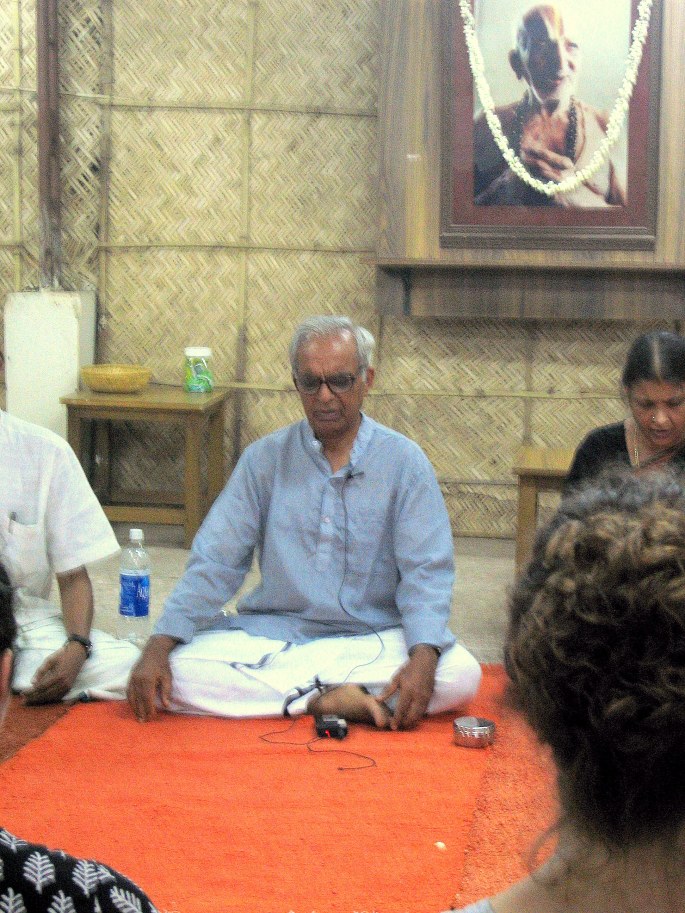
My first Vedic Chant class, KYM, September 2005

Photo ©Metta Yoga: Mind-Body Education 2016

I became a Yoga teacher in 2002.  Three years later in 2005 I did my first trip to the Krishnamacharya Yoga Mandiram.  I have studied at KYM every year since then and also with some of Krishnamacharya’s and Desikachar’s direct students.

Looking back I know now that before I went to KYM I floundered around as a teacher from 2002-2005.  In 2005 it all synced.  It synced when I heard Sir say “we begin where we are and how we are, and whatever happens, happens.”  My life and my Yoga were changed.

When I returned home in 2005 I was so excited about what I learned that like a religious convert I wanted to spread the Good News.  So I created a workshop in “Krishnamacharya Yoga” for the studio where I was teaching in far west suburban Chicago.  I geared it toward the teachers and seasoned students.

No one signed up.

I remember being shocked that even Yoga teachers did not know who Krishnamacharya was and did not know about what was then called the Viniyoga approach of teaching to the individual.

I wonder how many newbie Yoga teachers now, in this age of 200 hour teacher trainings in every studio on every block, know about Sri Desikachar.

I can tell you from experience that few (again, in MY experience) know about the slow, deliberate breath centered style of Yoga that Sir taught.  Last year when I was at a KYM intensive a student came up to me at the end of the first week and said, “You’ve been here many times so I want to ask a question….”  I knew what he was about to ask because I had heard it before: “Do the classes get any faster?”

I smiled.  “No.  If you’ve come here looking for an American style vinyasa class you’ve come to the wrong place.”

He did not return for the second week.

When I took the Trauma Sensitive Yoga training taught by Dave Emerson at The Trauma Institute, I realized on the first day that what he was teaching was recycled “Krishnamacharya Yoga”, i.e., breath centered Yoga.  Other than the physiological information about how trauma affects the brain and the body, it was nothing new to me.  If it was not for Sri Desikachar and the idea of teaching to the individual, I believe there would not be the “trauma sensitive yoga” trainings that there are today.

Weeping.

A true Yoga Master has died.

I remember how nervous I was to chant a few lines from the Gayatri Mantra for him the first time.

I remember Sir’s free public talks on the Sutras or Sanskrit or any other Yoga topic on Saturday mornings in Chennai.

From a blog post I wrote in 2006 after my second trip to KYM.  I believe the intensive was called “The Power of Yoga”:

“The teachers keep emphasizing how personal transformation is the true goal of yoga, not getting the yoga butt or abs, but personal transformation, changing our states of mind, replacing negative tendencies with positive ones, and connecting to the True Self, how ultimately this can not be done in a group yoga class, it can only be done one-on-one with a teacher, as Krishnamacharya taught.

They showed us the sequence on how to teach the bandhas, starting with jalandhara going down to mulabandha, and how people should be able to inhale and exhale at least to a count of 10 or 12, before even attempting to work with the bandhas. Also told us about contraindications. Again, once more this emphasized for me what NOT to teach in a group class because everyone is different and everyone will have a different reaction to it — uddiyana bandha aggravates vata for example.

We were told that Krishnamacharya did not believe in kriyas. He said pranayama practice — properly done — was effective enough to cleanse the body of impurities. Desikachar was with us last night and he told us stories of his father, about how Krishnamacharya stopped his own heart for 2 minutes — it was then that Desikachar took up the practice of yoga, when he saw the power of it.”

May his teachings live on in his students around the world.

May Sir have a fortunate rebirth.

diversity in Yoga — again

Back in 2007 when people used to read me, I wrote a post about the Color of Yoga asking why American Yoga is such a white thang.

Seven years later my friend and yoga teacher Oreste Prada said it was time to change the question about the whiteness of Yoga.

Today I read the perfect response to all of it.  One can talk the talk about Diversity in Yoga but ya gotta walk the walk:

“Most sanghas I visit are entirely white, and they ask me, ‘Pannavatti, how do we get more people of color in our sanghas?’ I say, ‘How many black people do you know? How many do you hang out with? How many do you invite over to your house? You can’t just put a shingle outside your center that says Black People Wanted.’” – Pannavati Bhikkhuni

Ven. Pannavati is known for her wit and humor and has received awards for her humanitarian work with “Untouchables” (Dalits) in India and ordaining nuns in Thailand & Cambodia.

I heart Ven. Pannavati.  Her work with dalits in my second home in India, Tamil Nadu, inspires me.

She comes from another mileu that is mostly populated by the white middle class: Western Buddhism.

Talk amongst yourselves.


what are they teaching out there?

depaul panel


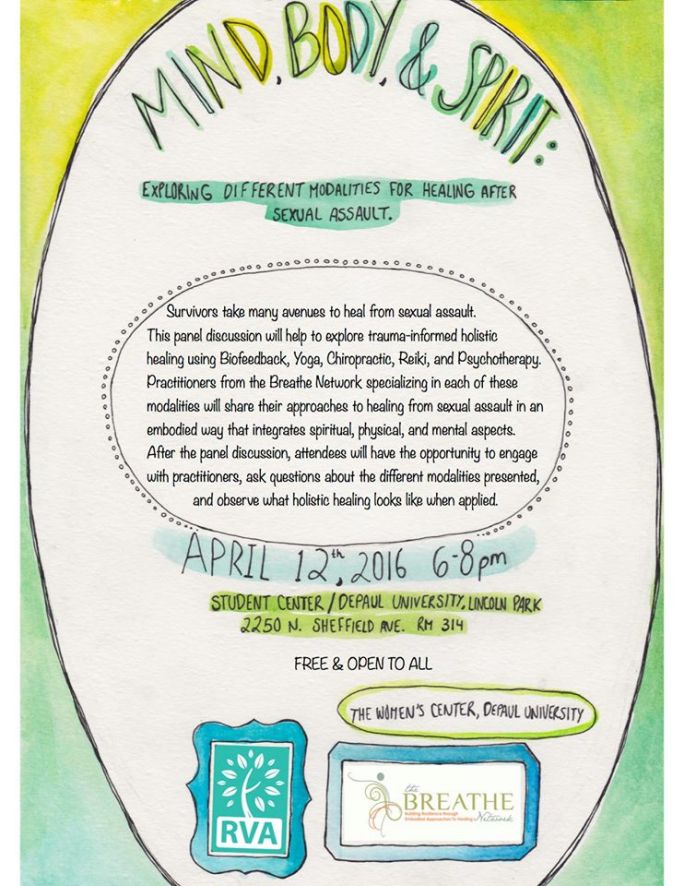
The other night I was one of the speakers on this panel discussion in Chicago. April is Sexual Assault Awareness Month and I was invited to be on this panel by The Breathe Network.  The Breathe Network is an excellent online resource for trauma survivors looking for practitioners of holistic modalities and I am proud to be a member.

It was a great event with a big turnout. The other three presenters spoke about their modalities, Biofeedback, Holistic Psychotherapy, and Reiki. I learned from all three presenters and what was interesting was that we all had a single thing in common, as noted by the moderator:  the BREATH and HOW WE BREATHE can change things for us mentally, emotionally, and physically.

Many of you know that I am a long time student (10+ years) in the Krishnamacharya Yoga tradition and that the Yoga I teach is all about the breath, a breath centered practice.  I have seen how conscious breathwork can change lives.  Yes, literally, such as with trauma survivors and people with anxiety attacks and major stress.  They learn to self-regulate just as the ancient yogis, the sramanas, discovered that asana and breath can regulate their internal systems.

“Trauma sensitive” and “trauma informed” Yoga are buzzwords in modern Yoga but when I did my four day Trauma Sensitive Yoga training at The Trauma Institute, I realized how the training was a retooling of what I learned at the Krishnamacharya Yoga Mandiram insofar as therapeutic yoga.  It was nothing new to me.  The only thing new was the information about the physiology of trauma, the parts of the brain that are affected, and some languaging, the “technical” stuff.

Before I did that training in 2011 I had already been teaching for 6 years to survivors at a domestic violence shelter starting in 2005.  I intuitively knew that what I had learned in India and from my own insight meditation practice would help them.  And it did, tremendously — because it was a breath centered Yoga practice.  The survivors learned how to be in charge of their own physiological systems.

After our 90 minute discussion we had breakout groups where attendees could ask us questions.  I had handouts of articles (one that I wrote) about how Yoga helps with PTSD.  More than a few young people (“young” meaning college age students) took my handouts and then it got interesting — they started telling me about their experiences in Yoga studios.  Note that this was in Chicago so they were talking to me about studios there.

I preface what comes next by saying that I no longer attend public Yoga classes so I don’t know what people are teaching nowadays.  If I do go to a studio it will be to my teacher’s class at the studio where I certified as a teacher 15 years ago (one of the first studios to open in Chicago.)

I take that back — I DID go to a class just last week.  It was a gong meditation plus Yoga class and one of my students came with me.  I know that every teacher is trained differently, has his/her own style, and I am 200% sure there are many who would hate my classes and probably with a vengeance.  But I was stunned at the practice.  Shocked even.

The teacher was also a “woman of a certain age” and whom I know has been teaching longer than me.  There was absolutely no attention paid to the breath.  In fact, I could not even catch my breath because the sun salutation was so fast.  I decided (of course!) to move at my pace with my own breath ratio.

My long time student was incredulous and instead of a calming, grounding practice to go into an hour long gong session (by the way, I was NOT expecting a gentle or restorative practice, just a more mindful one) I felt completely agitated.  This is the reason why I no longer attend public classes taught by teachers whose teaching styles I don’t know.

Each person at my table at DePaul asked me “where do I find a class as you describe?”  Because EACH student told me “I take Yoga but …”  It’s “competitive.”  A “work out.”  “No one talks about the breath.” “I feel intimidated.”  “How should I breathe?”  “They don’t teach meditation.”  If I lived in Chicago instead of 40 miles away I’d probably have a dozen new students now.

Finally, what made me sad was a trauma survivor who told me she went through a teacher training program at a corporate Yoga studio chain.  I won’t say which one but they are all over Chicago and other big cities.  Many times they open down the street from independent studios.

She told me that she went there looking for a more meditative, what she called “spiritual,” YTT.  Instead, she told me the training triggered her PTSD, so much so that she completely stopped her own Yoga practice.  What was worse, she told me, that when she tried to tell her trainers what was happening with her, no one knew how to help her.

She finished the training but no longer practices.  She told me that in order to teach she knows she has to work on herself.  She asked me how to get back on the Yoga horse.  I said slowly and recommended Sarah Powers’ book, Insight Yoga, and her DVDs.  I gave her my card, it was all I could do, and told her to contact me if she got stuck.

After listening to the questions and comments, I was re-inspired to create a teacher training so I had better get my ASSana in gear before I go to India in November.  But I am SO STUCK, I don’t know where to start.  Mainly because I don’t know where to begin in writing a manual.  You can’t charge $3,000 for a training and not have a manual, people expect one after dishing out the dough.  But I only know how to teach OLD SCHOOL, the way I am taught in India.  You sit down, listen, and take notes.  In all my years at KYM the only handouts I have are from asana and meditation classes.  Ten plus years of notes will make a kick ass YTT.  I’ve already decided that this book will be the class text.

But when the day comes when I have a Metta Yoga: Mind-Body Education training you can bet your ASSana that I will have sliding scale payment for survivors of sexual assault, domestic violence, and vets with PTSD.

What the hell are they teaching out there?


Modern American Yoga (TM)

IMG_0334I no longer write as prolifically as I once did.  I started this blog in 2005 and the Yoga Blogosphere as changed tremendously in 10 years.  Modern Yoga Bloggers have forgotten whom their elders are.

What some bloggers write about now I wrote about 3, 5, even 7 years ago: ageism, diversity, “slow yoga.”  “Slow Yoga” is a thing now (Google it) and I’ve been teaching slow since 2005 when I first came back from the Krishnamacharya Yoga Mandiram in India.  The more things change, the more they stay the same.

But sometimes things scream to be called out and discussed.

A long time, old school yoga teacher told me that where she’s from a yoga studio requires newbie teachers to “brand” themselves before finishing a one month yoga teacher training, i.e., make a website, a Facebook page, social media presence, etc., etc. etc.

Do the math.  If a large city has 1000+ YTTs, old school teachers like her and I are doomed.

BRANDING before teaching.

BRANDING before experiencing.

BRANDING before Living Your Yoga.

When I did my first website it took me 6 months to write my yoga bio.  Even after I studied in India the first time I thought that if I wrote too much about myself it would look like I was bragging.

Some people say that social media is the new normal. But I believe in what Buckminster Fuller said:

“In order to change an existing paradigm you do not struggle to try and change the problematic model. You create a new model and make the old one obsolete.”

Believe me, I try. But I’m tired.  Damn tired.  I believe in old school yoga teacher training, mentoring.  But my mentoring page is the loneliest page on my website.  I am not concerned with offering a standard 200 or 300 hour training because I believe in quality, not quantity.  Unfortunately, that’s not good for business because people chase the piece of paper that proclaims them a certified yoga teacher.  I can easily put together a 200 or 300 hour training based on 10 years of notes from the Mandiram alone.  But frankly, no one is interested.  Here.  I believe it takes 10 years of yoga teaching to learn how to teach besides having a dedicated personal yoga and meditation practice.  No one wants to hear that.

Like in real estate, it’s about location, location, location.  All I know is that in my area yoga teachers are a dime a dozen.  With yoga studios cranking out new teachers every week, there is no place for Yoga Elders.  I’m not whining, I’m just being realistic.

So I’m leaving.  Done, baby.  I’m going somewhere where what I teach is valued and appreciated.  One of my students gave me a testimonial:

 “Linda is Yoga. Living, breathing, in every aspect. Caring, supportive, knowledgeable, fun-loving, she walks the talk.”

That’s why I’m leaving.  Because I have too much passion for what I do if that makes any sense.

Goddess willing, I’ll live in Kerala, India by the end of next year and into 2017.  I’ve already started to look at houses to rent with space to teach.  I’ve been asked to do teacher trainings in India.  When I’m in India and I am asked what I do and I say “I’m a yoga teacher” people actually have respect for that.  They ask me who my guru is instead of telling me, “I do Pilates.”  No one asks  me what style of yoga do I teach.  I’m asked not to leave, to stay and teach, to help people.  No one pillories me for using the phrase “real yoga.”

Yeah, I said it.  REAL YOGA.  I’ve always said the real yoga kicks in during a health crisis or dealing with your own mortality. My yoga sadhana helped me through an ovarian cancer scare years ago.  It made me realize that “I am not this body” and it brought me peace.  When my time comes I’ll be chanting and doing pranayama, Goddess willing.  Thanks to my friend Cora Wen for making this beautiful video.

But what Cora talks about in her video, you can’t brand it.  You can’t Instagram it,  You can’t trademark it.

You can only live it.  Because Yoga is Life.